

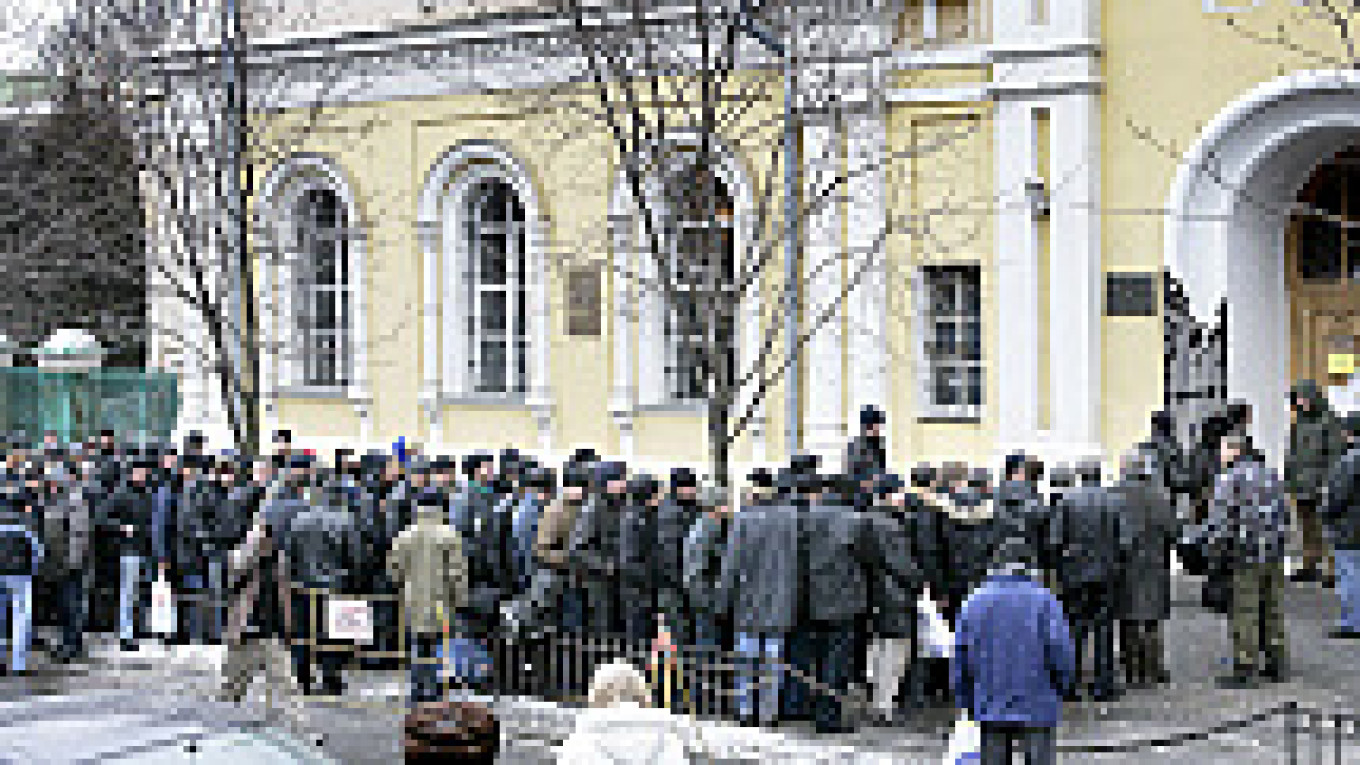
"Which embassy is that?" the man asked.
"It's not an embassy," replied a man from the line. "It's a church, and we are waiting for a meal."
The number of people lining up for free hot meals at the soup kitchen at the Church of Saints Cosmas and Damian has doubled in recent weeks as several hundred out-of-work people from various Russian regions and other former Soviet republics join the usual crowd of pensioners and the homeless, church volunteers said.
"The last time we saw such a great flow of visitors was about 10 years ago, in 1998," said Konstantin Murashev, a volunteer cook in the church's soup kitchen, unpacking big sacks of potatoes to make soup.
The church has been running the soup kitchen since 1997, a year before the 1998 financial crisis, when it fed about 30 people at its inaugural meal. It's hard to count how many people are showing up for the twice-a-week meals these days, but the number has certainly doubled to at least 600, said Tatyana Vasilyeva, another volunteer cook.
Some of those showing up for hot soup, dessert and tea are carrying bags with all their belongings, indicating that they are homeless. A few are hobbling on crutches. Many are pensioners struggling to survive on low pensions amid escalating prices.
But there are also people who have lost their jobs or are simply unable to make ends meet because of declining salaries and reduced buying power.
"I've been coming here to get a meal for the past six months, since I lost my job and documents," said Albert Isanchugin, a 42-year-old ethnic Tartar waiting patiently in line on a recent Wednesday afternoon.
Isanchugin used to make fireplaces, but when the crisis swept over the country six months ago, his employer disappeared with all his documents and his salary. He said he has not been able to find new work because of his lack of documents and the scarcity of jobs during the crisis. He said he didn't even have enough money for a train ticket to return home to his wife and four children in Orenburg, a Urals city about 1,450 kilometers southeast of Moscow.
Moscow police have refused to help him, he said. In desperation, he recently walked into the office of national ombudsman Vladimir Lukin to ask for help. "I went to Lukin's office. They told me he was away," Isanchugin said. "But I just saw him entering the office!
"My son will have his birthday soon. I'm very ashamed I can't buy him a present. I can't even buy cigarettes," he said.
Isanchugin said he would never return to Moscow if he managed to make his way home. "Pick out anyone from this crowd -- every other person has a story similar to mine," he said.
A man standing beside him dolefully nodded his head in silent agreement.
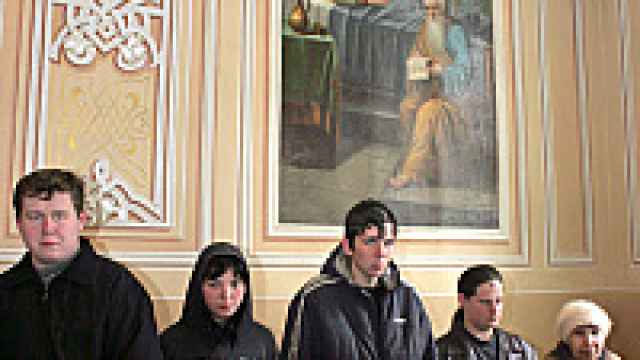
Igor Tabakov / MT
People standing for a mealtime prayer in the Cosmas and Damian Church.
|  |
| |
Isanchugin said things would be different if Prime Minister Vladimir Putin were still president because President Dmitry Medvedev is "too feeble."
Although the soup kitchen is just across the street from the Mayor's Office and at the start of Stoleshnikov Pereulok, lined with luxury fashion shops, it gets no support from the government and relies on private donations.
The Mayor's Office, however, is all too aware that unemployment is a growing challenge, and it estimates that the number of jobless people has doubled since last fall. "Despite the fact that the unemployment level in Moscow is the lowest in Russia, the number is growing daily," First Deputy Mayor Lyudmila Shvetsova said March 19, Interfax reported.
She said more people were seeking assistance from the state.
But the Moscow social welfare department said it has not seen an increase in panhandlers, estimating that the number has remained stable at 10,000.
"I don't think the financial crisis will cause an increase in panhandlers, because people become panhandlers in Russia for different reasons than in Western countries," said Andrei Pantyukhov, who oversees the city's program for the homeless at the social welfare department.
Pantyukhov said that in the West, people turn to panhandling when they lose their jobs and homes, as is happening now during the crisis, but in Russia panhandlers are usually ex-convicts, alcoholics, victims of real estate scams and those evicted from their apartments.
But he conceded that the crisis was contributing to an increase in homeless migrant workers. "There is a growing number of migrant workers who have lost their jobs at the construction sites," Pantyukhov said.
The city does not operate any soup kitchens, and Pantyukhov said it was not planning to open any this year.
The city does, however, offer accommodation in various buildings where up to 900 people can sleep, take a shower and receive a hot meal every day, Pantyukhov said.
"We are planning to open a center where panhandlers can stay during the day, receive health care and clean their clothes. There is no such place at the moment," Pantyukhov said, adding that it would open next year at the earliest.
At least 16 churches in Moscow run soup kitchens, although many are only able to provide food to a limited number of people, usually up to 50 at a time.
Robert Bronkema, pastor of the Moscow Protestant Chaplaincy, an interdenominational, English-speaking church, said five to 10 people showed up for free food, clothes and medical aid daily in August, but now the number has soared to 40 to 50 per day.
"People have to chose now between food and shoes," he said.
Many of the visitors are Africans who have difficulties finding work and cannot or do not want to return to their home countries.
"We are working on helping several people willing to return back home right now, and we never had such cases before," said Rony Kumi, a volunteer at the Moscow Protestant Chaplaincy.
"The problem is that there is no work in Moscow for me," said Patrice Guyllaume-Kabeya, a native of the Democratic Republic of the Congo, who recently lost his job in Moscow and comes to the church's center for free medical aid and clothes.
A charity group of volunteers that distributes food in Moscow train stations said the number of people asking for food there has increased in recent weeks, and an increasing number of them are young.
Father Oleg of the Russian Orthodox charity Miloserdiye, which operates a bus that travels around Moscow and provides aid and clothes for the homeless, cautioned that the real impact of the crisis remains to be seen.
"We are expecting more homeless people by next year," he said.
A Message from The Moscow Times:
Dear readers,
We are facing unprecedented challenges. Russia's Prosecutor General's Office has designated The Moscow Times as an "undesirable" organization, criminalizing our work and putting our staff at risk of prosecution. This follows our earlier unjust labeling as a "foreign agent."
These actions are direct attempts to silence independent journalism in Russia. The authorities claim our work "discredits the decisions of the Russian leadership." We see things differently: we strive to provide accurate, unbiased reporting on Russia.
We, the journalists of The Moscow Times, refuse to be silenced. But to continue our work, we need your help.
Your support, no matter how small, makes a world of difference. If you can, please support us monthly starting from just $2. It's quick to set up, and every contribution makes a significant impact.
By supporting The Moscow Times, you're defending open, independent journalism in the face of repression. Thank you for standing with us.

Remind me later.