

"I don't believe that most Russian people believe that the Americans are against Russia," said Alexei Moslenikov, 17. "It's mostly just some kind of political idea."
Clearly, things are changing for Nashi.
Poorly attended and suffering from a lack of direction, Nashi's annual summer camp on the shores of Lake Seliger, dubbed the "Innovation Forum," reflects just how difficult the transition from organizing street protests to running a mainstream youth movement is proving to be following the recent State Duma and presidential elections.
"The first idea was to block a possible Orange Revolution, that's why last year was so important. Now, they don't know what to do," said Sergei Markov, a Duma deputy from the United Russia party.
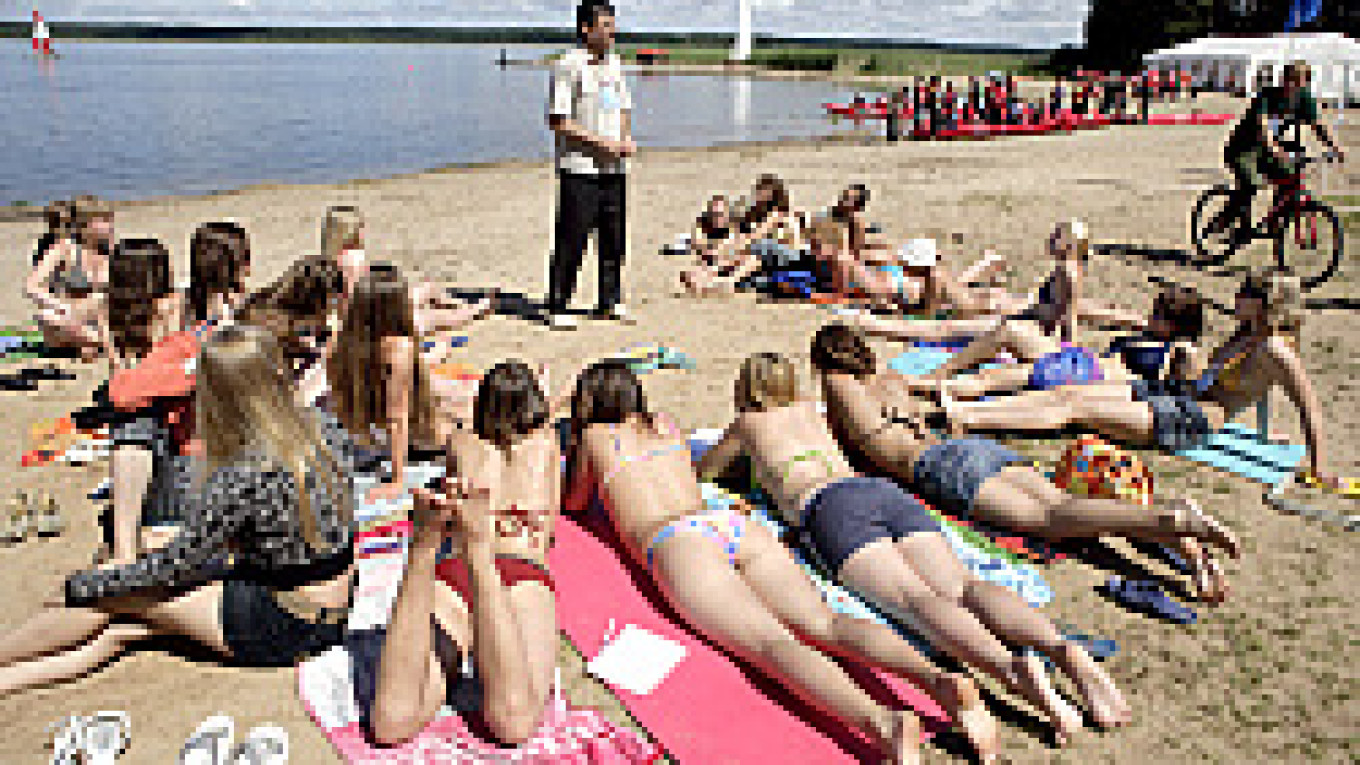
Attendance at the annual retreat on the shores of Lake Seliger was only 5,000 this time out, down sharply from the more than 10,000 activists who overran the campground last year. The sprawling grounds felt oddly empty, its numerous political education tents only half full.
Trotted out for a visiting contingent of journalists on Friday morning, many of the campers looked bored during their daily run. Many only picked up speed when they thought they were within sight of a camera.
To teach the cadres about business, they were given play money called "talanty" and told to spend it wisely at the many stalls hawking cheap wares like custom-made T-shirts. How this was meant to train them for careers as future barons of industry was unclear.
Igor Tabakov / MT
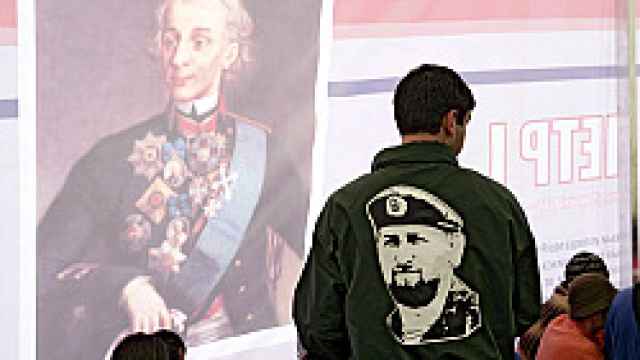
A Chechen youth whose clothing features Kadyrov's image standing near an image of General Alexander Suvorov.
|  |
| |
In fact, few of the campers seemed to have drawn much more than a few stock slogans from the message of economic innovation.
"If we just keep trying to build our country on oil and gas, we won't have a future," said Ilya Solovyov, 18, from Rzhev.
Bright-eyed and articulate, Solovyov stumbled when pressed about what innovation was. The country should develop nanotechnology and high-tech industry, he said. The country needs to innovate. So, in which field does Solovyov want to work after university?
"I don't know," he said. "Energy?"
Nashi burst onto the political scene in 2005, staging a 50,000-strong rally in Moscow to mark the 60th anniversary of Victory Day and was broadly seen as a response to the youth-led protests that helped bring pro-Western President Viktor Yushchenko to power in Kiev. Since then, the name has become synonymous with raucous street protests against Russia's supposed foreign and domestic enemies.
Last year, the group noisily picketed the Estonian Embassy following a feud over the relocation of a Soviet-era war memorial in Tallinn. It has also been accused of harassing former British Ambassador Anthony Brenton and plotting to seize key government buildings in the event of outside attempts to influence the presidential elections in March.
But Nashi has lost some of its brightest leaders and perhaps some of its key backers in the administration of late.
Igor Tabakov / MT
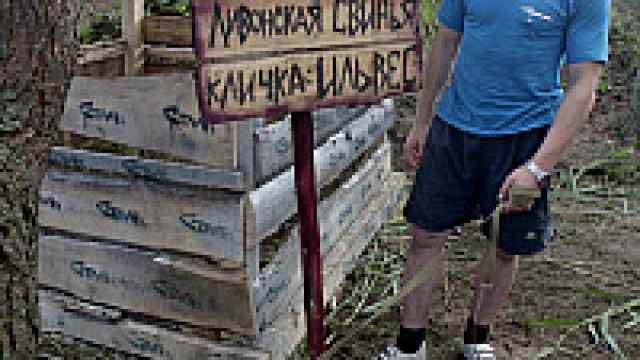
Sokolov with his pig, Toomas Hendrik Ilves, named after Estonia's president.
| |
| |
The group's wildly popular founder, Vasily Yakemenko, left last year to head up the Youth Affairs Committee.
Current leader Nikita Borovikov, for whom Seliger was somewhat of a coming out party, seemed desperately outmatched by the throngs of journalists peppering him with questions. A nearby press officer repeatedly intervened to clarify his statements, as he stammered and appeared on the verge of losing his temper.
Following the successful presidential transition from Vladimir Putin to Dmitry Medvedev, there is a strong sense among the members of the political elite that, having served its purpose, Nashi is not just a spent force but a potentially destabilizing element.
"I don't like Nashi. I think they're sheep and that they are a great danger to the current Russian government," Grigory Dobromelov, a professor of Political Science at St. Petersburg State University, said at the event Friday.
The authorities understand full well the danger posed by an unsupervised Nashi, Markov said. Sweeping them under the rug is, at this point, simply not an option.
"They will survive, because the Kremlin understands very well that if you give people a political education and then abandon them, they will move on to a different political groups, including the radical opposition," he said.
Igor Tabakov / MT
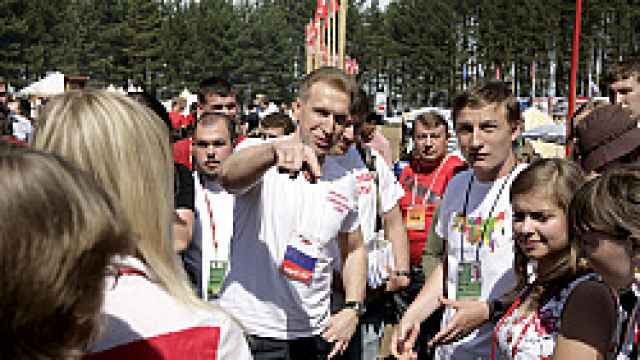
Shuvalov gesturing on Friday. Choosing him as keynote speaker suggested a shift in attention away from the group.
| |
| |
Sergei Belakovov, a United Russia Duma deputy, disagreed. Speaking to journalists in an almost empty field in front of the camp's large main stage, however, he struggled to explain the group's continuing relevance.
"Life changes and so do we," he said. "Now that the country is stable, they're not just standing around with their heads in their hands asking what to do. They all know what to do. They should start businesses."
Whatever the youth group's future might be, this year's camp was not without the amusingly offensive hijinks, which they call "actions," that have marked previous events.
In a small wooded nook alongside a winding dirt path, Oleg Sokolov, a 23-year-old commissar, keeps watch over his prize pig. The pig, he said, was named after Estonian President Toomas Hendrik Ilves. Next week they will release the pig at the Estonian border, sending him home to where he belongs, Sokolov said.
"They [Estonians] think they are a European country, but they're not," he said, standing in a pile of slop next to the porcine Toomas Ilves. "They're absolutely uncivilized."
A leader of Nashi's "Steel" section, charged with crowd control during protests, Sokolov seemed confused when asked to explain the camp's economic theme. He deftly maneuvered the conversation back onto familiar ground.

Igor Tabakov / MT
Fake money, called talanty, was used to teach the youth about business.
| |
| |
"Soon there will be a new election cycle; it's only two or three years away," he said. "There will be another chance for a Rose or Orange Revolution, and they won't stand in Red Square on our watch."
Despite the poor turnout, Nashi is far from a spent force. Many high-ranking political figures were in attendance, including First Deputy Prime Minister Igor Shuvalov, who swooped down in a jet-black helicopter midday on Friday.
Although ostensibly in attendance to give a lecture about economics, Shuvalov appeared much more at ease parading around the campgrounds for the media.
Dressed in jeans and a tight T-shirt, Shuvalov strutted in front of the cameras, chin out, nodding approvingly while staying as far as possible from the actual campers.
But given that previous keynote speakers have included Medvedev and Putin, as well as Chechen strongman Ramzan Kadyrov, the choice of Shuvalov contributed to the sense that some attention had shifted away from the youth group.
There was little indication that many of the campers, not least the 35 teenagers from the Chechen capital of Grozny, by far the camp's most enthusiastic attendees, noticed the political undertones.
Situated in their own campground, easily distinguishable by the red, white and green flags emblazoned with Kadyrov's smiling face, the group beamed when asked about the situation in their once war-ravaged republic.
"Before, things were impossible. Now, we have total security; you can go anywhere. In Chechnya, we have a president whose politics perfectly match ours," said Ismail Saidulhanov, 18. "All praise is due to Ramzan Akhmadovich Kadyrov, a true hero of Russia."
Several of the campers said the economic lessons they learned at the Nashi event are key to rebuilding the Chechen economy. For the most part, though, they just appeared to be happy to be out in the woods, among their Russian peers, in a safe place.
In the end, the most striking political message may have been the complete absence of posters of Medvedev. Among dozens of campers interviewed, not a single one mentioned Medvedev when asked about Russia's leadership.
"They don't know who Medvedev is," said Markov, "and Medvedev doesn't want to know who they are."
A Message from The Moscow Times:
Dear readers,
We are facing unprecedented challenges. Russia's Prosecutor General's Office has designated The Moscow Times as an "undesirable" organization, criminalizing our work and putting our staff at risk of prosecution. This follows our earlier unjust labeling as a "foreign agent."
These actions are direct attempts to silence independent journalism in Russia. The authorities claim our work "discredits the decisions of the Russian leadership." We see things differently: we strive to provide accurate, unbiased reporting on Russia.
We, the journalists of The Moscow Times, refuse to be silenced. But to continue our work, we need your help.
Your support, no matter how small, makes a world of difference. If you can, please support us monthly starting from just $2. It's quick to set up, and every contribution makes a significant impact.
By supporting The Moscow Times, you're defending open, independent journalism in the face of repression. Thank you for standing with us.

Remind me later.