

"The organizers of the contest in other countries will find it hard to match the standard set in Moscow," Deputy Mayor Valery Vinogradov told a news conference, Interfax reported.
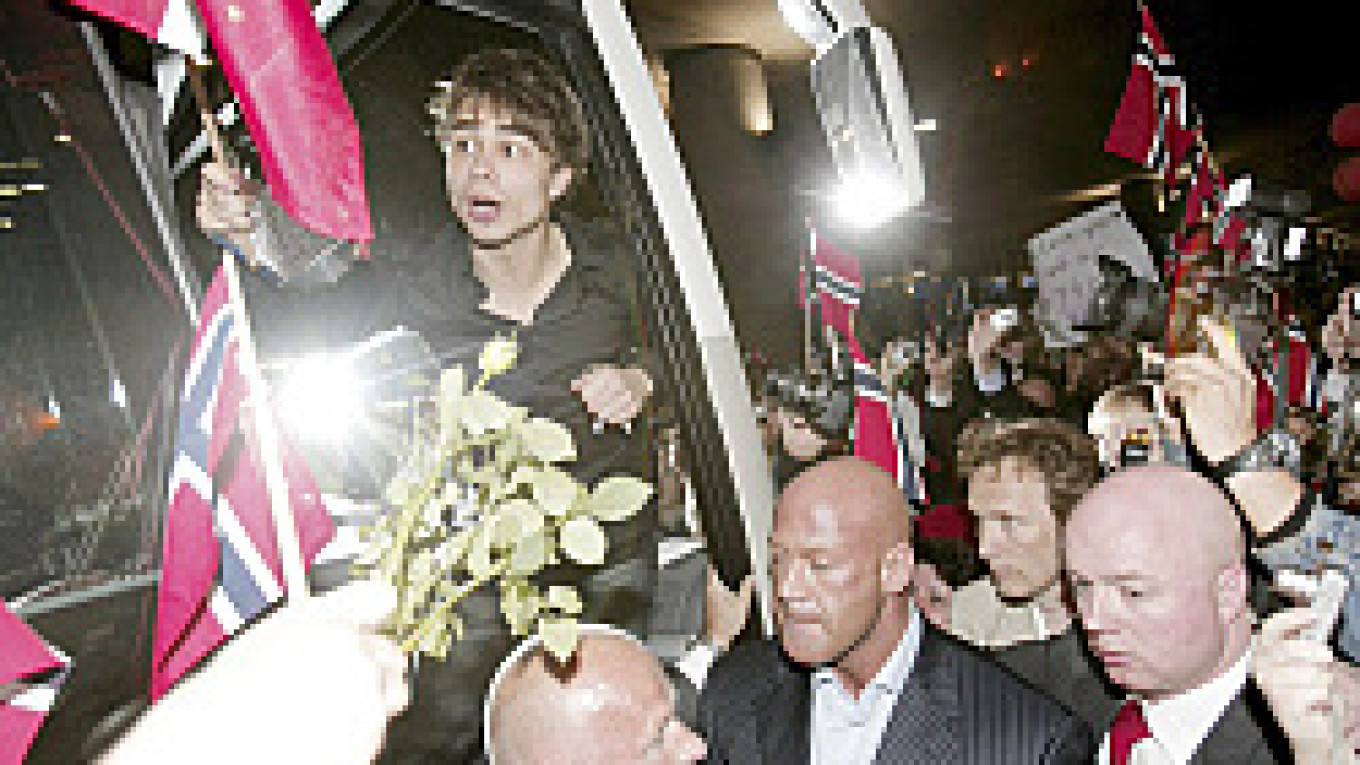
While even the winner of the event, Belarussian-born Norwegian singer Alexander Rybak, referred to the flamboyant contest as "the biggest gay parade in the world," Vinogradov described the attempted gay rights protest on the day of the final as "incompatible" with the show.
"I would not mix up incompatible things: the Eurovision television contest and attempts to hold a gay parade," said Vinogradov, who was in charge of the city's preparations for the event.
About 100,000 people visited the Olimpiisky Sports Complex, the site of the contest, over the course of the weeklong competition, Moscow deputy police chief Vyacheslav Kozlov told Interfax.
Just two people were detained from drinking alcohol in public, while 10 ticket scalpers were apprehended, Kozlov said.
The televised final Saturday night had an audience share in Moscow of 73 percent, Channel One, which broadcast the show, said Monday.
Meanwhile, the first voting scandals emerged Monday.
The event's Ukrainian broadcaster wrote to the European Broadcasting Union calling for an investigation into telephone votes cast for Russia and Israel, a Ukrainian television official said by telephone on Monday.
Ukraine gave Russia 8 points for its song "Mamo" — prompting cheers from the audience at Olimpiisky ?€” and Israel just 1 point for its peace anthem "There Must Be Another Way."
"We would like to find out what happened. We received the results three minutes before we had to broadcast, and we had to air them," Roman Nedzelsky, first vice president of Ukraine's Channel One, told The Moscow Times by telephone from Kiev. "We want to know where they got these numbers from."
The sensationalist web site Life.ru reported that Ukraine's professional jury ?€” which accounts for 50 percent of the country's votes ?€” gave zero points to Russia's entry, which was performed by Anastasia Prikhodko, who has a Ukrainian passport.
The jury votes have not been officially published.
Prikhodko initially auditioned to represent Ukraine. Her song, which has a chorus in Ukrainian, finished in 11th place in Saturday's final.
Russian voters gave neighboring Ukraine just 2 points for its song, "Anti-Crisis Girl," performed by Svetlana Loboda. The song finished 12th among the 25 finalists.
Meanwhile, the web site Panarmenian.net reported Monday that television viewers in Baku, Azerbaijan, were unable to see the telephone number to vote for Armenia on their screens.
The historic enmity between the two countries was reflected at Eurovision: Azerbaijan gave Armenia zero points, while Armenia gave its neighbor 1 point.
Public Armenian Television has submitted a complaint to the organizers, Panarmenian.net reported, but no one could be reached immediately for comment Monday at either country's national television network.
Azerbaijan finished third, while Armenia came in at 10th place.
European Broadcast Union spokesman Sietse Bakker could not be reached for comment Monday.
A Message from The Moscow Times:
Dear readers,
We are facing unprecedented challenges. Russia's Prosecutor General's Office has designated The Moscow Times as an "undesirable" organization, criminalizing our work and putting our staff at risk of prosecution. This follows our earlier unjust labeling as a "foreign agent."
These actions are direct attempts to silence independent journalism in Russia. The authorities claim our work "discredits the decisions of the Russian leadership." We see things differently: we strive to provide accurate, unbiased reporting on Russia.
We, the journalists of The Moscow Times, refuse to be silenced. But to continue our work, we need your help.
Your support, no matter how small, makes a world of difference. If you can, please support us monthly starting from just $2. It's quick to set up, and every contribution makes a significant impact.
By supporting The Moscow Times, you're defending open, independent journalism in the face of repression. Thank you for standing with us.

Remind me later.