

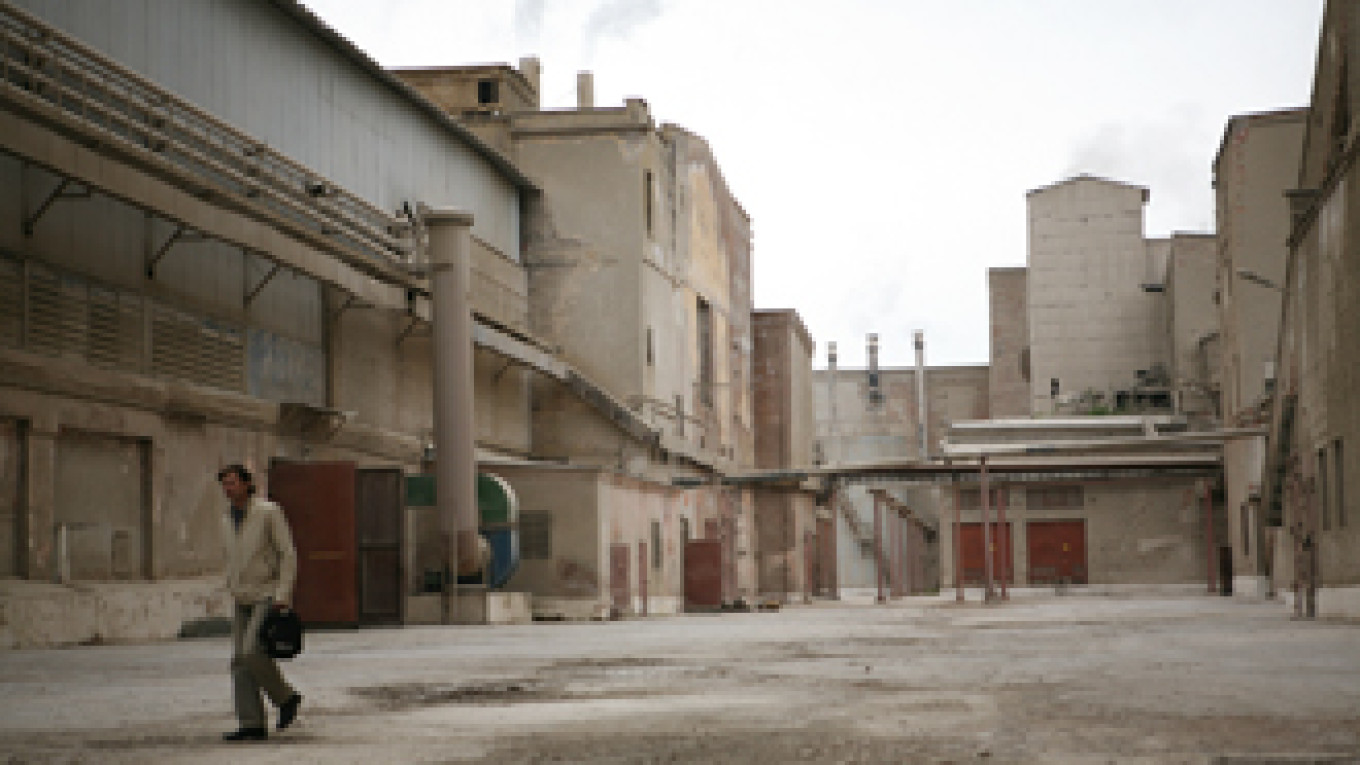
Prime Minister Vladimir Putin ordered the government to develop a plan to help the cities, known as monogorody, after workers in the Leningrad region town of Pikalyovo blocked a federal highway to protest wage arrears.
A government commission, chaired by Deputy Regional Development Minister Yury Osintsev, was ordered to develop criteria for determining what would qualify as a so-called monocity so that those most in need could be helped. Officials from the Regional Development and Finance ministries told Vedomosti that the criteria were settled on Friday.
A town or city can expect to receive state aid if it meets one of two criteria, two officials at the Regional Development Ministry said. The first is if more than 25 percent of the economically active population of a town works at one business or a group of businesses that are interreliant as part of a "technological chain." The second is if the output of such an enterprise or group of enterprises is no less than 50 percent of the town's overall production.
A source at the Regional Development Ministry said the proposals would be submitted to the government soon, although he conceded that the criteria were somewhat vague after the lengthy approval process.
"There could be problems in determining what classifies as a technological chain," he said.
Another official at the ministry said the most important thing was reaching agreement that more than one plant in a city would be considered, including factories with different owners.
The problematic cities were built in the Soviet period, when businesses were united as diversified groups and holdings, but they were privatized individually, a Regional Development Ministry source said. "The end result is that one company is connected to others through hundreds of agreements. If one of the owners decides to close a plant, then the rest can fail."
Another problem is that the criteria use the term naselyonny punkt, or settlement, a Finance Ministry source said. The budget system recognizes areas classified as cities but not municipal areas that are part of a district, he said.
A Regional Development Ministry source said they were aware of the problem. "That means we'll be allotting the money manually to the municipal body or city."
Under the criteria, more than 400 settlements qualify as monocities, but not all of them will get help, one of the Regional Development Ministry sources said.
"Cities with atomic or hydropower stations, oil and gas towns, closed and scientific cities, and all exporting cities are in normal economic shape," he said, adding that the government expected to provide aid to about 200 cities.
Places where budget revenue fell off sharply will be helped this year, "so that they don't have to worry about the start of winter," a regions ministry source said.
This year's funds will be drawn from federal budget money set aside to help cover regional budgets — 58.2 billion rubles, according to a government order signed Friday by Putin, the Finance Ministry source said. Another source at the Finance Ministry said 150 billion rubles in the budget reserved for supporting the regions could also be used.
A high-level Finance Ministry source said the 2010 budget would include about 10 billion rubles in assistance for one-factory towns, although an "exact figure has not been determined." A Regional Development Ministry source said the methods for supporting such cities would change next year, with money being given to fund actual anti-crisis programs.
Alexei Kozmin, president of the Irkutsk region's Regional Development Fund, said a unified approach to monocities was impossible. "You need to deal with each business individually," he said, otherwise it is very likely that ineffective businesses will receive money.
He said it was unfortunate that the criteria do not take into account how distant a town is from major cities. "You need to help the people who don't have the opportunity to go and work in a neighboring city," he said.
About five cities in the Irkutsk region would qualify under the new criteria, he said.
Alexander Puzanov, director of the Institute for Urban Economics, said the proposed system was needed to determine a cutoff point. "All of Russia's monocities are well-known to experts, long ago described, classified and analyzed," he said.
A Message from The Moscow Times:
Dear readers,
We are facing unprecedented challenges. Russia's Prosecutor General's Office has designated The Moscow Times as an "undesirable" organization, criminalizing our work and putting our staff at risk of prosecution. This follows our earlier unjust labeling as a "foreign agent."
These actions are direct attempts to silence independent journalism in Russia. The authorities claim our work "discredits the decisions of the Russian leadership." We see things differently: we strive to provide accurate, unbiased reporting on Russia.
We, the journalists of The Moscow Times, refuse to be silenced. But to continue our work, we need your help.
Your support, no matter how small, makes a world of difference. If you can, please support us monthly starting from just $2. It's quick to set up, and every contribution makes a significant impact.
By supporting The Moscow Times, you're defending open, independent journalism in the face of repression. Thank you for standing with us.

Remind me later.