

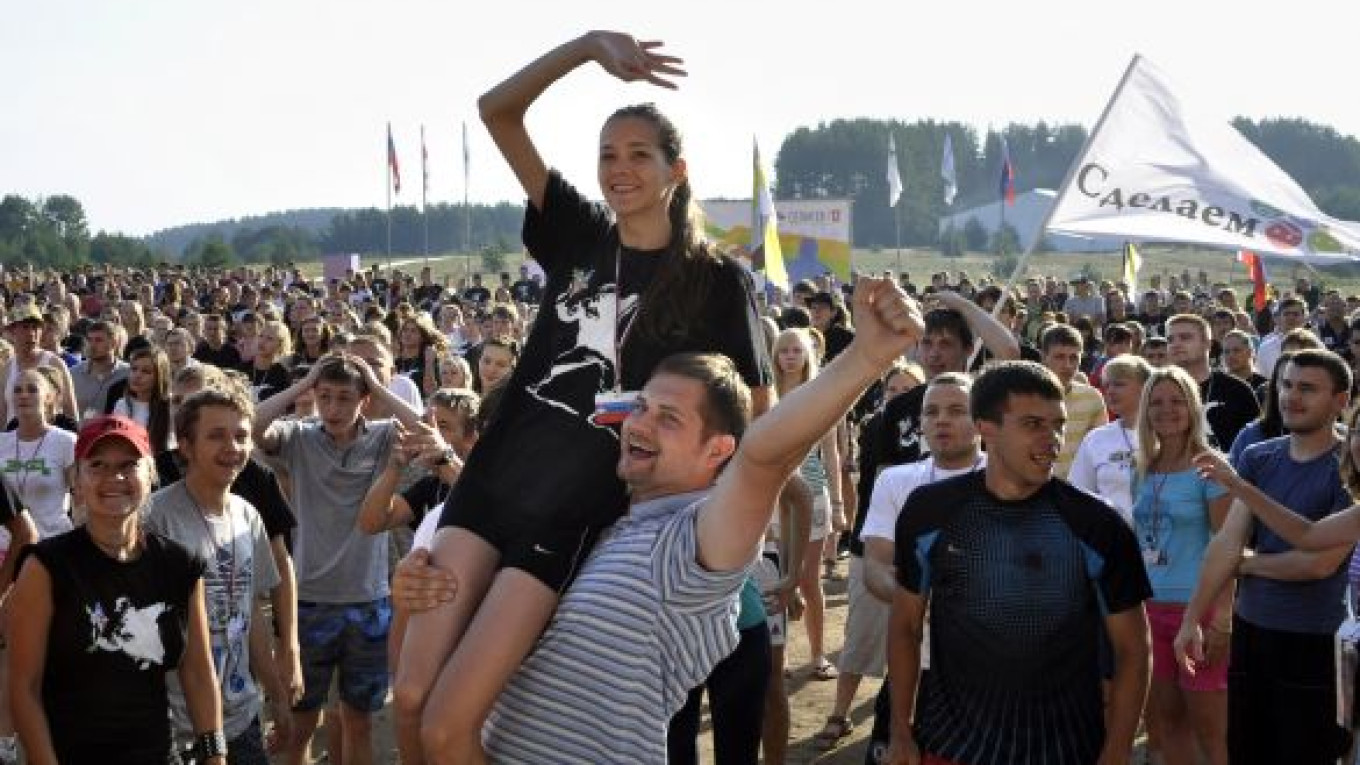
LAKE SELIGER, Tver Region — The spirit of rebellion roiling the nation this year stretches even into the Seliger youth camp, an annual Kremlin-funded event that has long been seen as a training ground for truculent Putin loyalists.
This year's camp, which wrapped up Thursday, struck a different chord. Organizers encouraged opposition activists to take part and cultivated an edgy vibe symbolized by a new logo designed by graffiti artist Banksy.
But many question whether Seliger's makeover is an attempt to constructively engage the opposition or co-opt a movement that severely rattled President Vladimir Putin with a wave of massive demonstrations over the past year.
Recently passed measures such as an astronomical increase in fines for taking part in an unauthorized demonstration may do little to discourage protesters — and even encourage more people to support the opposition. And Putin has shown tentative signs of trying to mollify the opposition without actually giving ground.
Whether that thinking underlies the Seliger camp's new image is unclear, but the changes this year were striking.
Inaugurated in 2005, the Seliger summer session for years was open only to members of Nashi, the pro-Kremlin youth group noted for its vehement devotion to those in power, and affiliated groups. The camp, located 350 kilometers northwest of Moscow, long had an iconography that some have likened to a neo-Soviet personality cult.
"Last year, there were only two portraits hanging on the stage: Putin and Medvedev," said Margaret Drimluzhenko, 21, who attended her first session in 2011.
Just one year earlier, in 2010, a group of campers pasted images of opposition leaders or human rights activists to Nazi hats under a sign that read: "You're not welcome here."
But this year, the banners glorifying the president and ruling party were gone, as were anti-opposition antics. Instead, the campground was dotted with the Banksy image of a young man preparing to toss a bouquet of flowers. The logo was painted in Putin's least favorite color, orange, the emblematic color of the 2004 Ukrainian demonstrations that rattled nerves in the Kremlin.
"This year, they got rid of everything [from before], so there weren't even any hints," Drimluzhenko said. "I don't think it's politicized. It's just a possibility to come and discuss, to make friends and go somewhere from there."
At the start of each day, bleary-eyed campers flocked around a central stage to do fist-pumping aerobics. Some wore white ribbons, the opposition's symbol, while others were dressed in T-shirts showing the yellow-black-and-white stripes of a 19th-century Russian flag that is now a popular image for nationalists.
On one recent morning, two men dressed as Cossacks, who symbolized fidelity to the Kremlin in imperial Russia, came to the stage and began fiercely cracking whips at each other, a characteristic demonstration of Cossack prowess.
Then up stepped Dmitry Ternovsky, a blogger and sometime opposition activist, who was chosen to direct Seliger this year.
"Occupy Seliger," the name of this year's session, is Ternovsky's brainchild. His goal this year was to attract new participants to the camp, the same young people who flocked to the protests that arose after December's fraud-tainted parliamentary election.
The skinny 31-year-old was greeted with applause and started to announce the day's events. But as soon as he whispered a few words about a discussion of electoral fraud, many in the audience started to boo.
And for all his efforts, attracting the opposition to a place with such a pro-Putin reputation was a tough sell. Alexei Navalny, an anti-corruption blogger and one of the most prominent faces of the opposition, immediately refused, as did most other pro-democracy activists.
"Seliger is firmly, hopelessly associated with the Nashi movement, which has been completely discredited both in the eyes of opposition activists and by society," pro-democracy activist Ilya Yashin told the newspaper Nezavisimaya Gazeta.
One of the few anti-Kremlin guests to give a lecture at the camp this year was Ilya Ponomaryov, an opposition member of parliament and a leading figure of the street protest movement.
"Nashi members all know me because a few years ago my picture was hung on a pine tree to have darts shot at it," he said.
But Ponomaryov said he was eager to attend the camp because he believed that the young, politically active members were ripe for genuine political discussion.
"I don't see a difference between opposition activists and activists for Nashi, except for the fact that those who are in Nashi fell into the wrong hands and have had a bunch of garbage beaten into their heads," he said.
Many young people have been attracted to the Nashi movement less out of ideological conviction than out of ambition, and Seliger provides a platform for young people to network and climb up the economic ladder.
Yelena Suchkova, 21, said she supported Putin because he brought "stability" to the country. But the young biochemistry student said she was at Seliger less for political reasons than to make "business connections, which you need for self-realization."
A smaller handful of campers said they had come to Seliger determined to engage in political debate. Alexander Trafimov, a graduate student in experimental medicine and an opposition activist, was at Seliger for the first time to discuss his views with other politically active young people.
"Navalny said he's not going to play by the rules of the crooks and thieves, but I think dialogue is necessary," the 25-year-old said. "There's not a lot of us here with white ribbons, but we're here and we're talking."
Ternovsky said the unwillingness of opposition leaders to attend hurt the democratic process.
"I think that in this case, everyone is using everyone, but it's a fight that you have to take part in," Ternovsky said.
But many question whether a Kremlin-approved dialogue can be a genuine dialogue at all. And most of the guests to the camp have been members of the ruling elite who concede the importance of "discussion" without truly engaging in it.
Putin, who visits the camp almost every year, arrived on Tuesday to speak with the campers. He was ready to moderate previous remarks about the protest movement, mentioning that "many patriotic people" were among the demonstrators.
But Putin repeated that political progress would be slow and evolutionary, not revolutionary.
"We already had that in 1917, and we know what came of that," Putin said of the Bolshevik revolution that led to the Soviet Union.
A Message from The Moscow Times:
Dear readers,
We are facing unprecedented challenges. Russia's Prosecutor General's Office has designated The Moscow Times as an "undesirable" organization, criminalizing our work and putting our staff at risk of prosecution. This follows our earlier unjust labeling as a "foreign agent."
These actions are direct attempts to silence independent journalism in Russia. The authorities claim our work "discredits the decisions of the Russian leadership." We see things differently: we strive to provide accurate, unbiased reporting on Russia.
We, the journalists of The Moscow Times, refuse to be silenced. But to continue our work, we need your help.
Your support, no matter how small, makes a world of difference. If you can, please support us monthly starting from just $2. It's quick to set up, and every contribution makes a significant impact.
By supporting The Moscow Times, you're defending open, independent journalism in the face of repression. Thank you for standing with us.

Remind me later.