

"North Korea's underground nuclear test in the region adjacent to the territory of the Russian Federation ... causes deep regret and the most serious concern," said President Dmitry Medvedev's spokeswoman, Natalya Timakova.
The Foreign Ministry warned that the test endangered security and stability in the region and dealt a serious blow to efforts to strengthen controls on the proliferation of nuclear weapons. "We cannot describe the North Korean move other than as a breach of UN Security Council Resolution 1718, which prohibits Pyongyang from carrying out nuclear tests," the ministry said in a statement.
The Defense Ministry confirmed an atomic explosion at 9:54 a.m. in northeastern North Korea, estimating the blast's yield at 10 to 20 kilotons -- comparable to the bombs that flattened Hiroshima and Nagasaki during World War II. "We are currently monitoring the situation," Defense Ministry spokesman Alexander Drobyshevsky said, RIA-Novosti reported.
Monday's atomic test was conducted about 190 kilometers southwest of North Korea's border with Russia's Primorye region, according to estimates from the Russian Defense Ministry.
 |
North Korea boasted that Monday's test was conducted "on a new higher level in terms of its explosive power and technology of its control" than in 2006, according to its official Korean Central News Agency. It said it "successfully conducted one more underground nuclear test on May 25 as part of measures to bolster its nuclear deterrent for self-defense." Hours later, the regime test-fired three short-range, ground-to-air missiles, South Korea's Yonhap news agency reported, citing unidentified sources. UN Security Council resolutions bar North Korea from engaging in any ballistic missile-related activity.
U.S. President Barack Obama called the moves "blatant defiance" of the Security Council.
The Russian permanent mission to the United Nations said the Security Council would convene for emergency talks later Monday.
In Moscow, the Foreign Ministry said continued six-party talks on North Korea were the only solution to the crisis.
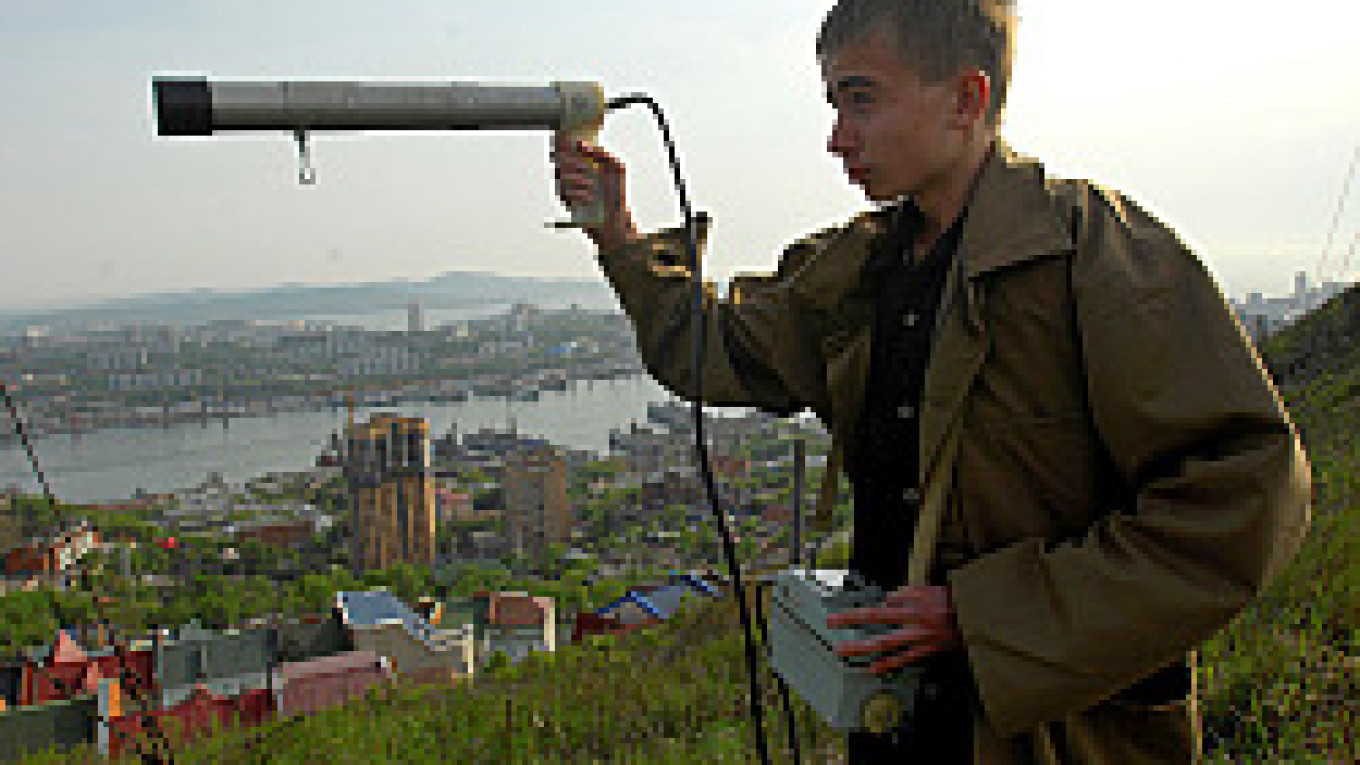
Radiation levels in the Primorye region were normal Monday several hours after the blast, the state meteorological office said.
In Vladivostok, a city of 500,000 people about 140 kilometers from the Russian-North Korean border, translator Alexei Sergeyev said he wasn't concerned about the test and doesn't fear North Korea. "Their nuclear program does not have military aims -- their only aim is to frighten the U.S. and receive more humanitarian aid as a result," Sergeyev said.
A Message from The Moscow Times:
Dear readers,
We are facing unprecedented challenges. Russia's Prosecutor General's Office has designated The Moscow Times as an "undesirable" organization, criminalizing our work and putting our staff at risk of prosecution. This follows our earlier unjust labeling as a "foreign agent."
These actions are direct attempts to silence independent journalism in Russia. The authorities claim our work "discredits the decisions of the Russian leadership." We see things differently: we strive to provide accurate, unbiased reporting on Russia.
We, the journalists of The Moscow Times, refuse to be silenced. But to continue our work, we need your help.
Your support, no matter how small, makes a world of difference. If you can, please support us monthly starting from just $2. It's quick to set up, and every contribution makes a significant impact.
By supporting The Moscow Times, you're defending open, independent journalism in the face of repression. Thank you for standing with us.

Remind me later.