

Yuan, who speaks the Karabakh dialect of the Armenian language fluently and goes by the Armenian name of Gurgen, moved to this de facto independent republic more than a year ago. He and two other Chinese cooks work at a hotel restaurant.
Yuan, 25, cracked the joke when asked what Kosovo's declaration of independence Sunday meant for Nagorno-Karabakh.
He and many other residents seem to have little idea what to expect, but they are hoping that life stays calm in the enclave, which Azerbaijan insists is part of its territory even though its Armenian majority declared independence more than 16 years ago.
Unlike Kosovo, the self-proclaimed Nagorno-Karabakh Republic enjoys no strong support from the European Union or the United States in its bid for independence. But Karabakh Armenians, who, with the support of Armenia, won a bloody war against the Azeris in the 1990s, are seeing parallels with Kosovo and the long struggle of its Albanian majority. For Karabakh's leaders, international recognition of Kosovo's independence would set an important precedent.
"We are confident that the recognition of Kosovo by the international community or by individual countries will strengthen our position in negotiations to resolve the conflict with Azerbaijan," Georgy Petrosyan, the foreign minister of the unrecognized republic, said in an interview.
Azerbaijan has offered Nagorno-Karabakh broad autonomy within the country during ongoing talks mediated by the Organization for Cooperation and Security in Europe. But Nagorno-Karabakh's population has insisted on independence. The enclave has a population of 137,737, 99.7 percent of whom are Armenian, according to the most recent census, taken in 2005.
"It is important that Kosovo might become an example of a country's independence being recognized against the will" of the country from which it is seceding, Petrosyan said.
He said he believed that the solution for Kosovo in its conflict with Serbia should also work for Karabakh in its conflict with Azerbaijan.
"A denial of this thesis would amount to a denial of the nature of the precedent and its role in contemporary international relations," he said.
Ashot Gulyan, speaker of Karabakh's parliament, agreed. "The situation around Kosovo cannot be perceived as a one-off case," he added.
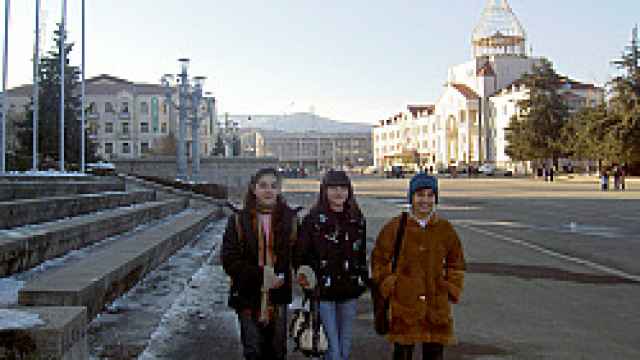
Karine Ohanyan / For MT
People walking down a street in Stepanakert, the main city in the self-proclaimed Nagorno-Karabakh Republic.
|  |
| |
Petrosyan said the omission might be an indication that Russia, which is participating in the OSCE negotiations, "is avoiding statements that would put its impartiality as a mediator in doubt." Russia, however, has also been involved in similar talks between Georgia and South Ossetia and Abkhazia.
The Karabakh war erupted after the parliaments of Armenia and Nagorno-Karabakh held a joint session on Dec. 1, 1989, to declare the unification of their territories. Azeri deputies from the Nagorno-Karabakh parliament did not participate in the vote.
The first clashes along the Armenian-Azeri border broke out the next year, and full-scale fighting started in 1991.
On Dec. 10, 1991, Nagorno-Karabakh's Armenian majority overwhelmingly backed a referendum in support of independence for their homeland.
The enclave's newly elected parliament established the independent Republic of Nagorno-Karabakh on Jan. 6, 1992.
The war ended in 1994, with Armenian forces driving Azeris out of the enclave and seizing control of several neighboring Azeri districts, forcing their population to flee. Armenian forces still control these districts, while Azeris control the northern tip of Nagorno-Karabakh, from which the Armenian population has fled. A conflict-resolution proposal suggested by OSCE mediators calls for Karabakh to return the districts to Azerbaijan in exchange for the right to hold a new referendum on the enclave's status.
Many Karabakh residents do not appear hopeful that international recognition of Kosovo's independence might mean a change for their homeland.
"Such issues are resolved the way that world powers want them resolved, even though our cause for independence is more just than Kosovo's," said Juleyetta Arustamyan, a 44-year-old singer who lives in the enclave's main city, Stepanakert.
Nune Khachatryan, the 35-year-old owner of a fashion store in Stepanakert, said she is happy for Kosovo's Albanians but not interested in politics. "Honestly speaking, I don't care whether others recognize us or not," she said. "With or without recognition, we will continue to live happily on our own land."
A Message from The Moscow Times:
Dear readers,
We are facing unprecedented challenges. Russia's Prosecutor General's Office has designated The Moscow Times as an "undesirable" organization, criminalizing our work and putting our staff at risk of prosecution. This follows our earlier unjust labeling as a "foreign agent."
These actions are direct attempts to silence independent journalism in Russia. The authorities claim our work "discredits the decisions of the Russian leadership." We see things differently: we strive to provide accurate, unbiased reporting on Russia.
We, the journalists of The Moscow Times, refuse to be silenced. But to continue our work, we need your help.
Your support, no matter how small, makes a world of difference. If you can, please support us monthly starting from just $2. It's quick to set up, and every contribution makes a significant impact.
By supporting The Moscow Times, you're defending open, independent journalism in the face of repression. Thank you for standing with us.

Remind me later.