

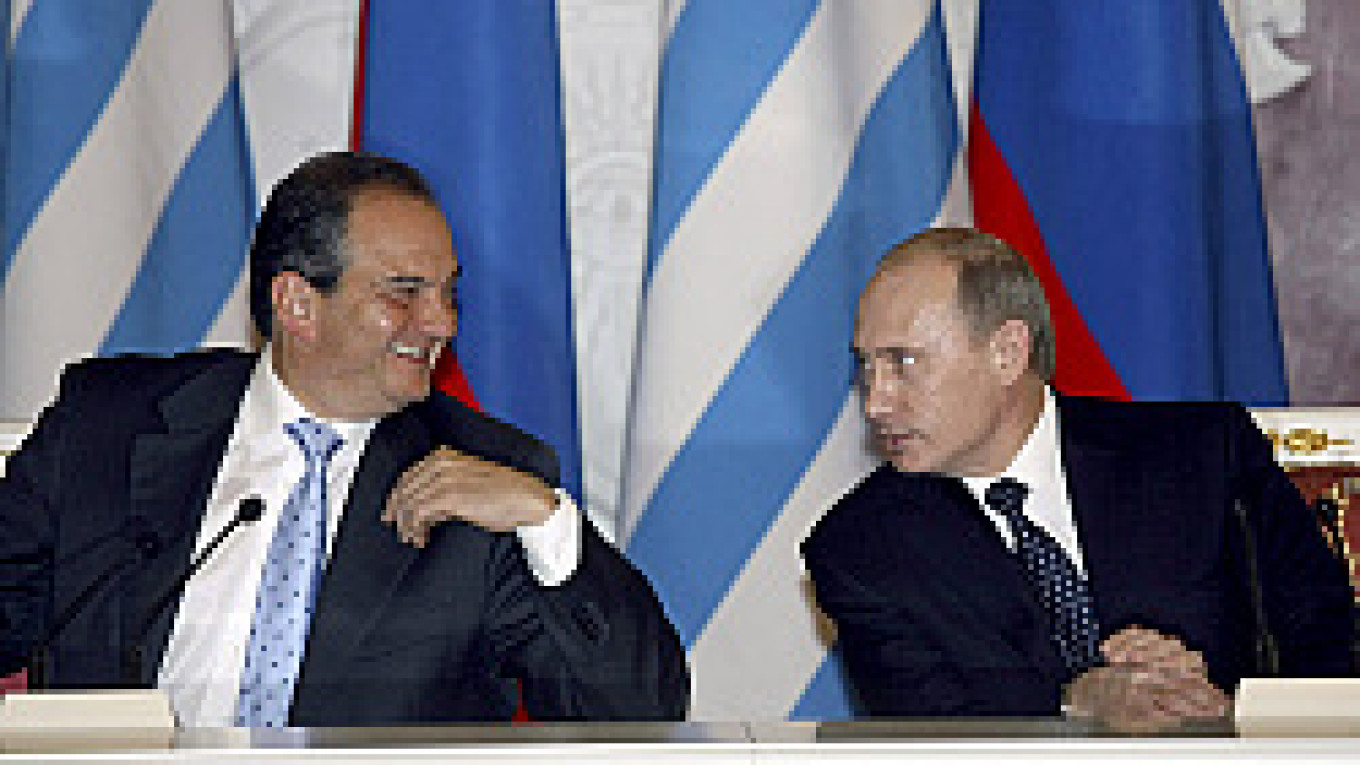
Welcoming Greek Prime Minister Costas Karamanlis to the Kremlin, President Vladimir Putin praised Greece's decision to join the 10 billion euro pipeline, which will carry 30 billion cubic meters of Russian gas per year to southern Europe, and said European resistance was the reason why another key project, a trans-Balkan oil pipeline, took so long to take off.
In what was scheduled to be his last meeting with a foreign leader as president, Putin used his own tie as a prop and turned to watches and underpants to argue that few countries could rival Russia on gas deliveries.
"The realization of the South Stream project doesn't mean that we are fighting with alternative projects," Putin said.
South Stream is seen as a rival to the European-backed Nabucco pipeline, and some European countries fear it might undermine the continent's drive to diversify its energy supplies.
"If Greece needed some ordinary goods ?€” watches, underpants or a tie ?€” they could buy them wherever they wanted. You could buy them in China, Switzerland ?€¦" Putin said and paused. He turned over his dark blue tie and briefly inspected its label as several aides and guests smiled. Serious-faced, Putin continued: "?€¦ or in Italy, for example. But you can count on a single hand the countries that are able to be the primary supplier of energy at the necessary volumes and at competitive prices for Europe."
In January, Putin traveled to Sofia, where he enlisted Bulgaria's support for South Stream. Russia also signed an agreement with Serbia that month and with Hungary in February. Construction of the pipeline is expected to start this year or in 2009, with first deliveries scheduled for 2013.
Karamanlis, who last came to Moscow for talks in December, said Greece wanted to participate in the pipeline because its needs for natural gas were expected to double in the coming years.
Speaking to reporters after the signing, Industry and Energy Minister Viktor Khristenko said Greece would receive 10 billion cubic meters of gas a year from Russia. Tuesday's framework agreement laid out a series of conditions on taxes and other issues, and now it will be up to the companies involved in the project to take it further, Khristenko said.
In March 2007, Putin traveled to Athens to sign, together with Greece and Bulgaria, a deal for the Burgas-Alexandroupolis oil pipeline, putting an end to 14 years of delays and haggling over the project, estimated to cost $1 billion. On Tuesday, Putin said a feasibility study for the pipeline should be prepared in the near future. Responding to a question from a Greek reporter about why the pipeline was taking so long to start, Putin said key projects always had a "political connotation," meaning competitors "have always made and will make energetic efforts to either torpedo or delay them."
On other issues, Putin and Karamanlis criticized Kosovo's unilateral declaration of independence, and Putin reiterated his criticism of NATO's eastward expansion.
The leaders agreed to host a Year of Russia in Greece and a Year of Greece in Russia in 2013, as part of preparations for the 2014 Olympics in Sochi.
Russian and Greek officials also discussed military cooperation, primarily details on the delivery to Greece of Russian-made infantry combat vehicles, Sergei Chemezov, general director of Russian Technologies, which includes the state arms exporter, said on the sidelines of the Kremlin talks.
Karamanlis said in December that Greece was looking to buy 400 infantry combat vehicles from Russia. The contract is estimated to be worth 1.2 billion euros, a Russian Technologies spokesman said.
Chemezov said no new arms deliveries were discussed Tuesday.
Karamanlis held a separate meeting with President-elect Dmitry Medvedev after the talks with Putin.
Putin's meeting with Karamanlis was scheduled to be his last with a foreign leader before Medvedev's inauguration on May 7, and the president looked visibly relaxed throughout the day. He surprised foreign tourists milling around the Kremlin buildings by walking across a courtyard from an awards ceremony to his talks with Karamanlis. The tourists froze as Putin, surrounded by bodyguards and with his spokesman, Alexei Gromov, at his side, nodded and smiled at them as he passed by.
A Message from The Moscow Times:
Dear readers,
We are facing unprecedented challenges. Russia's Prosecutor General's Office has designated The Moscow Times as an "undesirable" organization, criminalizing our work and putting our staff at risk of prosecution. This follows our earlier unjust labeling as a "foreign agent."
These actions are direct attempts to silence independent journalism in Russia. The authorities claim our work "discredits the decisions of the Russian leadership." We see things differently: we strive to provide accurate, unbiased reporting on Russia.
We, the journalists of The Moscow Times, refuse to be silenced. But to continue our work, we need your help.
Your support, no matter how small, makes a world of difference. If you can, please support us monthly starting from just $2. It's quick to set up, and every contribution makes a significant impact.
By supporting The Moscow Times, you're defending open, independent journalism in the face of repression. Thank you for standing with us.

Remind me later.