

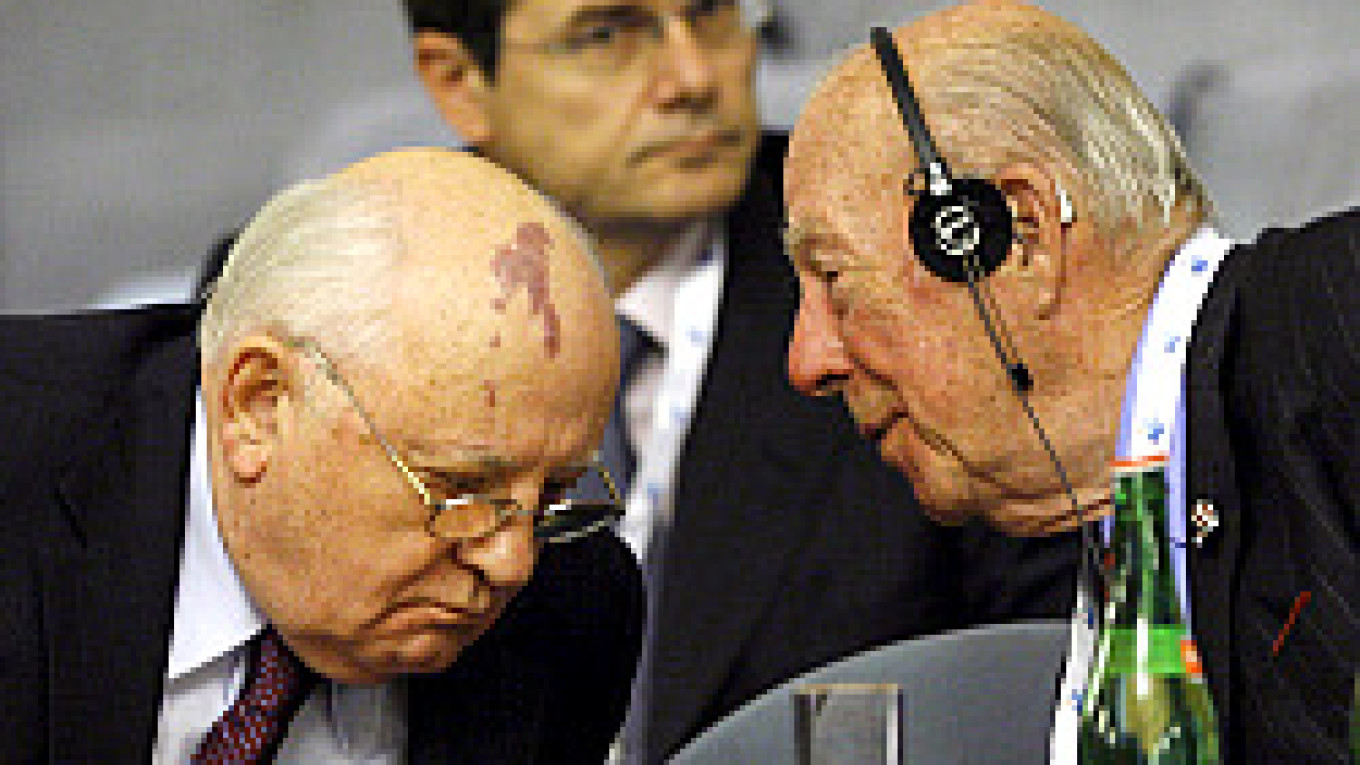
Today, slower of step but hardly of wit, Mikhail Gorbachev and George Shultz are allied in that same common cause and watched as their two countries' new presidents joined this month in the unprecedented step of declaring their governments partners in pursuing the goal of abolishing nuclear weapons.
"Persevere," is former Soviet President Gorbachev's advice to the two younger men.
Make sure your "home constituencies" are behind you, counsels former U.S. Secretary of State Shultz.
The two 20th-century statesmen looked back on the famous "failure" of the 1986 Reykjavik summit and ahead to this new disarmament effort in Associated Press interviews during a two-day conference on "Overcoming Nuclear Dangers" last week in Rome.
On that October 23 years ago, in the Icelandic capital's white-clapboard Hofdi House, Gorbachev, U.S. President Ronald Reagan and their lieutenants, Shultz among them, met to try to negotiate reductions in their nuclear missile forces.
When Gorbachev surprised the Americans by proposing that Moscow and Washington eliminate all nuclear weaponry, Shultz barely hesitated. "Let's do it," the transcript shows him responding.
Both presidents had touched on the idea in recent speeches, but few outside the inner Kremlin circle expected it to land on the bargaining table. Reagan was enthusiastic, Gorbachev optimistic. But it wasn't meant to be. This earthly aspiration ?€” of a world without a nuclear nightmare ?€” foundered in the shoals of outer space.
Reagan was unyielding on his other dream of a space-based defense system that would shield the United States from any rogue state's missile attack. The Russians, meanwhile, were unconvinced that such a scheme was meant to give their old Cold War foes a permanent military advantage.
"We came very close. We were ready to sign an agreement in principle," Gorbachev said, sitting beneath the lofty, lush murals of Raphael's 16th-century Villa Madama, the site of the Italian government's conference dinner Thursday. But "we regarded this" ?€” Reagan's Strategic Defense Initiative ?€” "as an attempt to weaponize outer space. We saw that that was a real danger."
The Russians demanded that the SDI be limited to laboratory research. Reagan refused. "In the end, it got entangled," recalled Shultz, meeting with a reporter in the marble-clad grand halls of Italy's Mussolini-era Foreign Ministry. "If anything was to happen, everything had to happen." The summit ended in seeming discord.
A generation later, however, both men look back and see more success than failure. The ambition and spirit of Reykjavik contributed, they believe, to the 1991 U.S.-Soviet START agreement, the first reduction of the superpowers' ranks of atomic-tipped missiles, and to the concurrent end of the Cold War. "Certainly, our efforts were not in vain," said Gorbachev, 78. "A very large proportion of nuclear weapons have already been destroyed."
For his part, Shultz, at 88 still natty in a rich, gray-striped suit and commanding in his precise, lawyerly tone, carries around a chart to show people how the number of weapons declined post-Reykjavik. The old, missile-heavy doctrine of "mutually assured destruction" was "not a very healthy way to achieve peace," he said.
Still, more than 23,000 nuclear warheads remain worldwide, 95 percent of them in Russian and U.S. arsenals. When U.S. President Barack Obama and President Dmitry Medvedev embraced the no-nukes goal in a joint declaration on April 1, they said they would start by negotiating further reductions in those arsenals.
The two travelers on the long road from Reykjavik were asked what they would now advise the presidents.
Gorbachev, somewhat hobbled but still ebullient and overflowing with ideas, recalled that he met quietly with Obama at the White House last month. "I said to him, 'I've been following your campaign, and it seems I've known you for a hundred years,'" Gorbachev said. "He said, 'But I've known you longer.'"
"Now," Gorbachev turned to the reporter's question, "what's my advice?
"Once you have taken the first step, persevere, make the second step and a 10th step, move forward in cooperation, in dialogue, in discussion, don't be afraid of unexpected turns and situations that might develop."
The Republican Shultz said the Democrat Obama's popularity gives him "wind at his back," but he suggested that the two young presidents' "most difficult negotiations" on arms control may first come in their capitals, "within the constituencies on each side." Then, "when they agree on something, they can carry it out at home."
The no-nukes movement can only grow in support in the months and years to come, said both elder statesmen.
"We have learned some lessons," said Gorbachev. "I hope."
A Message from The Moscow Times:
Dear readers,
We are facing unprecedented challenges. Russia's Prosecutor General's Office has designated The Moscow Times as an "undesirable" organization, criminalizing our work and putting our staff at risk of prosecution. This follows our earlier unjust labeling as a "foreign agent."
These actions are direct attempts to silence independent journalism in Russia. The authorities claim our work "discredits the decisions of the Russian leadership." We see things differently: we strive to provide accurate, unbiased reporting on Russia.
We, the journalists of The Moscow Times, refuse to be silenced. But to continue our work, we need your help.
Your support, no matter how small, makes a world of difference. If you can, please support us monthly starting from just $2. It's quick to set up, and every contribution makes a significant impact.
By supporting The Moscow Times, you're defending open, independent journalism in the face of repression. Thank you for standing with us.

Remind me later.