

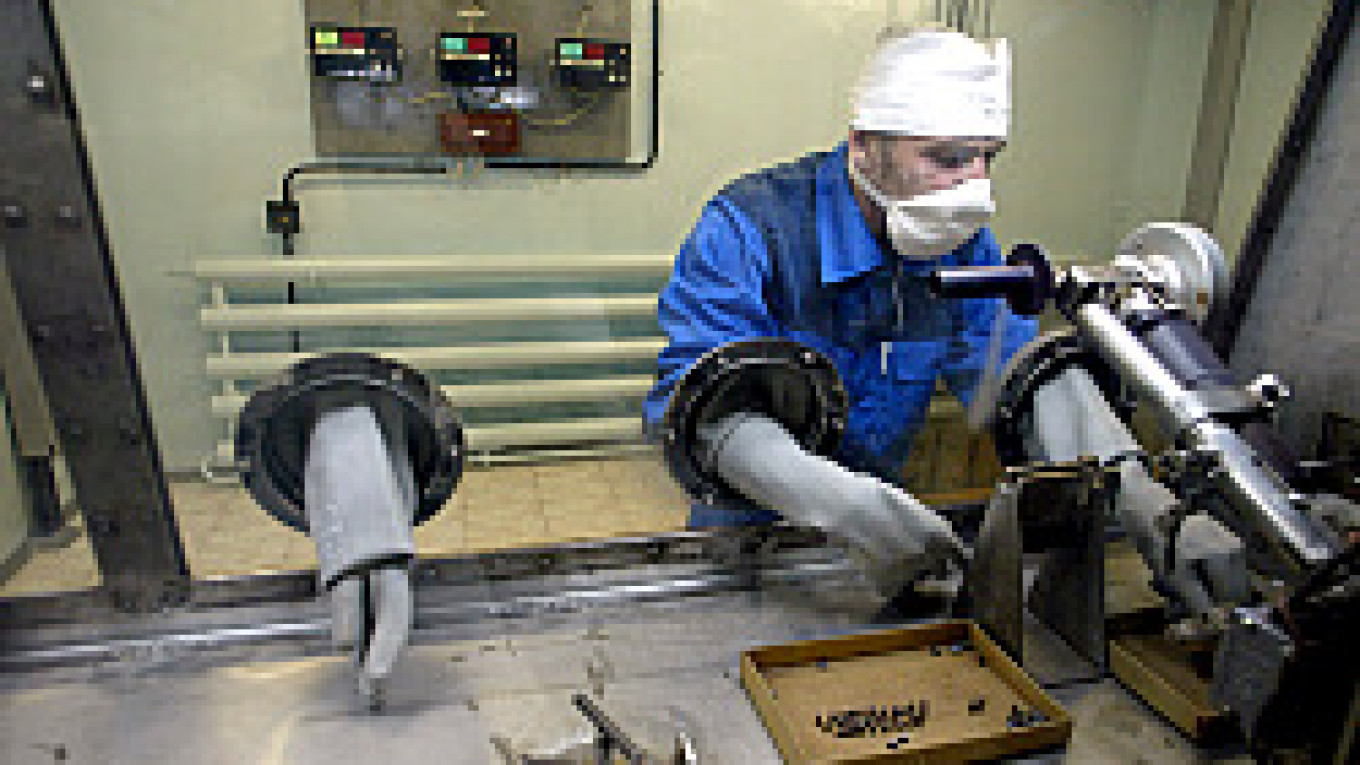
The $150 million idea, with seed money from U.S. billionaire Warren Buffett, must still navigate the tricky maze of global nuclear politics, along with a parallel Russian plan. But the notion of such fuel banks is moving higher on the world's agenda as a way to keep ultimate weapons out of many more hands. Decisions may come as early as next month here in Vienna.
The half century-old vision, to establish international control over the technology fueling atom bombs, was resurrected in 2003, when Iran alarmed many by announcing that it would develop fuel installations -- for nuclear power, it insisted. Mohamed ElBaradei, the UN nuclear chief, said then that the time had come to "multinationalize" the technology to stop its spread to individual countries.
Last month, the new U.S. president gave the idea its biggest boost.
In a speech in Prague, Barack Obama detailed an aggressive plan for arms control, including setting up an international fuel bank "so that countries can access peaceful power without increasing the risks of proliferation."
That's the fear: The centrifuges that enrich uranium with its fissionable isotope U-235, to produce power-plant fuel, can be left spinning to enrich it much more, producing fissile, highly enriched uranium for nuclear bombs.
Only a dozen nations have enrichment plants, but ElBaradei's Vienna-based International Atomic Energy Agency, or IAEA, foresees nuclear power use almost doubling in the next 20 years. More and more governments may want the fuel-making capability.
"The real risk is that highly enriched uranium could be acquired by, say, terrorist groups," Russian government adviser Alexander Konovalov told a conference in Rome on nuclear dangers. "All they need is 50 kilograms of enriched uranium. All the rest [to make a bomb] can be found on the Internet."
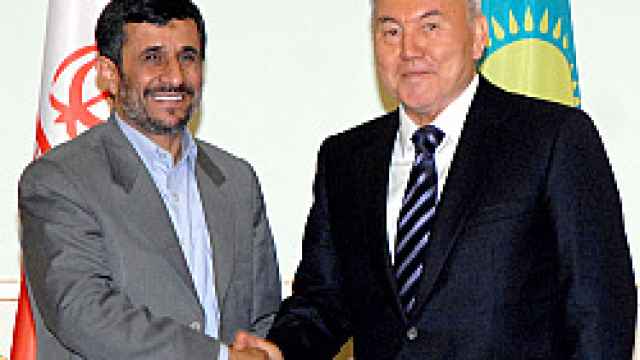 Ilyas Omarov / AP Ahmadinejad meeting with Nazarbayev in Astana, Kazakhstan, on April 6. |  |
| |
Only one proposal has money behind it already, however -- the idea advanced by the Nuclear Threat Initiative, a Washington-based organization founded by philanthropist Ted Turner and former U.S. Senator Sam Nunn.
Calling it an "investment in a safer world," investor and initiative adviser Buffett pledged $50 million to such a bank, provided that governments put up an additional $100 million. That threshold was passed in March, with most of the money coming from the United States and the European Union.
The $150 million would buy enough low-enriched uranium to fuel a 1,000-megawatt power plant, jump-starting a constantly replenished fuel stockpile that would be owned and sold by the IAEA at market prices and on a nondiscriminatory basis.
On April 6, the day after Obama's address, another piece of that picture fell into place when another president spoke in Astana, the capital of Kazakhstan. "If a nuclear fuel bank for nuclear energy was created, then Kazakhstan would consider hosting it," Kazakh President Nursultan Nazarbayev said.
Nazarbayev is eager to develop his nuclear industry, which is based on Soviet-era facilities and Kazakhstan's large uranium deposits.
"It has a lot of qualifications," Nunn said of Kazakhstan. "It would be highly symbolic to put the fuel bank in a country that got rid of nuclear weapons."
He said he first approached the Kazakh leader about hosting a fuel bank "a couple of years ago." By this May 5, Nazarbayev's foreign minister was in Washington discussing the plan with Obama's national security adviser.
Most intriguing, perhaps, is the fact that Nazarbayev's announcement came with Iran's visiting president, Mahmoud Ahmadinejad, standing at his side. The Iranian called the fuel bank "a very good proposal."
Iran isn't likely to give up its controversial fuel facilities, which some fear could lead to an Iranian bomb. But Nunn said a Kazakh or other multinational fuel bank, by involving Iran in an enterprise with international oversight, "could be a very useful tool, not the whole answer, but part of an answer" to what he called "the Iranian challenge."
The Nuclear Threat Initiative proposal may be put on hold until September while IAEA governors next month consider a Russian plan that is more developed and less ambitious, since it doesn't put the IAEA into the fuel sales business. Instead, the Russians would maintain their own fuel stockpile at a Siberian enrichment plant, which they would make available via the IAEA, "depoliticizing" sales by leaving it to the UN agency to certify buyers.
ElBaradei, meanwhile, views these as early steps in a longer process that eventually would bring all new enrichment facilities under some multinational control. "It's a bold agenda," he said in March. "It's going to take some time, but I think we need to start."
A Message from The Moscow Times:
Dear readers,
We are facing unprecedented challenges. Russia's Prosecutor General's Office has designated The Moscow Times as an "undesirable" organization, criminalizing our work and putting our staff at risk of prosecution. This follows our earlier unjust labeling as a "foreign agent."
These actions are direct attempts to silence independent journalism in Russia. The authorities claim our work "discredits the decisions of the Russian leadership." We see things differently: we strive to provide accurate, unbiased reporting on Russia.
We, the journalists of The Moscow Times, refuse to be silenced. But to continue our work, we need your help.
Your support, no matter how small, makes a world of difference. If you can, please support us monthly starting from just $2. It's quick to set up, and every contribution makes a significant impact.
By supporting The Moscow Times, you're defending open, independent journalism in the face of repression. Thank you for standing with us.

Remind me later.