

"Do you agree with what you told the Supreme Court that day?" he asked, quizzing Blakey on the procedural details of a landmark anti-racketeering law.
"This court ought not to use my language in this way, as if it were a statement in a statute," Blakey responded.
"I don't mean to imply that any of your statements should be treated as law. Rather, the opposite," the questioner returned, staring pointedly at Blakey.
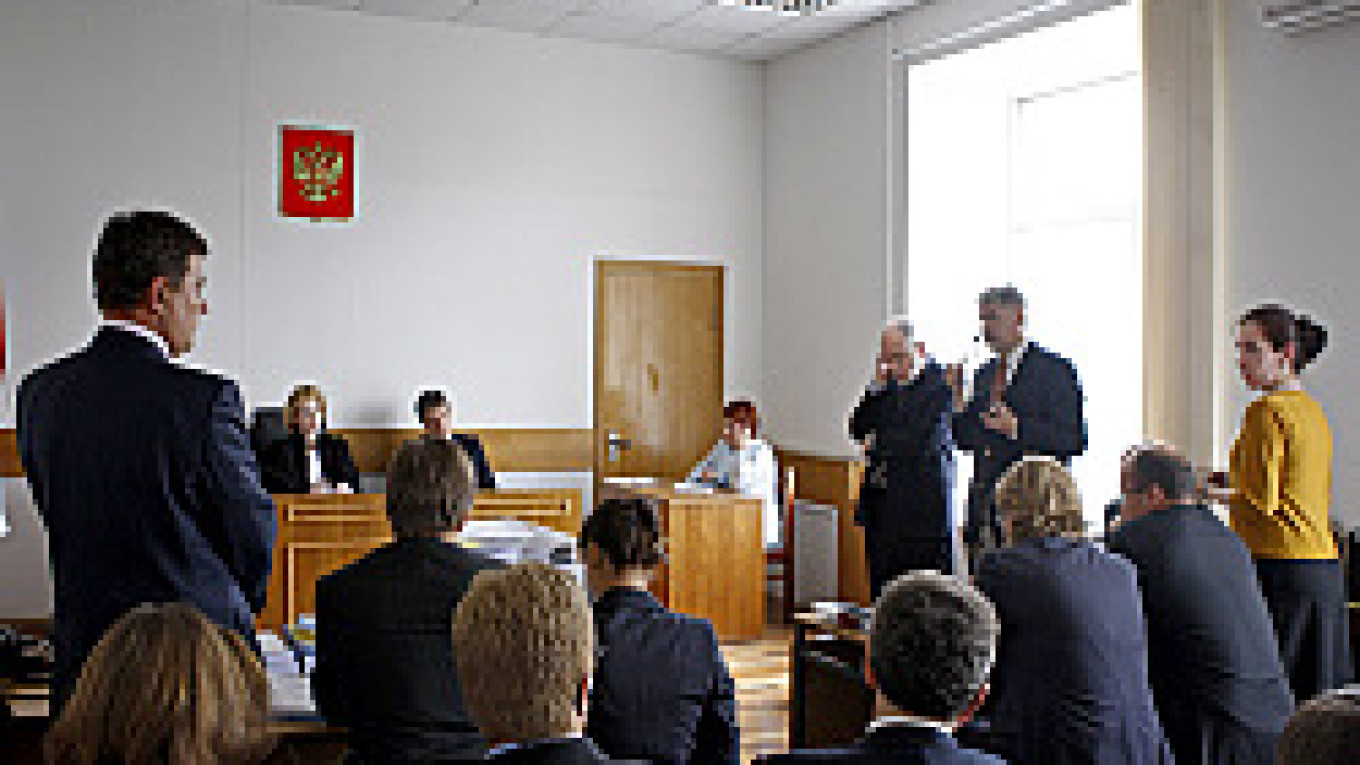
The scene ?€” with personal barbs, sharp questioning and carefully crafted responses ?€” could have come from any TV court drama. It unfolded, however, in a chilly room in the Moscow Arbitration Court, and the actors were speaking through a translator as they presented competing interpretations of U.S. law before a Russian-speaking judge.
Ivan Marisin, a Russian lawyer representing Bank of New York Mellon, was grilling Blakey, a law professor at the University of Notre Dame and one of the drafters of the U.S. Racketeer Influenced and Corrupt Organizations Act, in a $22.5 billion lawsuit brought by the Federal Customs Service.
The law, known as RICO and drafted to fight organized crime in the United States, has never been successfully argued in a foreign court, but that isn't stopping the Russian government from trying.
The suit has barely passed the starting line after 16 hearings, with Judge Lyudmila Pulova still trying to decide whether her court has the jurisdiction to hear the case. The 17th hearing is scheduled for Monday.
From 1996 to 1999, Lucy Edwards, a former vice president at Bank of New York, and her husband, Peter Berlin, used the bank to help Russian clients illegally transfer around $7.5 billion out of Russia.
In 2000, the couple pled guilty to conspiracy in a U.S. court, in what many have called the largest money-laundering operation in history. Six years later, they were sentenced to fines and restitutions of $725,000, six months of house arrest, and five years of probation.
In 2005, the bank ?€” one of the oldest in the United States ?€” paid $14 million in penalties to end two criminal investigations after admitting that it did not report and supervise suspicious transactions.
Although the bank has received immunity in the United States, the Federal Customs Service revived the case in Russia last year, arguing that the bank never compensated the Russian government for its losses.
The bank refused an initial offer to settle the claims out of court, leading the customs service to sue.
A group of Miami lawyers working for the customs service on a 29 percent contingency fee have filed the case under the civil provisions of RICO, which allow a trebling of damages.
Both sides have attracted star-studded lists of expert witnesses to debate the application of the U.S. law in a foreign court, often creating a surreal spectacle out of the high-stakes case.
In the latest hearing, on Tuesday, Alan Dershowitz, a Harvard law professor who is acting as an expert witness for the customs service, said there was nothing in RICO to prevent it from being applied in a Russian court.
"By its nature, money laundering is transnational. To limit [RICO] to the American courts ?€¦ would undercut the liberal and remedial will of Congress in enacting this statute," Dershowitz said in his testimony.
Dick Thornburgh, a former U.S. attorney general known for fighting organized and white-collar crime, said the very opposite in his written testimony, arguing that Congress never intended for the act to be applied abroad.
The hearing was also dominated by wrangling over the act's interpretation. Under a special provision, the customs service may only file for civil damages if they can prove that Bank of New York committed a crime.
The customs service claims that the bank's nonprosecution agreement with the U.S. government is sufficient evidence of a crime, citing a news release from the Justice Department announcing the deal.
Representatives of the bank contested the contents of the statement, saying it contained errors and that criminal conduct must still be demonstrated.
But because the Moscow Arbitration Court can only hear civil cases, the suit will be dismissed if it involves proving criminal acts, said Jonathan Schiller, one of the bank's lawyers. "In this court, the word crime is like kryptonite for Superman," he said.
Despite the substantial legal issues yet to be decided, the hearing focused more on witnesses' credibility and procedural sleights of hand.
Marisin, the Bank of New York cross-examiner, sought to undermine the testimony of Dershowitz, citing critical comments from a Rhode Island federal judge.
"If a U.S. federal judge doesn't consider your words trustworthy, why should we?" Marisin said.
"I'm so glad you asked this question, because I know something you don't know," Dershowitz replied. He said the federal judge, Ronald Lagueux, had been rebuked for his critique after Dershowitz filed an official complaint.
Dershowitz, who has represented such clients as O.J. Simpson and Michael Milken, was only allowed to speak after Blakey, the drafter of RICO, left the court unexpectedly in the midst of his cross-examination.
Dershowitz had flown to Russia especially to testify on behalf of the customs service.
Marisin was "categorically opposed" to letting him speak, arguing that the other side had already admitted that his testimony was not essential to their case and that the bank's experts had not been allowed to testify when they flew to the country.
"Will he just make a TV show here?" Marisin said, referring to Dershowitz. "Who is he? Is he an expert? Or a member of a theater troupe?"
After a break called to decide whether Dershowitz would be allowed to speak, a lawyer for the customs service said Blakey could not continue because he was not feeling well and that he could not appear in court to attest to his ill health.
At the end of the seven-hour hearing, the debate continued in the hallway outside the courtroom. Away from the Russian judge and translators, U.S. lawyers ?€” including Dershowitz ?€” debated with each other directly in front of reporters, in comments that became increasingly heated and personal.
Gregory Joseph, one of the bank's expert witnesses, called Blakey's illness "obviously faked."
Blakey could not be reached for comment.
"I don't like to get personal about these things, but when I'm attacked, I fight back," Dershowitz told reporters after the dispute.
The hearings are to resume Monday with the remainder of Blakey's cross-examination.
A Message from The Moscow Times:
Dear readers,
We are facing unprecedented challenges. Russia's Prosecutor General's Office has designated The Moscow Times as an "undesirable" organization, criminalizing our work and putting our staff at risk of prosecution. This follows our earlier unjust labeling as a "foreign agent."
These actions are direct attempts to silence independent journalism in Russia. The authorities claim our work "discredits the decisions of the Russian leadership." We see things differently: we strive to provide accurate, unbiased reporting on Russia.
We, the journalists of The Moscow Times, refuse to be silenced. But to continue our work, we need your help.
Your support, no matter how small, makes a world of difference. If you can, please support us monthly starting from just $2. It's quick to set up, and every contribution makes a significant impact.
By supporting The Moscow Times, you're defending open, independent journalism in the face of repression. Thank you for standing with us.

Remind me later.