

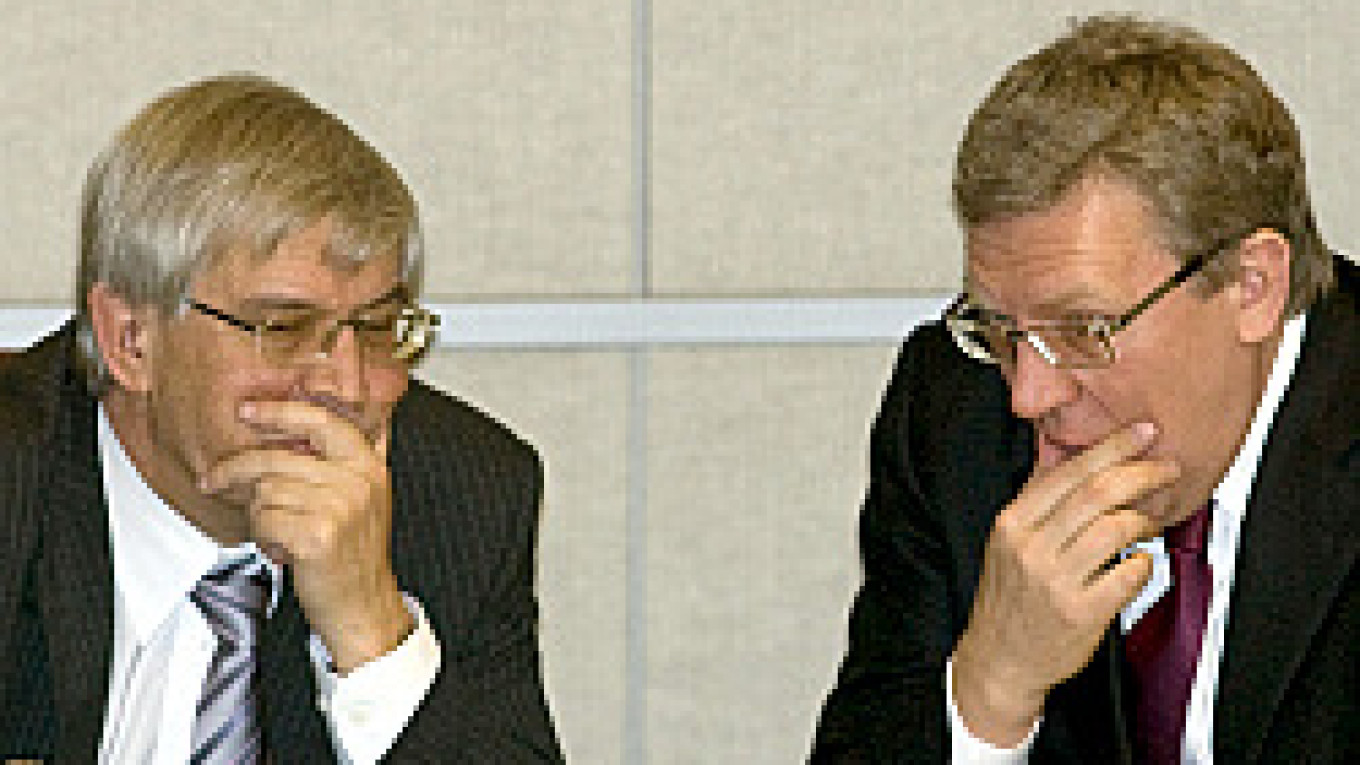
Central Bank Chairman Sergei Ignatyev said the bank had spent $57.5 billion in the currency market to shore up the ruble in September and October.
The bank also spent $14 billion as part of the government's program to assist banks. The reserves fell another $30.1 billion because the ruble has followed the euro closer than the dollar but is pegged to a multicurrency basket.
Finance Minister Alexei Kudrin told the Duma during the same session that he had supported the Central Bank's easing of the ruble.
"We paid for stability," Kudrin told lawmakers, Reuters reported.
"The Central Bank is carrying out a mild widening of the ruble corridor. This is normal, this will allow us to keep the exchange rate stable and to spend less reserves."
Kudrin also told the parliament that the government had already spent $3.28 billion of the National Welfare Fund to support domestic stock and bond prices. This represented 18 percent of the fund, he said.
The state maintains two rainy-day funds: the National Welfare Fund, a sovereign oil fund for discretionary expenditures, and the Reserve Fund, established to safeguard the federal budget in the event of an energy price drop.
The funds were created with tax revenues on windfall oil profits as world energy prices had soared in recent years.
Kudrin said the government might spend more than 500 billion rubles from the Reserve Fund next year to maintain spending amid an economic slowdown and low world oil prices.
The purchases on the securities markets have been made through Veneshekonombank, also known as the Development Bank, which took a deposit of 170 billion rubles ($6.2 billion) from the National Welfare Fund to be spent on a national bailout two weeks ago, Reuters reported.
"We expect significant revenue from investing the National Welfare Fund in local stocks and bonds,'' Kudrin said, Bloomberg reported. He added that this would come despite the fact that some investments could initially fall in value and that the country had earned $6 billion from investing the oil funds since the beginning of the year.
Arkady Dvorkovich, the Kremlin's top economic aide, advised that investors holding shares in Russian companies should hold on to the stocks.
"I know the plans and potential of Gazprom, Rosneft and the private companies operating on this market," Dvorkovich said at a United Russia media event Wednesday, Interfax reported. "Long-term investment in these, if money is not needed in a week, in a month or in three months, is profitable and may yield results."
Russia's foreign reserves, which stood at about $475 billion on Nov. 7, according to Bloomberg, have fallen by $122.7 billion since early August.
The $57.5 billion that Ignatyev referred to Wednesday was $7 billion more than three weeks ago, said UralSib chief economist Vladimir Tikhomirov.
"It's a quite sizeable amount, but compared to the overall size of the reserves it is not that much to spend," Tikhomirov said.
He called the news "obviously negative, but not catastrophic," adding that the numbers came as no surprise given significant recent capital outflows.
Investors were at least happy to get a breakdown of Central Bank expenditures.
"From the market's standpoint, the more transparency, the better," said Alexei Moisseyev, head of fixed income research at Renaissance Capital.
On Wednesday, Kudrin told lawmakers that the National Welfare Fund held $61.2 billion and the Reserve Fund held $131.3 billion as of Monday, for a total of $192.5 billion. That total was almost $5 billion lower than the $197.4 billion figure on Nov. 1.
Kudrin offered a positive projection, saying overall inflation should fall to about 8 percent. Ignatyev told the Duma that the current rate was at about 13 percent or 14 percent. The World Bank said in a report released Tuesday that reducing inflation below 12 percent next year would be "difficult."
It also appears likely that the ruble will continue to lose value.
"The ruble has declined much less than most other commodity currencies," Moisseyev said. "Therefore, it has some catching up to do."
A Message from The Moscow Times:
Dear readers,
We are facing unprecedented challenges. Russia's Prosecutor General's Office has designated The Moscow Times as an "undesirable" organization, criminalizing our work and putting our staff at risk of prosecution. This follows our earlier unjust labeling as a "foreign agent."
These actions are direct attempts to silence independent journalism in Russia. The authorities claim our work "discredits the decisions of the Russian leadership." We see things differently: we strive to provide accurate, unbiased reporting on Russia.
We, the journalists of The Moscow Times, refuse to be silenced. But to continue our work, we need your help.
Your support, no matter how small, makes a world of difference. If you can, please support us monthly starting from just $2. It's quick to set up, and every contribution makes a significant impact.
By supporting The Moscow Times, you're defending open, independent journalism in the face of repression. Thank you for standing with us.

Remind me later.