

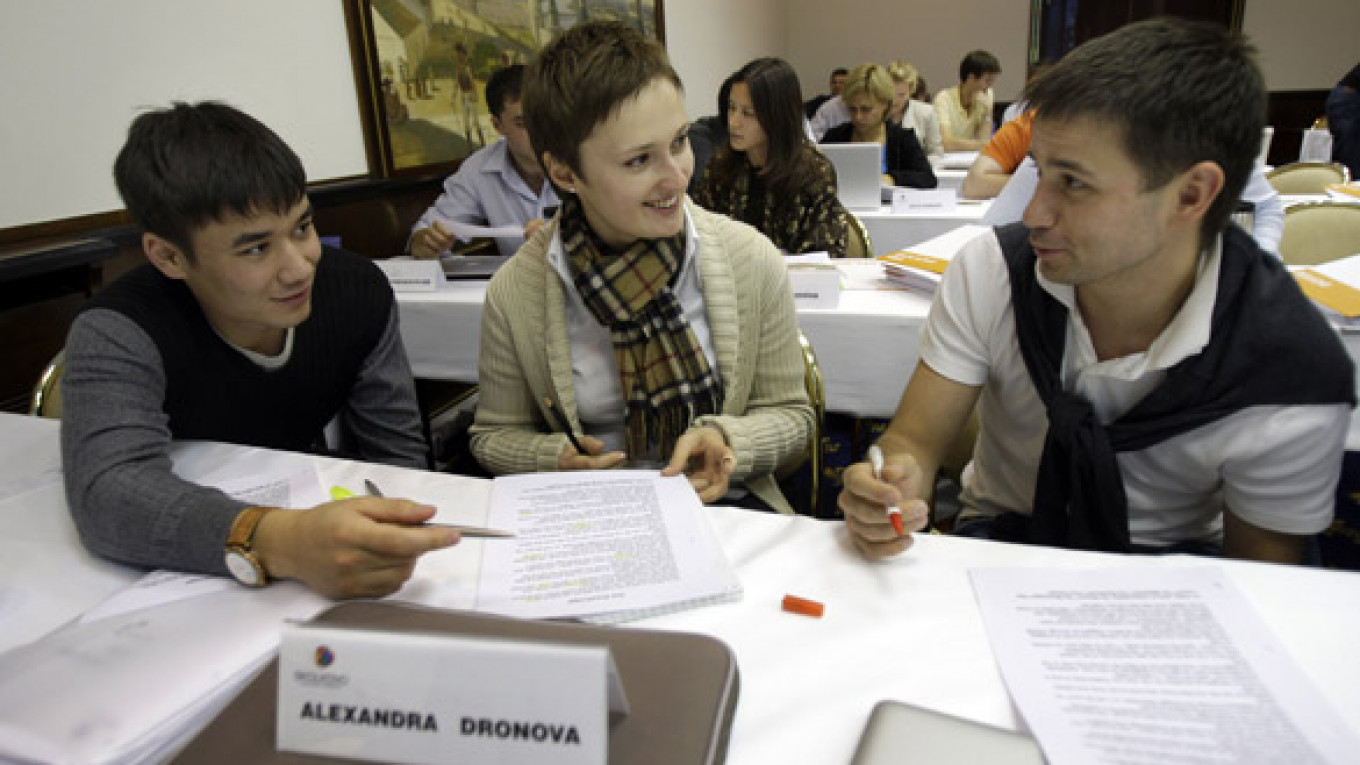
A handful of top business figures have created an MBA program that tackles the issues that they faced themselves: bribery, relentless bureaucracy, imperfect laws.
Supporters of the Moscow School of Management Skolkovo say it will fill an important niche by getting students ready for the unpredictable, sometimes corrupt world of emerging market economies.
“We’d like to change the whole model,” said Dean Wilfried Vanhonacker. “It doesn’t make sense for us, nor are we interested in competing with Harvard. That’s a business school of the past, I have to say. But a business school of the future has to be different.”
With construction not quite finished on its $250 million glass-and-steel campus just outside Moscow’s city limits, the school last month launched its full-time, 16-month master of business administration degree program, with classes temporarily in the five-star Baltschug Kempinski hotel near the Kremlin.
Vanhonacker, former director of the doctorate program at France’s prestigious INSEAD business school, said developing economies hold out the biggest opportunities. But business schools don’t prepare students to work in them.
“We looked, and we didn’t see any business school preparing this talent, even though in most corporate sectors this is where we expect the growth to come from,” Vanhonacker said.
Skolkovo includes classroom courses in management theory, but invites dozens of guest speakers to provide the students with real-life examples of the challenges of emerging economies. And part of their training consists of working in real companies solving real-world problems.
After three months of studying management theory, students are placed with a government department or company in Russia, China, India or the United States. “It’s learning by doing, not learning by acting or playing,” said Serge Hayward, MBA program director.
Hayward said he is considering asking officials in police agencies and private security firms to speak to the business students, and might even invite an organized crime boss to talk about the challenges of management. “We’re trying to put them in an environment where they are going to function rather than tell them about this environment,” he said.
One of the aims of throwing students into the world of business and government, Vanhonacker said, is to break down their preconceptions. “We want to shock them that there is a reality out there which is very different from what they think it is,” he said.
On a recent day, 40 students in their 20s and 30s, most in casual dress such as sports shirts and jeans, listened intently to Professor Pierre Casse lecture on leadership. Casse used a hypothetical murder case to illustrate how judgment depends on one’s own point of reference and how leadership is about rallying people around one reference point.
Student Julia Davis, an American, said she chose the Moscow school because it is a “forward-looking” institution that has no preconceived notion of either business education or the nature of the global economy.
Davis said she was glad to find Skolkovo instructors talking about topics rarely discussed in conventional MBA classrooms — such as corruption, flawed legislation, powerful bureaucracies and the role of ruling parties in running emerging economies.
Among the patrons are some of the Russian business world’s biggest names: Ruben Vardanian, founder of the Troika Dialog investment bank, and billionaire Roman Abramovich, as well as global companies such as Credit Suisse and industrial giants such as the Severstal steelmaker.
President Dmitry Medvedev, who has spoken of the need to combat corruption, sits on the advisory board and spoke at the program’s inaugural ceremony. Vardanian said only private money is involved, but approval from higher authorities has spared the project bureaucratic hurdles that it might have otherwise faced.
Abramovich, the investor and owner of the Chelsea football team, donated 26 hectares of choice land outside Moscow for the construction of the gleaming $250 million campus, which has its own helipad.
Several of the Russian students will work as consultants to the government and are braced for a major challenge. “I want to understand how one can manage to work in the Russian government, how one can bring in new things and get adapted without sinking to the lows of bureaucracy,” student Alexandra Dronova said.
Skolkovo faculty members said they avoid moral judgments and offer no ready-made strategies for handling corruption and predatory practices.
“It’s up for everyone to make their own choice because they need to realize that they will be competing against a company that will be giving bribes and they won’t,” Vardanian said. “Their company will need to be more efficient than the one that will be giving bribes, or they’ll lose.”
Other business schools do offer some focus on emerging markets. France’s INSEAD, for example, offers fieldwork in China, India and the Middle East. Loic Sadoulet, academic director of the INSEAD Africa Initiative, said one optional course focuses on developing countries and deals with such issues as foreign direct investment, corruption and health.
Although there are MBA programs running at a handful of universities in Russia, few of them attract globally renowned teachers, and most are taught in Russian. Classes at Skolkovo are conducted in English, the business world’s lingua franca.
Skolkovo’s training doesn’t come cheap. Fees for a full-time MBA, including accommodation, flights to India, China and the United States, come to 50,000 euros ($74,000), comparable to prices at leading business schools globally. The sum will sound daunting for many in Russia, where a monthly salary averages 18,000 rubles ($590) across the country and 33,000 rubles in Moscow. Loans are available.
Dronova said she chose Skolkovo because she wanted an education relevant to life in Russia.
“I specifically wanted to get an MBA in Russia,” she said. “There’s not much point to be educated somewhere in the States. There are excellent schools there, but how do you apply this in Russia?”
A Message from The Moscow Times:
Dear readers,
We are facing unprecedented challenges. Russia's Prosecutor General's Office has designated The Moscow Times as an "undesirable" organization, criminalizing our work and putting our staff at risk of prosecution. This follows our earlier unjust labeling as a "foreign agent."
These actions are direct attempts to silence independent journalism in Russia. The authorities claim our work "discredits the decisions of the Russian leadership." We see things differently: we strive to provide accurate, unbiased reporting on Russia.
We, the journalists of The Moscow Times, refuse to be silenced. But to continue our work, we need your help.
Your support, no matter how small, makes a world of difference. If you can, please support us monthly starting from just $2. It's quick to set up, and every contribution makes a significant impact.
By supporting The Moscow Times, you're defending open, independent journalism in the face of repression. Thank you for standing with us.

Remind me later.