

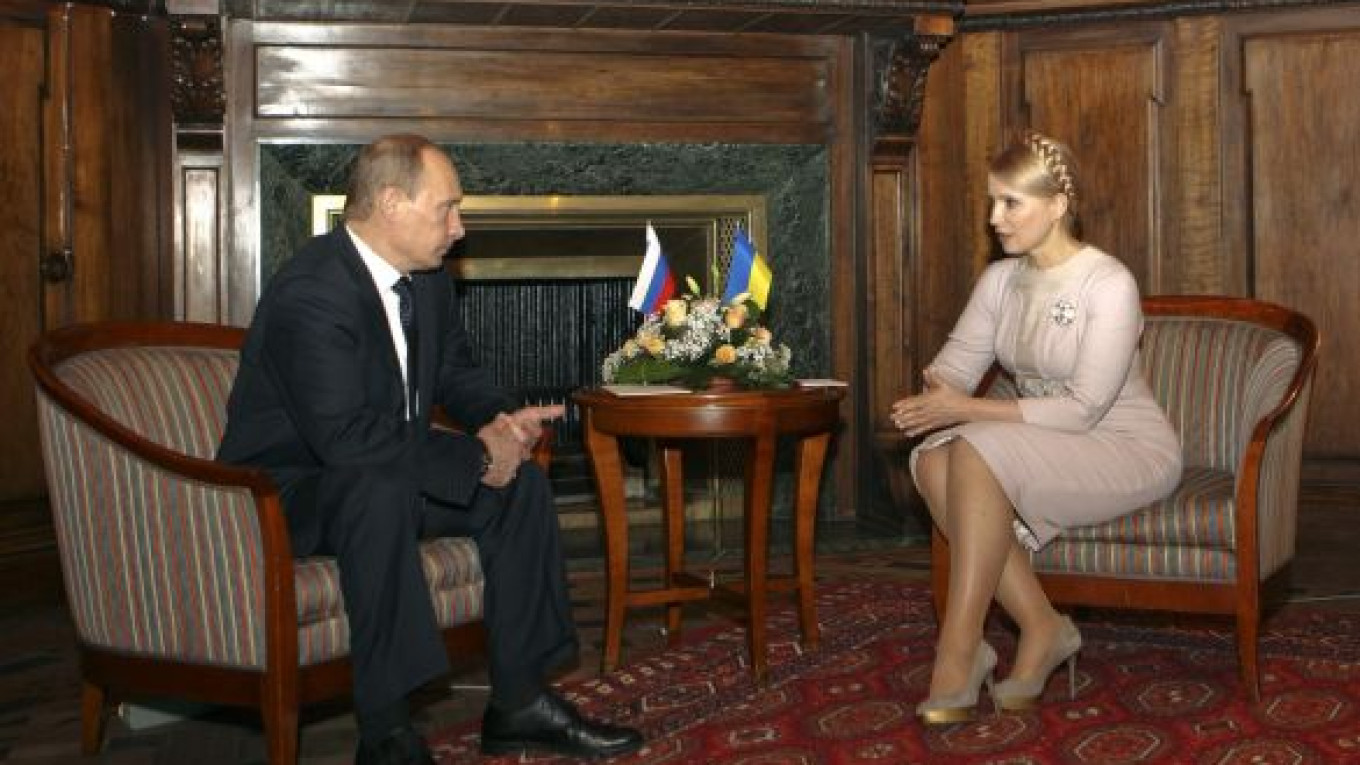
Prime Minister Vladimir Putin and his Ukrainian counterpart, Yulia Tymoshenko, began talks Thursday that the European Union hopes will avert a possible new conflict disrupting supplies of Russian gas to EU consumers.
Even before they met, the Kremlin snubbed Ukrainian President Viktor Yushchenko, who had called for a revision of a gas agreement brokered by the two leaders early this year and it accused Kiev of trying to blackmail Russia and Europe over energy supplies.
Following are details of the January contract between Gazprom and Naftogaz Ukrainy
- The contracts on Russian gas supplies to Ukraine and the transit of Russian gas to Europe via Ukraine were signed separately and are independent of each other.
Gazprom, which supplies Europe with a quarter of its gas needs, says separate contracts will help prevent any future severance of European supplies in the case of future gas pricing disputes with Ukraine.
- Under the transit contract, Gazprom pays Ukraine the discounted transit fee of $1.70 for transporting 1,000 cubic meters 100 kilometers. From Jan. 1, 2010, the transit fee will reach market levels and will be calculated according to a general European formula. It should reach about $2.67-$2.72, according to Gazprom and Naftogaz.
Gazprom agreed to export up to 120 billion cubic meters of gas to Europe via Ukraine in 2009 but said later that volumes could be smaller because of a drop in European demand and as customers preferred to buy cheaper liquefied natural gas.
- Under the supply contract, Ukraine pays the European market price with a discount rate of 20 percent. That brought the gas price for Ukraine to $360 per 1,000 cubic meters in the first quarter of 2009, $273 in the second quarter, $198 in the third quarter and $208 in the fourth quarter.
The price should reach full European market level from Jan. 1, 2010.
Gazprom had been due to export 40 billion cubic meters of gas for Ukrainian consumption in 2009 but Putin later agreed not to impose fines on Ukraine for low gas purchases after Tymoshenko said the country would not need more than 25 bcm. The issue could still cause tensions as new volumes have never been agreed on paper.
By comparison Ukraine bought 49 bcm in 2008 and paid $8.6 billion.
- Both contracts are valid from 2009 until 2018.
- The contracts state that Gazprom and Naftogaz deal directly with each other, eliminating intermediaries.
— Reuters
The deal last January ended a conflict over gas pricing that led to Russian gas flows to Europe via Ukraine being halted for two weeks in midwinter.
But relations between Russia and its neighbor have slid further in the run-up to a presidential election on Jan. 17, and the outcomes of the talks in Yalta are difficult to anticipate.
Putin and Tymoshenko were still meeting in private late Thursday in the Livadia Palace, which also hosted the famed Yalta Conference in 1945, where the Allies discussed the fate of postwar Europe.
Tymoshenko met Putin on the street and the two prime ministers shook hands in front of their countries flags ahead of the talks, Interfax reported.
The gas deal has become mired in infighting in Ukraine between Tymoshenko and Yushchenko, her political rival.
Though Ukraine has so far settled all its bills on time, Tymoshenko has conceded that, given the dire state of the economy, meeting the monthly payments for gas is a struggle.
She says however that the 10-year supply contract agreed with Russia does not have to be revised and provides for stable supplies of gas in 2010.
Putin, though, has raised the temperature around the talks with a warning that Russia will cut gas deliveries again if Ukraine stops paying on time or siphons off transit gas.
A Putin aide said Wednesday that the prime minister, who is taking with him a heavyweight team including Gazprom CEO Alexei Miller, was “pressing all the pedals” in an attempt to sort out gas problems with Ukraine.
Russian supplies across Ukraine provides Europe with a fifth of its gas and earlier this week an anxious EU agreed with Russia an “early warning” mechanism to shield Europe from potential energy supply cuts in the event of further cuts.
Just hours before talks were due to start, Yushchenko, who has constantly sniped at Tymoshenko for accepting last January’s deal, appealed to President Dmitry Medvedev to revise the agreement which he said was too onerous for the Ukrainian economy.
He believes the price accepted for Russian gas was too high while transit fees coming to Ukraine were pitched too low.
In an open letter to the Kremlin chief, published on his web site, Yushchenko said, “Keeping the contracts unchanged … will create potential threats specifically to the reliability of supplies of gas to Ukraine and its transit to other European states.”
But Kremlin aide Sergei Prikhodko, speaking to journalists in Moscow, poured scorn on Yushchenko’s plea.
Ridiculing Yushchenko and Tymoshenko for constantly contradicting each other, he said, “We are categorically against energy security in Europe becoming dependent on the personal ambitions of Ukrainian politicians.”
“The attempt to intimidate Russia and Europe with forecasts of a crisis in the transit of gas — this already looks something like political blackmail,” he said.
(Reuters, MT)
A Message from The Moscow Times:
Dear readers,
We are facing unprecedented challenges. Russia's Prosecutor General's Office has designated The Moscow Times as an "undesirable" organization, criminalizing our work and putting our staff at risk of prosecution. This follows our earlier unjust labeling as a "foreign agent."
These actions are direct attempts to silence independent journalism in Russia. The authorities claim our work "discredits the decisions of the Russian leadership." We see things differently: we strive to provide accurate, unbiased reporting on Russia.
We, the journalists of The Moscow Times, refuse to be silenced. But to continue our work, we need your help.
Your support, no matter how small, makes a world of difference. If you can, please support us monthly starting from just $2. It's quick to set up, and every contribution makes a significant impact.
By supporting The Moscow Times, you're defending open, independent journalism in the face of repression. Thank you for standing with us.

Remind me later.