

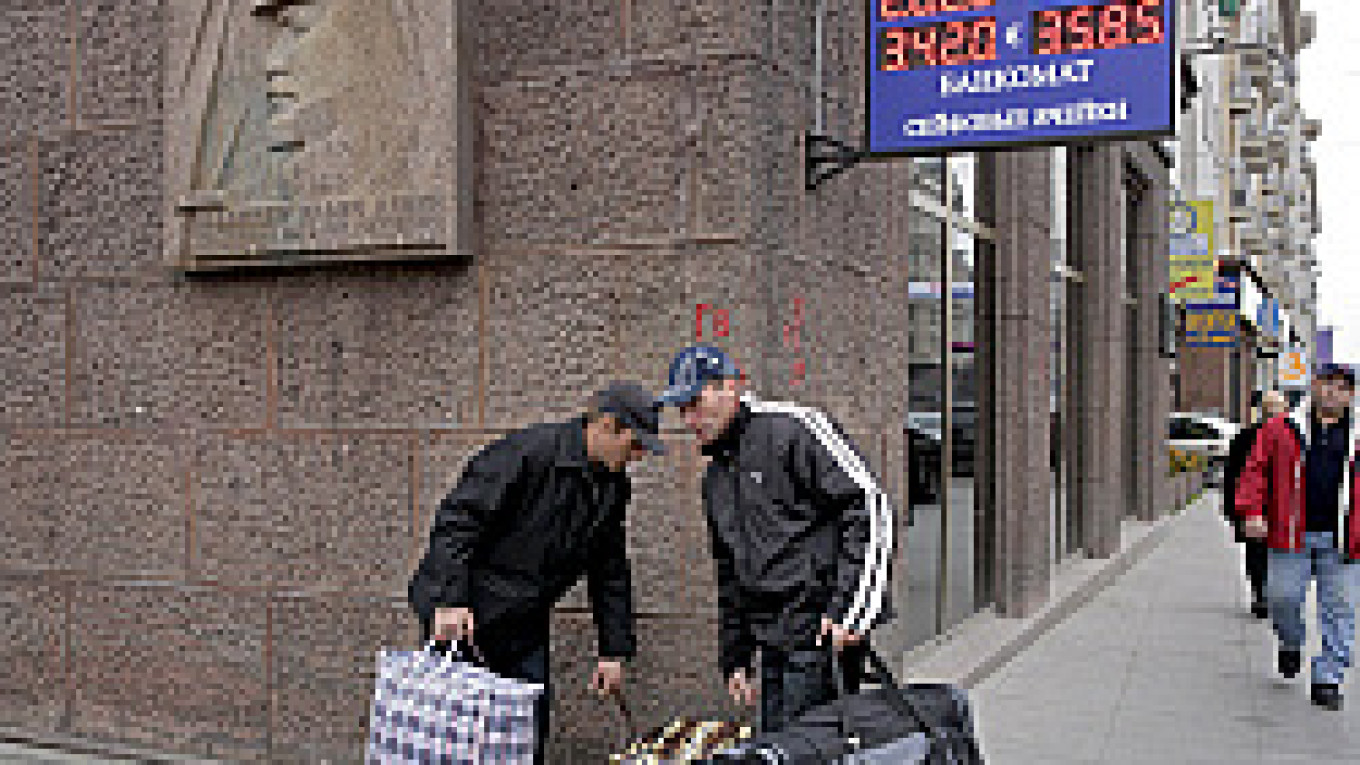
The government is pumping billions of dollars into propping up the ruble, with the Central Bank saying Thursday that it had spent a record $13 billion last week alone as ordinary Russians cashed out their rubles for dollars and euros.
The ruble started out the week at the official rate of 27.35 to the U.S. dollar, an 11 percent drop from 24.57 to the dollar on Sept. 1. The Central Bank on Friday set the official rate at 26.54.
In an apparent appeal for calm, Medvedev and Putin said this week that they would keep their savings in rubles ?€” and in the bank.
"I have kept all my accounts at the bank. I have not taken the money out, not changed rubles into dollars and not bought any shares," Medvedev told the Argumenty i Fakty newspaper.
"I am convinced that my savings ?€” and the money of other Russian depositors ?€” are not under threat," Medvedev said Tuesday in response to a reader's question.
Medvedev has savings of 2.74 million rubles ($102,675) in eight bank accounts, according to an income declaration he filed ahead of the March presidential election.
Reporters traveling with Putin to Kazakhstan on Thursday pressed him over whether he was also sticking to the ruble.
Putin said he had not touched his savings at Sberbank and VTB. "I don't see any need to change anything," he said, Izvestia reported Friday.
Asked whether he had lost any money because of the weakening ruble, he said, "I haven't had time to count, but I don't think that I've lost anything."
Putin said his savings were mainly in rubles. It was unclear how much money he has in the two banks.
Russians pulled 5.98 trillion rubles ($225 billion) out of their bank accounts in September, representing 1.5 percent of all savings, the Central Bank said this week. Anecdotal evidence suggests that the trend picked up pace in October. Newspapers are rife with reports of people spending their savings on cars and furniture as a hedge against a depreciated ruble.
But Putin's spokesman Dmitry Peskov described the exchange of rubles for other currencies as "insignificant" and said it was "triggered by an emotional reaction" rather than by any real threat of ruble depreciation.
"There will be no acute fluctuations of the ruble rate," Peskov said.
A Central Bank spokeswoman said the best advice she had for ordinary depositors worried about a depreciating ruble was to "stay calm."
Banking analysts said it was next to impossible to predict what would happen to the ruble but expressed confidence that the government would do all within its power to keep it stable.
Natalya Orlova, chief economist at Alfa Bank, said people should keep their savings in the currency that they mainly use. "For example, if a person travels abroad a lot, he should keep it in a foreign currency," she said.
Alexei Moiseyev, managing director at Renaissance Capital, said savings could be kept in the currency used to pay debts. That way, a person who makes apartment mortgage payments in rubles should keep his savings in rubles. Alternatively, Moiseyev said, a person could create a currency basket of rubles, dollars and possibly other currencies in the bank.
"The last thing you should do is rush to a currency exchange booth," he said. "You will lose on exchange operations more than you will gain."
People waiting to exchange money at several currency exchange booths in central Moscow said they were not particularly worried about a weaker ruble.
"I am not really afraid to lose my money because I have little," said Alisa Borisova, a pensioner, outside a currency exchange booth on Smolensky Bulvar.
Sergei Filatov, a middle-aged engineer who keeps his savings in dollars, said at a currency exchange booth on Ulitsa Butyrskaya that he was planning to exchange his dollars into rubles "in case the dollar keeps falling."
Alexandra Odynova contributed to this report.
A Message from The Moscow Times:
Dear readers,
We are facing unprecedented challenges. Russia's Prosecutor General's Office has designated The Moscow Times as an "undesirable" organization, criminalizing our work and putting our staff at risk of prosecution. This follows our earlier unjust labeling as a "foreign agent."
These actions are direct attempts to silence independent journalism in Russia. The authorities claim our work "discredits the decisions of the Russian leadership." We see things differently: we strive to provide accurate, unbiased reporting on Russia.
We, the journalists of The Moscow Times, refuse to be silenced. But to continue our work, we need your help.
Your support, no matter how small, makes a world of difference. If you can, please support us monthly starting from just $2. It's quick to set up, and every contribution makes a significant impact.
By supporting The Moscow Times, you're defending open, independent journalism in the face of repression. Thank you for standing with us.

Remind me later.