

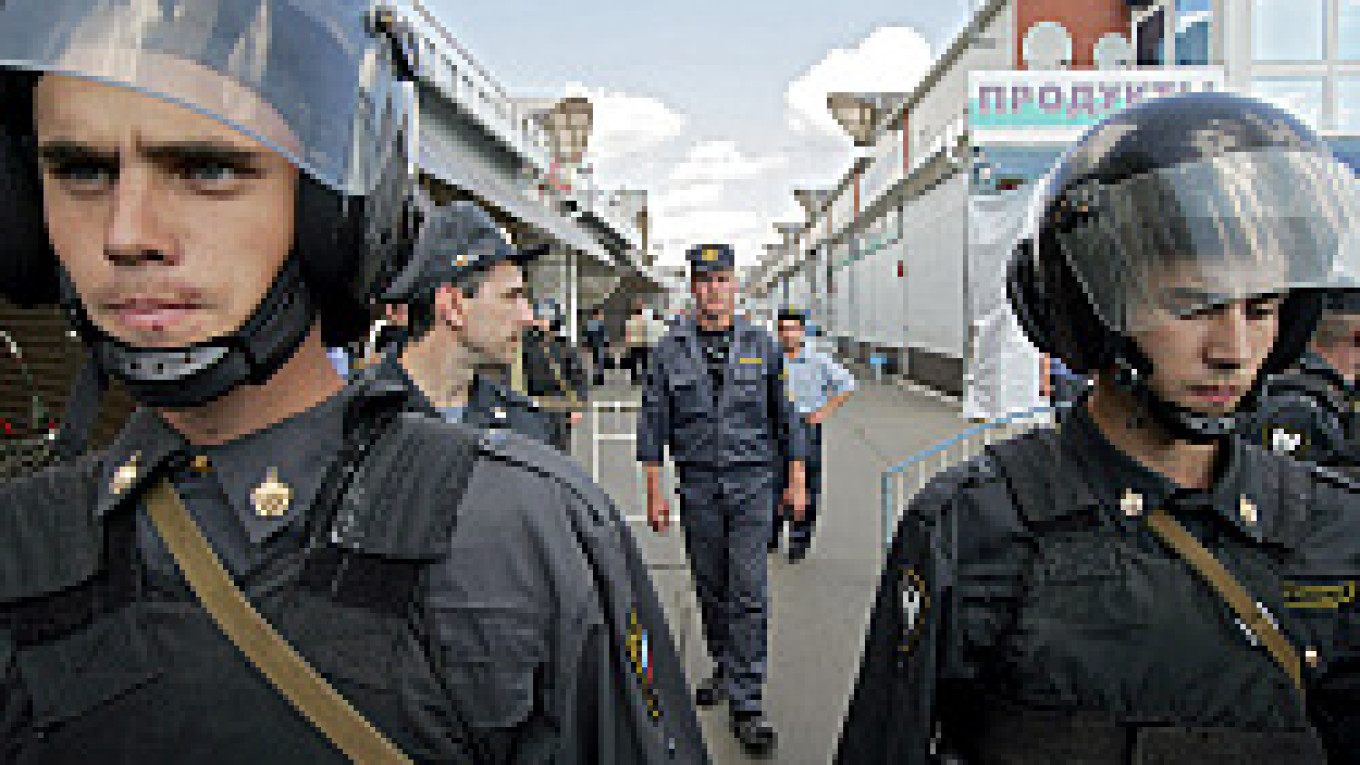
Nikolai Yevtikhiyev, prefect of the Eastern Administrative District, where the market is located, said the complex was closed temporarily so its multimillionaire owner, Telman Ismailov, could fix a long list of sanitary and storage violations.
Once all of the problems are corrected, the Federal Consumer Protection Service will inspect the market again and decide when it may reopen, Yevtikhiyev said. Police will make sure that the market remains closed, including denying entry to "what some estimate to be the 5,000 buses that arrive there every day," he said.
Also on Monday, the Investigative Committee sent a message to Mayor Yury Luzhkov asking him "to eradicate the circumstances" that led to the sale of smuggled goods, committee spokesman Vladimir Markin said.
"Extending the operations of the markets run by [Ismailov's] AST Group will lead to more crimes being committed, since the commercial activity there is not being adequately supervised by the market's administrators or Moscow's consumer protection department," Markin told Interfax. He said the market showed signs of "many violations of migration, civil, administrative and criminal law."
AST and Cherkizovsky were not immediately available for comment.
Earlier this month, Luzhkov -- reportedly a friend of Ismailov who in May attended the opening of the businessman's $1.5 billion hotel in Turkey -- promised to shut down the market by the end of the year.
City Hall first announced plans to close the market in 2007, but the deadline has been repeatedly pushed back.
Fourteen people were killed in a bomb blast at the market in 2006, which authorities blamed on ultranationalists. Eight people were convicted last year for their roles in the attack.
Last week, Investigative Committee head Alexander Bastrykin vowed to shutter the market, calling it a "disgrace in the center of Moscow" and a "hellhole" that existed almost entirely outside the law.
"It is a state within a state," Bastrykin said at a prosecutor's conference in Kazan. "It has its own police, its own customs service, its own courts, its own prosecutor and stand-alone infrastructure, including brothels.
"There is everything you need there," he said. "Some people spend a year without leaving it."
Earlier this month, police arrested seven people suspected of smuggling 1 billion rubles ($32 million) worth of consumer goods headed for Cherkizovsky, and a raid on the market in September resulted in the confiscation of a record $2 billion in smuggled goods.
The September raid went relatively unnoticed until Putin criticized officials at a government meeting on June 1 for a lack of results.
"A result would be to send people to jail -- but where are the convictions?" Putin said.
A Message from The Moscow Times:
Dear readers,
We are facing unprecedented challenges. Russia's Prosecutor General's Office has designated The Moscow Times as an "undesirable" organization, criminalizing our work and putting our staff at risk of prosecution. This follows our earlier unjust labeling as a "foreign agent."
These actions are direct attempts to silence independent journalism in Russia. The authorities claim our work "discredits the decisions of the Russian leadership." We see things differently: we strive to provide accurate, unbiased reporting on Russia.
We, the journalists of The Moscow Times, refuse to be silenced. But to continue our work, we need your help.
Your support, no matter how small, makes a world of difference. If you can, please support us monthly starting from just $2. It's quick to set up, and every contribution makes a significant impact.
By supporting The Moscow Times, you're defending open, independent journalism in the face of repression. Thank you for standing with us.

Remind me later.