

Earlier this month, Andrei Krainy, head of the Federal Fisheries Agency, tried to take a page out of the prime minister’s playbook.
In a surprise visit to a local supermarket, Krainy, along with Gennady Onishenko, the government’s chief consumer protection watchdog, said the fish they found were overpriced.
Krainy said middlemen and “retail dictators” were inflating fish processing prices by more than 100 percent and that vendors were trying to pass off cheaper kinds of fish as more expensive ones.
The visit, which came shortly after Prime Minister Vladimir Putin also paid a surprise visit to the same supermarket to rebuke retailers for high meat prices, is part of a broader government effort to reform the country’s seafood industry.
Although Russia’s fishing industry is one of the largest in the world, Russians consume on average only 12 kilograms of fish a year — half as much as Europe and North America.
While part of the disparity is because of structural problems in financing and logistics, the government is hoping it can boost seafood consumption by getting rid of the middleman and selling the fish to retailers and consumers directly.
In the fall, the government hopes to kick off a program of electronic fish exchanges and specialized fish wholesale markets and is restoring a state-owned seafood retail chain called Okean, which was popular in Soviet times.
Electronic fish exchanges may help shorten supply chains and allow fishermen to get more favorable terms. Instead of waiting for ships to return with their catch, electric exchanges allow fishermen to sell some or all of the catch before the boat even touches shore.
A returning vessel will radio a monitoring unit on shore and give them details of the catch it has on board. After the fishing authorities confirm that the boat has the rights to fish in that area, the harvest will come online on the electronic exchange. The St. Petersburg Commodities Exchange has begun trading 20 types of fish on an electronic exchange.
The government will require fishermen to sell a quarter of their catch on electronic exchanges, said Timur Mitupov, an analyst at the Russian Fishing Union, which represents the interests of producers and merchants. In return, fishermen get certain allowances, such as 10-year rights to their fishing plots.
But the wholesale markets and state-run retail chain may make the biggest difference for the consumer.
Wholesale fish markets will be
established in Moscow, St. Petersburg, Kaliningrad and Primorye. The Moscow market is expected to handle 450,000 tons annually, while the St. Petersburg market will carry 250,000 tons.

|
|
For MT
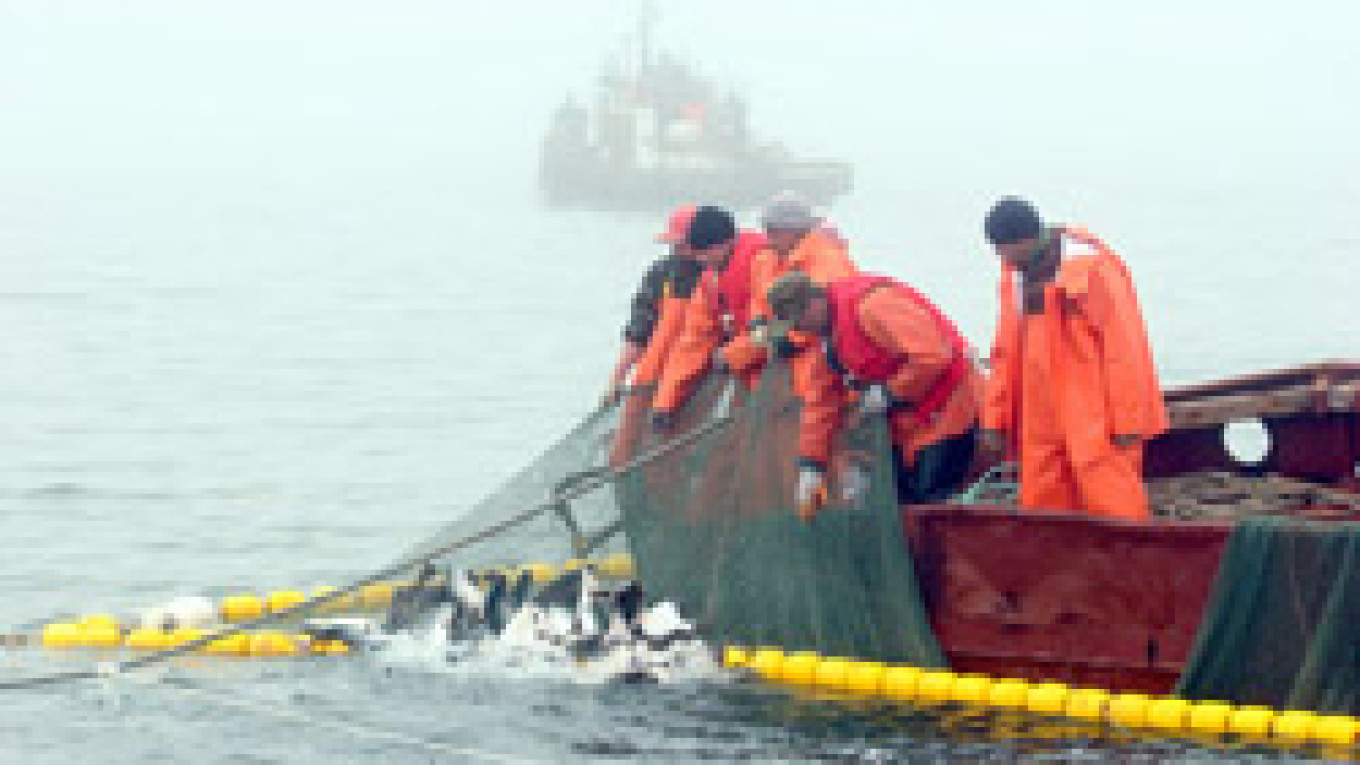
Fish exports from the Far East rose elevenfold since the start of the year. |
In addition, the fisheries agency will open the Okean chain of franchise seafood stores. The chain will include about 250 specialized fish stores that will be opened in key regions by 2012.
While the fisheries agency hopes that the wholesale markets will help reduce the role of middlemen in the industry, middlemen broadly support the initiative, saying they still provide an important service.
“Middlemen are the ones who can increase variety for retailers by purchasing large amounts and taking risks,” said Sergei Gudkov, head of the Russian Fishing Union. “Retailers will never deal directly with fish producers, as they try to buy many different kinds of fish but in small volumes. And fish producers from their side will never wait through retailer’s payment delays, which may take up to one month,” he said.
Financing and logistical issues are still the biggest problems the industry faces. And the problems are so severe that many fishermen operate on black markets, selling directly to East Asian countries where they can easily deliver their catch and obtain financing.
In January, a law went into effect requiring that fish caught in Russian waters be declared in Russian customs points. This effectively ended the common practice of transporting catches directly to Korean, Chinese or Norwegian ports, or transferring the fish to foreign barges in the middle of the ocean.
Once the law went into effect, the results were immediately apparent. In the first half of the year, the total volume of sea food exported from the Far East increased elevenfold, said Alexander Savelyev, a spokesman for the Federal Fisheries Agency. Fish that once were transported directly from Russian territorial waters to Asian markets now were taxed and accounted for as part of the Russian economy.
While the law brought much of the industry out from the shadows, systemic problems still exist that hamper its development. As much as one-fifth of the catch is still bought and sold illegally, Mitupov said.
“The international black market for Russian-caught fish arises from the inefficiency of the Russian financial system,” Mitupov said.
“‘Grandfather Li,’ as Russian fishermen call their Asian partners, can prepay for the harvest, while local banks require fishermen to mortgage their vessels. But their vessels are too worn-out to be mortgaged, making credit prohibitively expensive,” he said.
Financing problems force many fishermen to sell their product on Asian markets, despite the fact that prices for their catch are much higher on local markets.
The other big problem is a familiar one: Russia is a big country.
About 65 percent of the country’s fish resources are located in the Far East, while most consumers live in the European part of Russia, and transporting fresh fish between the distant regions can be a challenge. Typically, transporting fish from Vladivostok to Moscow can take up to two weeks, and refrigerated trains able to carry the volume are in short supply.
Most of the deliveries are made by automobile transportation, with train deliveries accounting for a paltry 17 percent of the total cargo.
Analysts estimate that of the $810 million worth of fish caught in the Far East, only a quarter could be sold in western Russia.
The Federal Fisheries Agency in January asked Russian Railways to lower its tariffs by 50 percent during the fishing season and introduce refrigerated train routes from the Far East to Moscow, the Urals and Siberia.
Refservice, a subsidiary of Russian Railways, said in July that it hopes to decrease railway delivery times to those of road transportation and aims to take 15 percent of the market share away from road transportation. But that is unlikely to be enough.
Russian refrigeration capacities are severely underdeveloped, Savelyev said. “The Korean port of Pusan alone posses refrigeration capability of about 1,200,000 tons annually, while annual capacity of Russian refrigeration complexes are about 235,000 tons,” he said.
Krainy is confident that providing new wholesale spaces for the fish industry will help overcome the hurdles the industry faces.
“The barrier of retail diktat doesn’t allow fishermen to provide cheap fish,” he said. “All the profit margins are eaten up by the resellers and traders.”
A Message from The Moscow Times:
Dear readers,
We are facing unprecedented challenges. Russia's Prosecutor General's Office has designated The Moscow Times as an "undesirable" organization, criminalizing our work and putting our staff at risk of prosecution. This follows our earlier unjust labeling as a "foreign agent."
These actions are direct attempts to silence independent journalism in Russia. The authorities claim our work "discredits the decisions of the Russian leadership." We see things differently: we strive to provide accurate, unbiased reporting on Russia.
We, the journalists of The Moscow Times, refuse to be silenced. But to continue our work, we need your help.
Your support, no matter how small, makes a world of difference. If you can, please support us monthly starting from just $2. It's quick to set up, and every contribution makes a significant impact.
By supporting The Moscow Times, you're defending open, independent journalism in the face of repression. Thank you for standing with us.

Remind me later.