

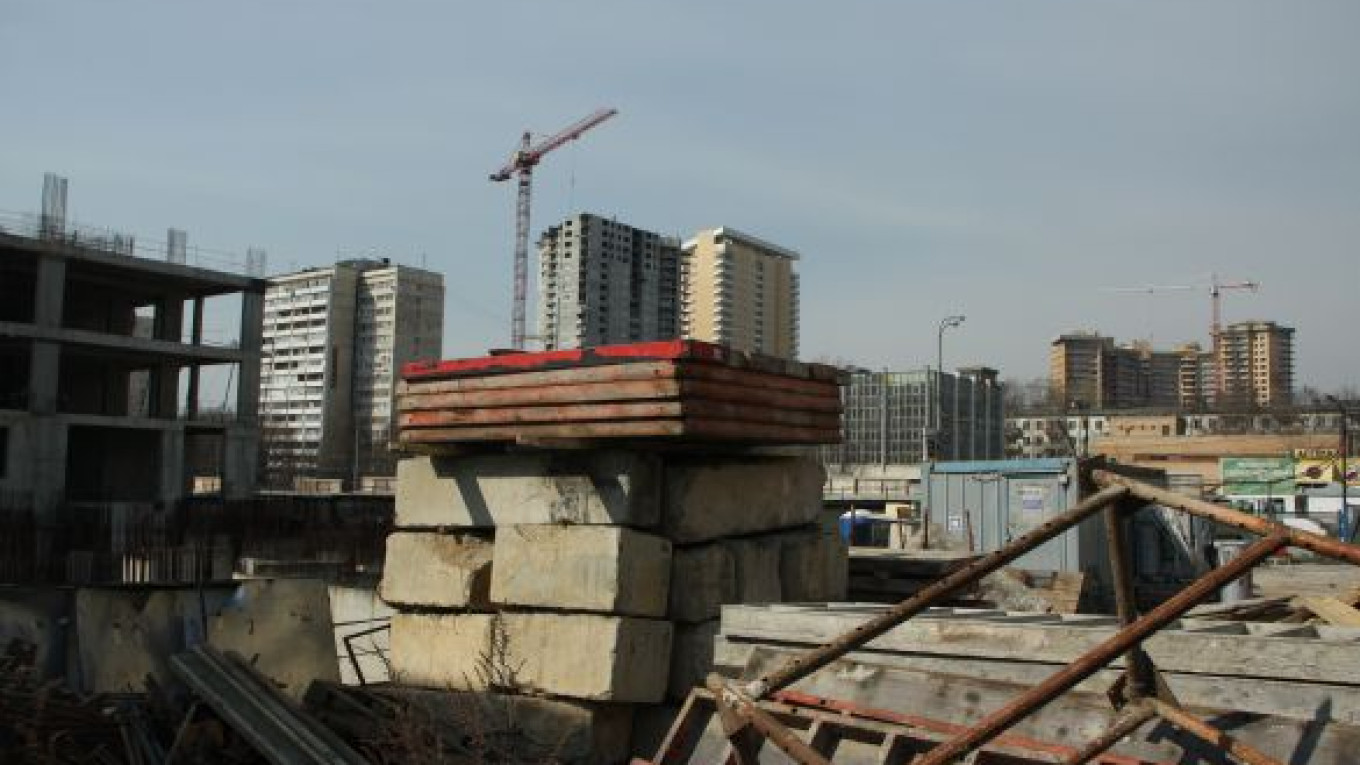
While it is becoming easier to build in Russia, administrative barriers in several regions, such as Moscow and the Moscow region, remain high, the Regional Development Ministry said.
The ministry analyzed administrative barriers to construction in a report submitted to the government on the efficiency of government agencies in 2009, a copy of which was obtained by Vedomosti.
The problems arise both in industrial and residential construction. It takes six months from the day the results of a land auction are confirmed to the moment the construction permit is granted. Builders have to wait another 22.4 months until the building can be inhabited, the ministry said. The situation is improving, but slowly: In 2007, the figures were 8.6 months and 26.5 months, respectively.
When dealing with industrial construction, builders have to wait 5.6 months for a permit to lease the land, six months for a construction permit, and another 20 months until the building is usable. The longest procedure is in the Far East, where it takes more than 10 months just to properly form the lease.
Companies must get their plans approved by 11 institutions on average, down from 13 in 2008, the ministry said. But in certain regions, construction firms must go through even more agencies. In Moscow, permission must be granted by 40 bodies, and the Moscow and Tula regions require the agreement of 25 agencies.
The ministry recommended that regional officials lower administrative barriers for builders, by reducing the time it takes to give out permits and accepting and distributing documents through a "single window." Without doing so, it will be difficult for the construction sector to recover, the ministry said.
In 2009, the amount of land under residential development decreased by one-third, the ministry said. And despite an increase in the housing supply —? from 21.5 square meters per person in 2007 to 22.4 in 2009 —? more than 40 million Russians live in homes built from 1947 to 1970, and about 35 million in ill-equipped apartments.
In 2009, Moscow passed an ordinance cutting red tape in construction, said a representative of the city's economic policy and development department. The time it takes to give out documents was cut from two months to two weeks, and the permit fee was canceled, as was the requirement that the process be repeated for small changes to the project. Builders have to go through many different agencies because building in a metropolis requires the resolution of additional infrastructure issues, he said.
After a meeting with the main construction firms in the Tula region, a program is being prepared that will reduce administrative barriers, said a spokesman for the Tula governor. Calls to a Moscow region spokesman were not answered.
Federal officials have promised to help construction firms. The Economic Development Ministry and the Regional Development Ministry have already come to an agreement on measures to simplify the process for getting construction permits, said Sergei Belyakov, director of the Economic Development Ministry's investment policy department.
Companies will also be able to get their inspections done by nonstate agencies, inspections must be completed within 60 days instead of 90, and fines will be introduced for baseless refusals or delays in handing out construction permits. Several regulatory amendments will also be made this year, Belyakov said.
For builders, Moscow's leadership in the field of administrative barriers is nothing new, said Anton Danilov-Danilyan, chairman of construction firm Rodex Group, and Mikhail Urinson, managing director of Alur.
Nor do Danilov-Danilyan and Urinson sense a reduction in red tape in other regions. In place of old regulations, new ones are put in place — for example, utilities slap on new requirements on the municipal level when it comes to connecting buildings to infrastructure, Danilov-Danilyan said. Urinson said the number of procedures does not necessarily need to be reduced. Rather, the existing ones need to be monitored more tightly.
Either way, reducing red tape will lower the costs of construction firms, but it won't lead to the rapid growth of the sector, Danilov-Danilyan and Urinson said. The main problems of the sector are expensive credit and declining demand, Danilov-Danilyan said.
A Message from The Moscow Times:
Dear readers,
We are facing unprecedented challenges. Russia's Prosecutor General's Office has designated The Moscow Times as an "undesirable" organization, criminalizing our work and putting our staff at risk of prosecution. This follows our earlier unjust labeling as a "foreign agent."
These actions are direct attempts to silence independent journalism in Russia. The authorities claim our work "discredits the decisions of the Russian leadership." We see things differently: we strive to provide accurate, unbiased reporting on Russia.
We, the journalists of The Moscow Times, refuse to be silenced. But to continue our work, we need your help.
Your support, no matter how small, makes a world of difference. If you can, please support us monthly starting from just $2. It's quick to set up, and every contribution makes a significant impact.
By supporting The Moscow Times, you're defending open, independent journalism in the face of repression. Thank you for standing with us.

Remind me later.