

President Dmitry Medvedev on Saturday will address the annual Asia-Pacific Economic Cooperation summit in Singapore, where leaders will discuss ways to spur economic recovery and Medvedev will hold a series of bilateral talks with his Asian and American counterparts.
Medvedev will carry out bilateral talks with Chinese leader Hu Jintao, Japanese Prime Minister Yukio Hatoyama and U.S. President Barack Obama, a Kremlin official said Thursday. Medvedev and Obama will also have one-on-one talks in which they will discuss a revision to the Strategic Arms Reduction Treaty, due to expire Dec. 5, the White House said.
At the APEC CEO summit Saturday, Medvedev is slated to give a keynote address, in which he will discuss priorities for action in the global economy.
The summit for heads of state comes after a week of lower-level ministerial conferences discussing ways to cement worldwide economic recovery. APEC finance ministers met Thursday and agreed to move to “market-oriented” exchange rates and keep in place huge stimulus programs for as long as it takes for the economy to completely recover.
“We will undertake monetary policies consistent with price stability in the context of market oriented exchange rates that reflect underlying economic fundamentals,” the ministers said in a statement.
China has come under increasing criticism for its pegged exchange rate, which critics say artificially props up the countries’ exporters, providing an unfair trade advantage. China’s central bank said Wednesday that it would consider major currencies in guiding the yuan, suggesting a departure from the effective dollar peg. Russia’s Central Bank has set a floating exchange rate as its long-term goal.
Nevertheless, the countries agree that sudden realignments in exchange rates are no ‘silver bullet’ for addressing economic imbalances, Shanmugaratnam said.
Separately, APEC foreign and trade ministers met on Thursday and expressed concern over a fragile global recovery and high unemployment. They promised to “lay a foundation for growth that is inclusive, balanced and sustainable, supported by innovation and a knowledge-based economy.”
Delegates also reiterated their support for Russian accession to the World Trade Organization in line with a regional push to dismantle trade barriers.
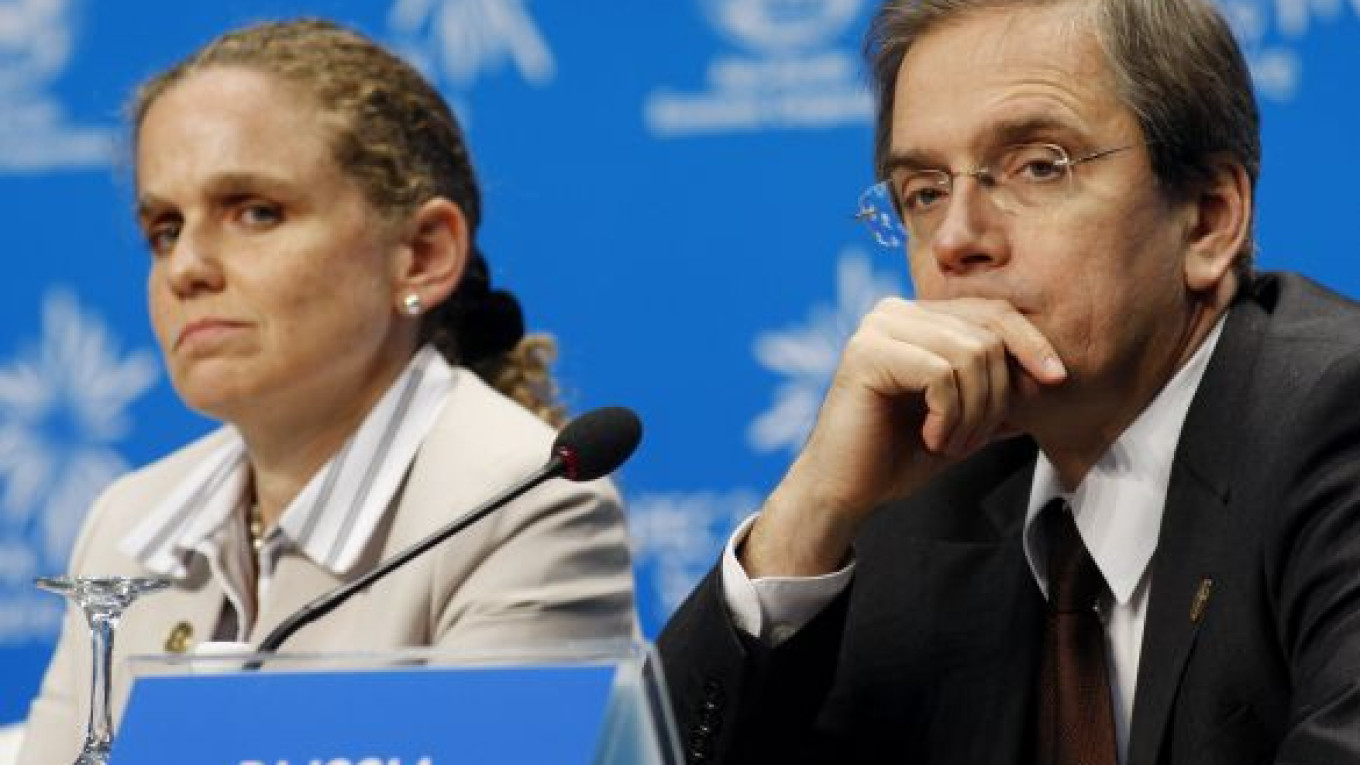
Deputy Finance Minister Dmitry Pankin headed Russia’s delegation to the finance ministers’ meeting, while Economic Development Minister Elvira Nabiullina led the country’s delegation to the foreign and trade ministers’ meeting.
Deputy Foreign Minister Alexei Borodavkin, also at the meeting, said Thursday that North Korea’s nuclear program will be the focus of multilateral talks on the summit sidelines.
“We intend to put to use possible contacts with our colleagues from China, South Korea, Japan, the United States and other countries to compare our positions on the sidelines of the summit, including [our views] on the Korean Peninsula nuclear problem,” Borodavkin said. Medvedev’s visit to Singapore is the first ever to the Pacific Rim country by a Russian head of state.
A Message from The Moscow Times:
Dear readers,
We are facing unprecedented challenges. Russia's Prosecutor General's Office has designated The Moscow Times as an "undesirable" organization, criminalizing our work and putting our staff at risk of prosecution. This follows our earlier unjust labeling as a "foreign agent."
These actions are direct attempts to silence independent journalism in Russia. The authorities claim our work "discredits the decisions of the Russian leadership." We see things differently: we strive to provide accurate, unbiased reporting on Russia.
We, the journalists of The Moscow Times, refuse to be silenced. But to continue our work, we need your help.
Your support, no matter how small, makes a world of difference. If you can, please support us monthly starting from just $2. It's quick to set up, and every contribution makes a significant impact.
By supporting The Moscow Times, you're defending open, independent journalism in the face of repression. Thank you for standing with us.

Remind me later.