

The Kremlin is concerned that Russian, once the main language throughout the Soviet Union, is losing ground to local languages and English.
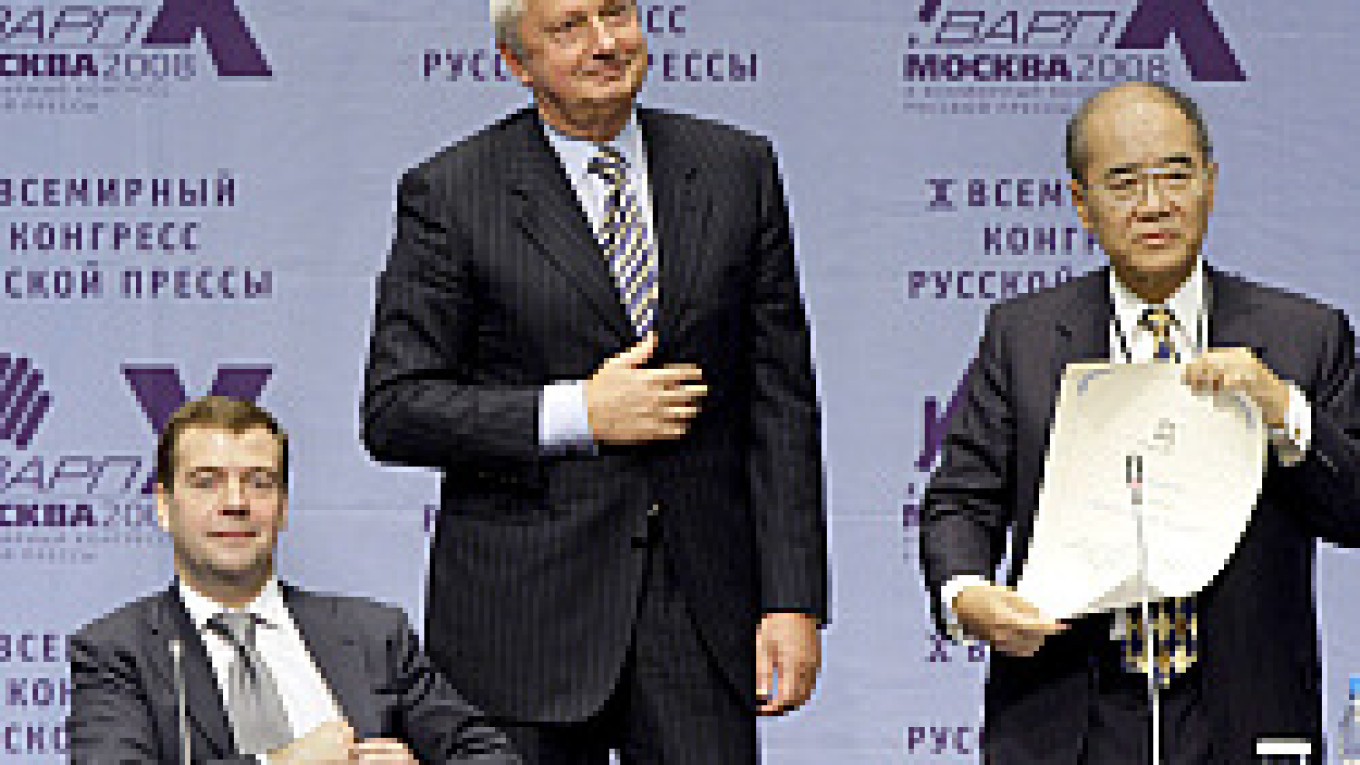
He said 300 million people worldwide used Russian media and that a Cyrillic domain name would be a key part of raising the importance of the language, a task he said was his personal priority as president. "We must do everything we can to make sure that we achieve in the future a Cyrillic Internet domain name -- it is a pretty serious thing," Medvedev told the International Congress of Russian Press in Moscow.
"It is a symbol of the importance of the Russian language and Cyrillic. ... And I think we have a rather high chance of achieving such a decision."
Medvedev has been keen to portray himself as an Internet-savvy head of state: He has publicly used his mobile telephone to connect to the Internet and says he surfs online every morning for news.
Russian Internet sites use domain names in the Latin script, as in most parts of the Internet. Addresses end either with the suffix .ru, or in some cases .su, a domain name inherited from the Soviet Union.
Industry experts say Russia wants its domain name to be .rf -- for Russian Federation -- but written in Cyrillic.
Some in the industry have raised concerns, though, that it could allow the state to control more of the content in a sphere that has remained a relatively free forum for dissent at a time when traditional media have become subject to tighter control.
A Message from The Moscow Times:
Dear readers,
We are facing unprecedented challenges. Russia's Prosecutor General's Office has designated The Moscow Times as an "undesirable" organization, criminalizing our work and putting our staff at risk of prosecution. This follows our earlier unjust labeling as a "foreign agent."
These actions are direct attempts to silence independent journalism in Russia. The authorities claim our work "discredits the decisions of the Russian leadership." We see things differently: we strive to provide accurate, unbiased reporting on Russia.
We, the journalists of The Moscow Times, refuse to be silenced. But to continue our work, we need your help.
Your support, no matter how small, makes a world of difference. If you can, please support us monthly starting from just $2. It's quick to set up, and every contribution makes a significant impact.
By supporting The Moscow Times, you're defending open, independent journalism in the face of repression. Thank you for standing with us.

Remind me later.