

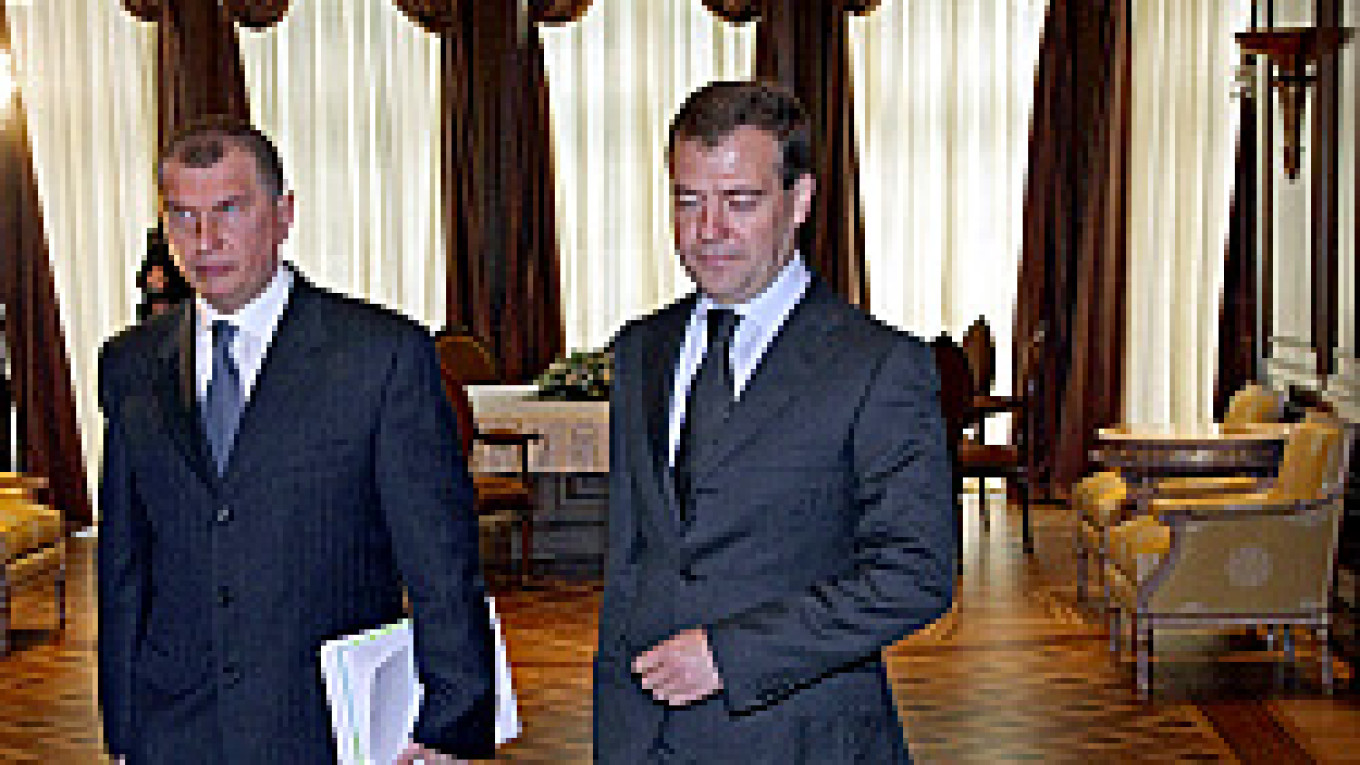
In a televised meeting with Deputy Prime Minister Igor Sechin, who oversees the energy industry, Medvedev outlined priorities for developing some of the country's richest and most-challenging oil deposits.
The government will take the unusual step of selecting companies to develop the Arctic reserves, instead of holding auctions or tenders, Medvedev said.
"The continental shelf is our national heritage," he said, signaling a move toward greater state control over the country's lucrative energy industry. "This was done consciously to ensure rational use of this national wealth."
Sechin said that only state-controlled energy companies with a minimum of five years' experience working on the continental shelf would be eligible to operate the projects, which would effectively leave just Gazprom and Rosneft.
In May, then-President Vladimir Putin signed a law establishing limits on foreign participation in sectors deemed strategic, including energy, aerospace and telecommunications.
"This is very much in the vein of this economic policy of differentiating sectors according to which are strategic, and which are not," said Yaroslav Lissovolik, chief economist at Deutsche Bank.
But analysts have questioned whether Russian majors have the necessary financing and technology to lead major offshore projects without significant foreign participation.
Despite soaring oil prices, the country's energy majors have struggled recently under the burden of high taxes, which they claim makes it difficult to invest in new fields to offset declining production. Sechin, as chairman of Rosneft, has been one of the chief lobbyists for tax cuts.
Facing its first declines in oil production in years, the government has taken concrete steps to provide a boost to the energy sector.
Earlier this month, the Federation Council approved a raft of tax breaks in the oil sector, which it is estimated will save the industry up to 140 billion rubles annually ($6 billion). The bill proposed tax holidays for companies working on the continental shelf, lasting 10 to 15 years or until output reaches 35 million tons of oil.
Rosneft chief Sergei Bogdanchikov has estimated developing the country's offshore reserves will cost 61 trillion rubles ($2.6 trillion).
Russia has been increasingly assertive in the Arctic region as global warming makes resources there more accessible. Moscow last year sent an expedition to plant a Russian flag on the seabed under the North Pole and said research indicated that a massive underwater mountain range in the area ?€” believed to contain huge oil and gas reserves ?€” was part of Russia's continental shelf.
A Message from The Moscow Times:
Dear readers,
We are facing unprecedented challenges. Russia's Prosecutor General's Office has designated The Moscow Times as an "undesirable" organization, criminalizing our work and putting our staff at risk of prosecution. This follows our earlier unjust labeling as a "foreign agent."
These actions are direct attempts to silence independent journalism in Russia. The authorities claim our work "discredits the decisions of the Russian leadership." We see things differently: we strive to provide accurate, unbiased reporting on Russia.
We, the journalists of The Moscow Times, refuse to be silenced. But to continue our work, we need your help.
Your support, no matter how small, makes a world of difference. If you can, please support us monthly starting from just $2. It's quick to set up, and every contribution makes a significant impact.
By supporting The Moscow Times, you're defending open, independent journalism in the face of repression. Thank you for standing with us.

Remind me later.