

SYZRAN, Samara Region — Integrated Energy Systems, the country’s biggest private power generator, presented a new investment program Friday that pushed back several construction deadlines, the first time a company has done so without state approval.
The announcement is the latest turn in a dispute between the government and power companies, which say lower industrial demand in the next few years means less new capacity will be needed. The Energy Ministry has insisted that generators continue with their state-approved investment plans.
IES, majority owned by billionaire Viktor Vekselberg, will invest 172 billion rubles ($5.3 billion) to build new stations from 2009 to 2015, IES chief executive Mikhail Slobodin told reporters at a new power unit in Syzran, about 900 kilometers southeast of Moscow.
The company will build 19 units with an overall capacity of around 3,000 megawatts, he said. One-third of the construction will be financed with the company’s own funds; another third — roughly 50 billion rubles — will be borrowed; and the rest will come from reinvested profit from new stations.
The Syzran unit was supposed to be finished by the end of 2010, but IES said it would not be completed before late 2011. Slobodin said the date had not been agreed with the Energy Ministry.
IES was one of three private companies that Energy Minister Sergei Shmatko reprimanded on April 16 for not investing enough in electricity assets, but the ministry took a more understanding tone on Sunday.
“We have received IES’s suggestions on changing its investment program. We are working on them now and will soon hand them down to the state commission on the generators’ investments programs, chaired by Deputy Prime Minister Igor Sechin,” ministry spokeswoman Irina Yesipova said. She could not say when a decision would be made.
Slobodin told reporters Friday that alterations to generators’ investment programs, including deadlines and location, would be agreed on by Sept. 1.
All the private generators that took part in the privatization of Russia’s electricity system accepted obligations to build new power stations by fixed deadlines or face a fine of 25 percent of their investment program. Of the 19 units IES plans to build, 14 are mandatory.
In the program presented Friday, IES pushed back deadlines for a number of stations for one or two years, including the Novokuibyshevsk station in the Samara region, to 2012 from 2011.
Companies ranging from energy and metals producers to soft-drink makers have delayed expansion plans, and power producers have used the changes to argue that they should also be able to move or delay their construction.
Novo-Bogoslovskaya, in the Sverdlovsk region, and Novo-Bereznyakovskaya, in the Perm region, could be relocated because there are no guaranteed consumers, IES said.
The 9 billion ruble, 235-megawatt unit in Syzran also has no guaranteed industrial buyers, Slobodin said.
“It can provide electricity to four cement plants with an annual capacity of 2 million tons, or 45 [average] soft-drink plants,” IES said in a statement. “Otherwise, the unit can provide electricity for 22 to 45 shopping centers or big shops, like Auchan or IKEA.”
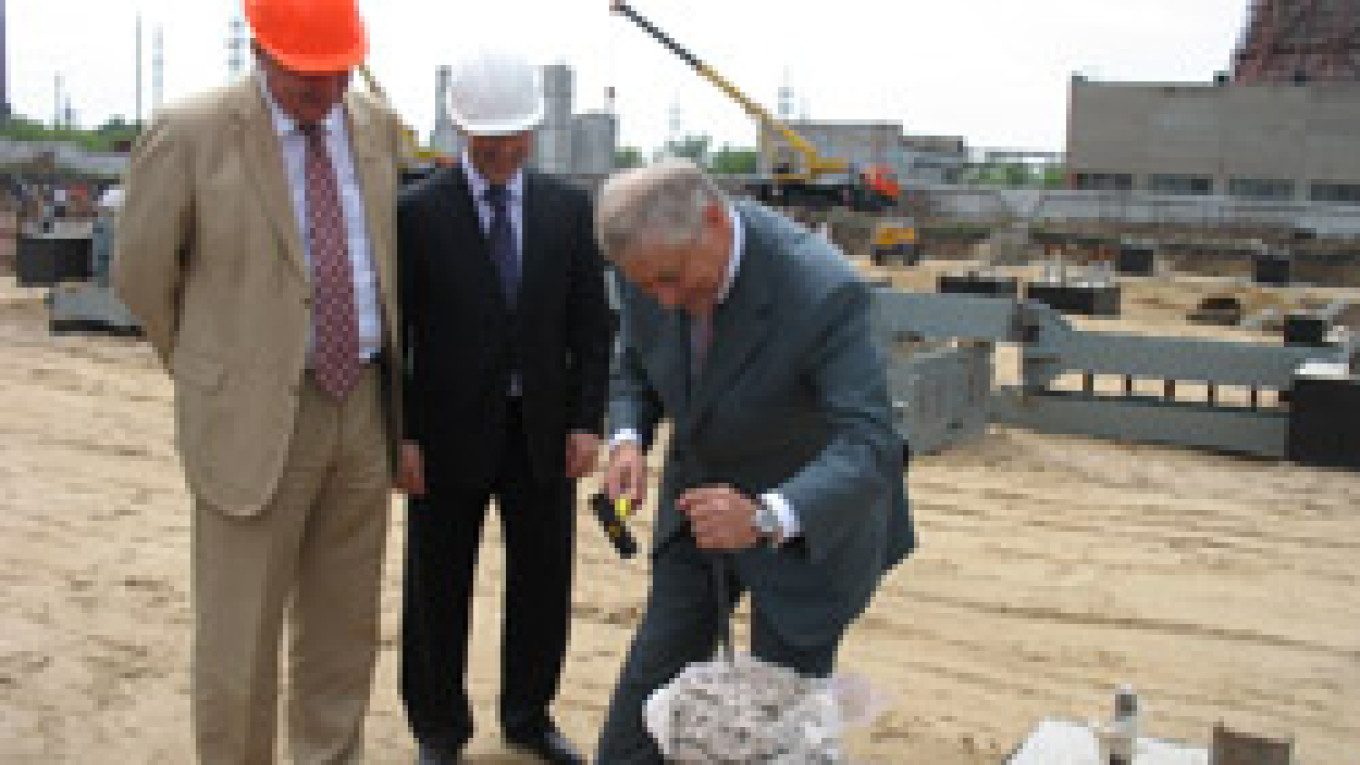
Slobodin and local officials used a hammer to break open a rock containing Volga agate, which IES chose to symbolize the station. It also presented a colorful model of its expansion plans with 15 other precious and semiprecious stones, some of which are local to where the stations will be built.
Separately, Slobodin said IES would introduce contracts for households in three regions fixing prices for electricity for six months. He declined to name the regions but said IES would offer yearlong contracts beginning January.
“It will be a unique experience for the whole electricity market.” Slobodin said. “It will be like in telecoms, with a ‘Jeans’ rate or something,” he added, referring to a telephone plan from Mobile TeleSystems.
Receivables for heat were 13 billion rubles as of July 1, or twice as much as the entire budget for winter maintenance, Slobodin said. Receivables for electricity were 7 billion rubles.
The sector’s profitability, suffering from higher gas costs and lower power prices, will be up this year, but still very low, he said.
“The EBITDA margin for the sector will be in the range of 10 to 12 percent, but even this low indicator will require significant efforts for us,” he said.
The average EBITDA margin in the oil industry is from 35 to 40 percent, he said.
A Message from The Moscow Times:
Dear readers,
We are facing unprecedented challenges. Russia's Prosecutor General's Office has designated The Moscow Times as an "undesirable" organization, criminalizing our work and putting our staff at risk of prosecution. This follows our earlier unjust labeling as a "foreign agent."
These actions are direct attempts to silence independent journalism in Russia. The authorities claim our work "discredits the decisions of the Russian leadership." We see things differently: we strive to provide accurate, unbiased reporting on Russia.
We, the journalists of The Moscow Times, refuse to be silenced. But to continue our work, we need your help.
Your support, no matter how small, makes a world of difference. If you can, please support us monthly starting from just $2. It's quick to set up, and every contribution makes a significant impact.
By supporting The Moscow Times, you're defending open, independent journalism in the face of repression. Thank you for standing with us.

Remind me later.