

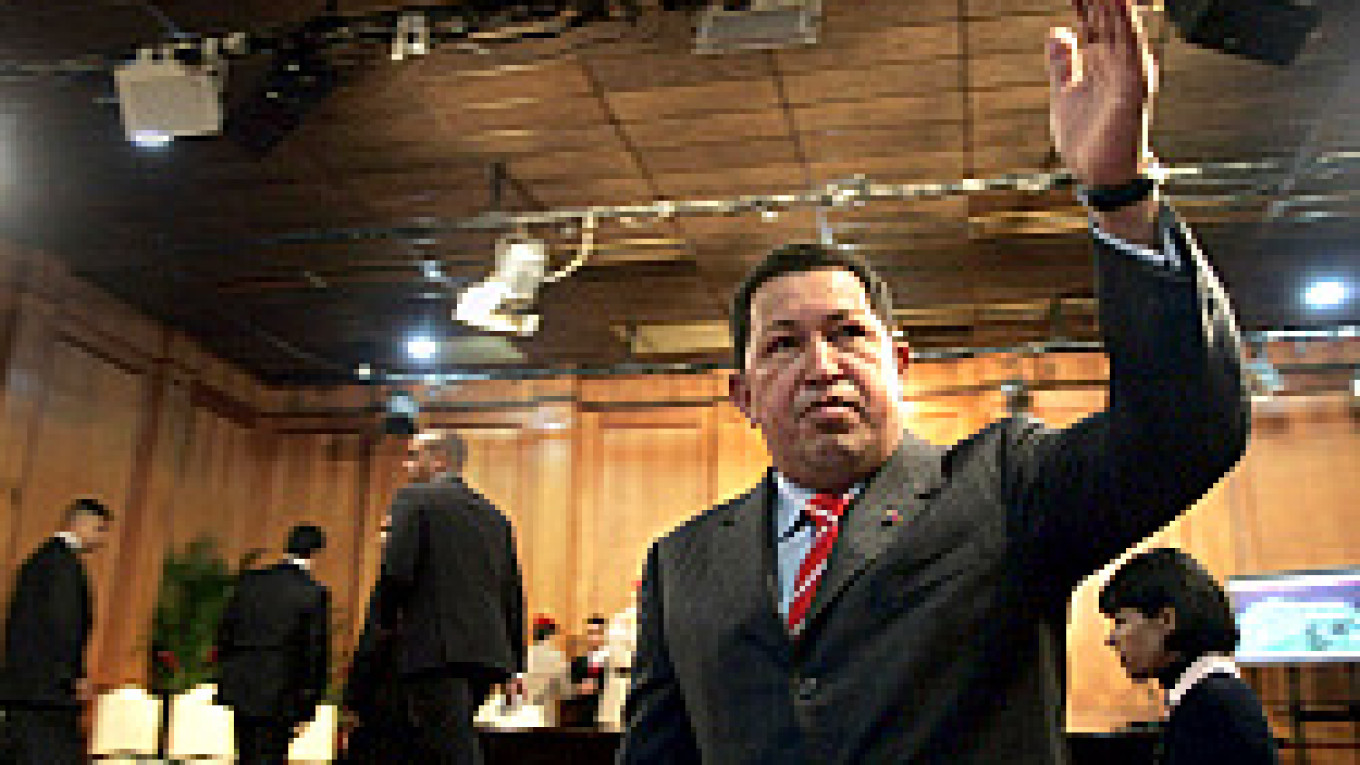
The deals included U.S.-based Chevron, Italy's Eni, Portugal's GALP Energia, Qatar Petroleum, Malaysia's Petronas, Argentina's Enarsa and Japanese companies Mitsui, Mitsubishi and Itochu, in a sign that Chavez's government is open to some outside investment despite sweeping nationalizations.
The ceremony came a day after Gazprom and Total signed another deal to explore for gas with neighboring Bolivia, another country that is seeking to bolster its ties to Moscow.
Venezuela is home to South America's largest natural gas reserves, but they have remained largely untapped while the country focused on oil production.
Officials expect joint investment over the next eight years to hit some $19.6 billion, Venezuelan Energy Minister Rafael Ramirez told reporters.
Under one agreement, Gazprom, Eni and Petronas signed a memorandum of understanding to help develop the offshore gas fields Blanquilla and Tortuga.
Chavez, who ejected U.S. majors ExxonMobil and ConocoPhillips from multibillion-dollar oil production projects last year, told the Chevron delegation, "We want to be friends with gringos."
Earlier this month, Chavez expelled the U.S. ambassador and threatened to cut off oil supply to the United States.
Chavez, who is traveling to Moscow next week at the invitation of Prime Minister Vladimir Putin, is planning new oil projects with Russian companies and joint military exercises with Russian warplanes and ships in the Caribbean by December.
Venezuela also is in talks to buy Russian air-defense systems and armored vehicles, and has expressed interest in the new Su-35 fighter, due off assembly lines in 2010, Russian Technologies chief Sergei Chemezov said Wednesday in Caracas, where he was accompanying Deputy Prime Minister Igor Sechin, Interfax reported.
The allies have sealed more than $4 billion in defense deals since 2005. Venezuela has bought Sukhoi fighter planes, Mi-17 helicopters, and 100,000 Kalashnikov assault rifles, most of which have already been delivered.
The Russian-Venezuelan alliance was mocked Thursday by U.S. Secretary of State Condoleezza Rice, who said Russia was only isolating itself.
The United States is confident that its own relations with Western Hemisphere countries "will in no way be diminished by a few, aging Blackjack bombers visiting one of Latin America's few autocracies," she said.
During his visit, Sechin announced that Rosneft, LUKoil, Gazprom Neft, Surgutneftegaz and TNK-BP are looking to build a $6.5 billion refinery to process Venezuela's tar-like heavy crude, RIA-Novosti reported.
On Thursday, Gazprom and Total signed a deal with Bolivia's state energy company YPFB that could bring $4.5 billion into Bolivia, the Bolivian government said.
Total chief executive Christophe de Margerie said in Sochi on Friday that the deal was part of a global partnership with Gazprom.
Bolivia also plans to seek Russian aid in energy, agriculture, and defense, the country's leftist president, Evo Morales, said at the signing ceremony Thursday.
(Reuters, AP)
A Message from The Moscow Times:
Dear readers,
We are facing unprecedented challenges. Russia's Prosecutor General's Office has designated The Moscow Times as an "undesirable" organization, criminalizing our work and putting our staff at risk of prosecution. This follows our earlier unjust labeling as a "foreign agent."
These actions are direct attempts to silence independent journalism in Russia. The authorities claim our work "discredits the decisions of the Russian leadership." We see things differently: we strive to provide accurate, unbiased reporting on Russia.
We, the journalists of The Moscow Times, refuse to be silenced. But to continue our work, we need your help.
Your support, no matter how small, makes a world of difference. If you can, please support us monthly starting from just $2. It's quick to set up, and every contribution makes a significant impact.
By supporting The Moscow Times, you're defending open, independent journalism in the face of repression. Thank you for standing with us.

Remind me later.