

While oil companies blame the fundamentals for the price growth, the Federal Anti-Monopoly Service has again voiced its concern over possible price collusion among major market players.
In early 2008, the service fined the major oil companies a total of 13.2 billion rubles ($430 million), with Rosneft, LUKoil, TNK-BP and Gazprom Neft, paying the lions share. The four firms were fined an additional 1.5 billion rubles each later that year.
The service sued the majors again in 2009 for repeated increases in gasoline prices and warned that continued high prices may result in fines topping several hundred million dollars.
Oil producers reply that they have again fallen victim to poor tax policy, which is geared toward raising cash rather than regulating business.
“Today, we’re witnessing a pretty typical situation for a country that does not have interior gasoline pricing and is stuck to oil market tendencies,” said Grigory Sergienko, executive director of the Russian Fuel Union. “Therefore, Russia, a major oil exporter, enjoys the same pricing policy as importing countries.”
Each time there is a significant drop in market oil prices, Russian producers compensate for their losses by increasing the cost of gasoline inside the country or by simply freezing the prices, Sergienko said.
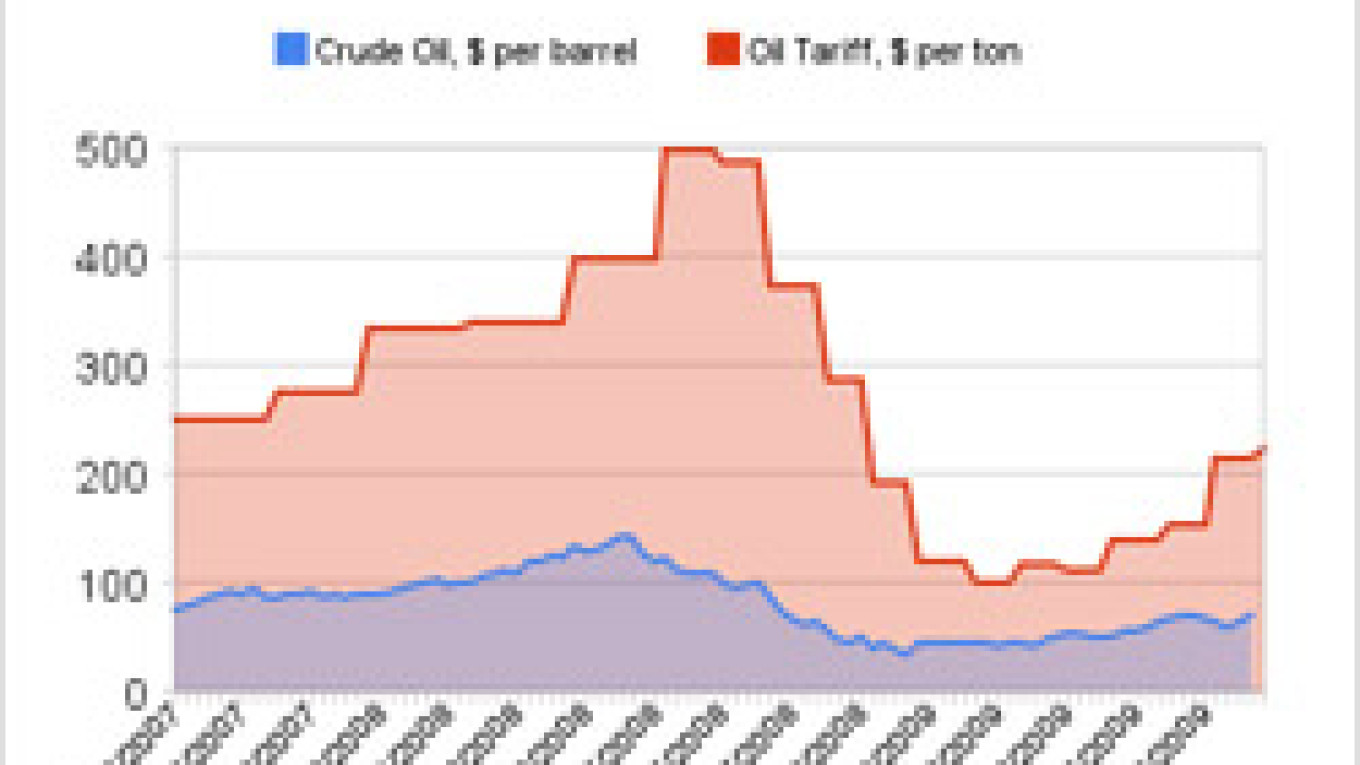
The Energy and Industry Ministry used to adjust the oil tariff every two months based on the average price during the previous period. When the oil price began to fall in August 2008, they switched over to a monthly regime.
But with oil prices falling so fast, that was still a significant delay. In October 2008, the lags were so bad that some oil firms had to reduce their exports so as not to operate at a loss.
“Imagine, today the state takes 87 kopeks of each ruble earned by the oil companies in taxes. How do you want them to generate profits then?” Sergienko said.
But critics say there is currently no mechanism to prevent oil companies from charging whatever they want.
“It is common knowledge that major market players can afford setting the price they want to and there is nothing to prevent them from doing so,” said Mikhail Delyagin, head of the Russian Institute for Globalization Problems.
“According to Russian law, you can sue companies for monopolistic activities only if you have direct proof of a ‘deal’ between them. And in this case there may be no deal at all — they just set the prices they think are appropriate and follow up with each other.”
But investigations, such as those by the anti-monopoly service, are largely pointless, Delyagin said, as other parties usually bear the brunt of any punishment levied by the authorities.
“Some time ago [the anti-monopoly service] opened about 200 cases to punish the monopolists but ended up penalizing several gasoline stations,” he said.
A Message from The Moscow Times:
Dear readers,
We are facing unprecedented challenges. Russia's Prosecutor General's Office has designated The Moscow Times as an "undesirable" organization, criminalizing our work and putting our staff at risk of prosecution. This follows our earlier unjust labeling as a "foreign agent."
These actions are direct attempts to silence independent journalism in Russia. The authorities claim our work "discredits the decisions of the Russian leadership." We see things differently: we strive to provide accurate, unbiased reporting on Russia.
We, the journalists of The Moscow Times, refuse to be silenced. But to continue our work, we need your help.
Your support, no matter how small, makes a world of difference. If you can, please support us monthly starting from just $2. It's quick to set up, and every contribution makes a significant impact.
By supporting The Moscow Times, you're defending open, independent journalism in the face of repression. Thank you for standing with us.

Remind me later.