

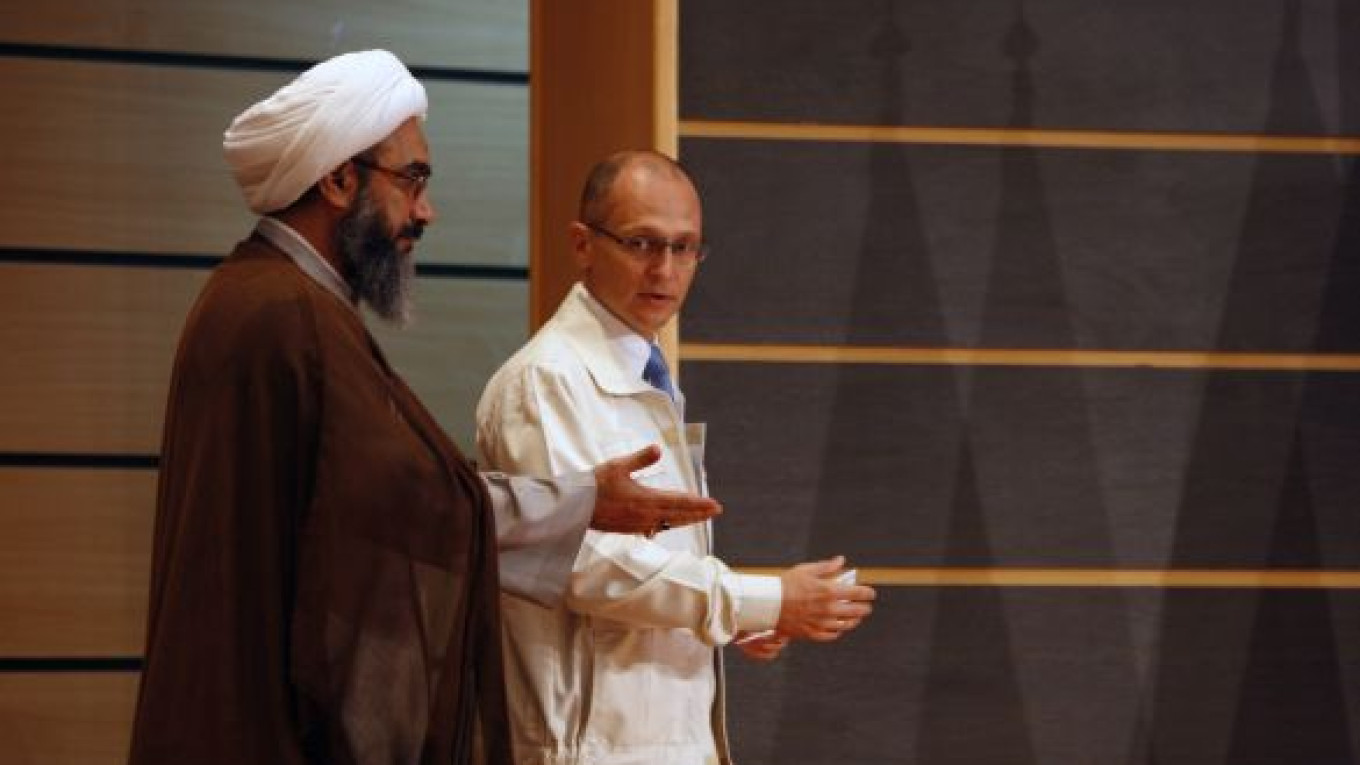
Russia and Iran on Saturday jointly launched the Bushehr atomic power plant, the first in the Middle East, bringing the Islamic republic into the ranks of the world’s 29 nuclear power generating nations.
Both sides hailed the startup as a landmark. Russia, which agreed to complete the facility for $800 million in 1992, had delayed the final work in recent years amid international pressure on Tehran over its nuclear program.
The completion helps state-run Rosatom further its case to developing countries that it is a reliable supplier of nuclear power stations.
Prime Minister Vladimir Putin said in March that Rosatom had the capacity to build 25 percent of the world’s planned nuclear plants, up from the 16 percent it is building now.
“No one among the world’s professionals has any doubts about the possibility of the power plant in Bushehr being used for non-peaceful purposes. It’s absolutely clear that there has never been such a possibility,” Rosatom chief Sergei Kiriyenko said Saturday.
Moscow reached an agreement with Tehran under which it would supply fuel for the plant and dispose of spent rods, which could be used to develop nuclear weapons. The United Nations International Atomic Energy Agency has said it will monitor compliance.
“At this point, we’re not discussing new nuclear energy projects in Iran. We must first complete construction of the Bushehr power station,” Kiriyenko said. “We are not discussing any concrete projects to construct new blocks.”
The launch of the plant will be finished this year, he said, allowing it to start producing power. Russia has also agreed to provide two key nuclear isotopes for medical research.
Russian engineers will remain at the station for two to three years before handing the facility over to Iran.
But in a sign that Tehran was not content to start the plant without a scandal, Vice President Ali Akbar Salehi, also the country’s nuclear chief, vowed to continue seeking to enrich uranium ahead of the launch.
“The contract we have with the Russians doesn’t oblige us to buy the fuel from them,” Salehi said, Bloomberg reported. “It’s an agreement that when we need the fuel, they’ll supply it.”
Washington said it was unconcerned about Bushehr’s opening because of Russia’s role in handling the fuel.
“We recognize that the Bushehr reactor is designed to provide civilian nuclear power and do not view it as a proliferation risk,” State Department spokesman Darby Holladay told reporters Saturday.
Analysts agreed that fears — including from Israel — about Bushehr were largely unfounded.
“The Bushehr project is not a major proliferation risk given that the reactor is under IAEA safeguards and the spent fuel it will create will be taken back by Russia and cannot be used by Iran to extract plutonium,” Daryl Kimball, executive director of the Arms Control Association, told The Moscow Times.
The real threat, analysts say, is at the Natanz uranium-enrichment plant and Qom, the second uranium-enrichment facility now under construction, as well as the heavy-water reactor Iran is constructing in Arak.
“Until Iran takes additional steps to assure the international community that it is not seeking a nuclear weapons production capability, I doubt Russia or any other state will initiate new civil nuclear power production there,” Kimball said.
The launch is something of a turning point for the Russian nuclear industry, which was near collapse before getting the Iranian contract for Bushehr.
Finishing the plant, started by a German consortium in 1974, may not have been as profitable as first planned, but it has given Rosatom a boost in its competition for new contracts.
Kiriyenko stressed in a meeting with Putin on Thursday that the start proves that “Russia fulfils its obligations.”
Bushehr, which has cost more than $1 billion to finish, will generate 1,000 megawatts, or 2 percent of Iranian’s projected electricity usage. By comparison, Kiriyenko has estimated that the Turkish deal for four reactors is worth $20 billion, and each reactor will be able to produce about 20 percent more energy than the one started in Iran.
Atomstroiexport, Rosatom’s civilian construction unit, won clearance this year to build a major plant in Turkey, and the company’s leadership plans to visit Bangladesh and Vietnam this fall.
“The projects Russia is pursuing elsewhere will not be as problematic as Bushehr. Russia could list a number of reasons why the project … took so long,” Anton Khlopkov, head of Moscow-based Center for Energy and Security Studies, told The Moscow Times.
He cited the 1979 Islamic Revolution, attempts by Iran to finish the reactor on its own, and switching from dollars to euros with subcontractors.
Bushehr is also something that Iranian leaders can show off to its citizens and neighbors.
“This project is a symbol of prestige for a nation that’s developing, although not at the pace it would like. Bushehr puts Iran ahead of some of its wealthier neighbors,” Khlopkov said.
A Message from The Moscow Times:
Dear readers,
We are facing unprecedented challenges. Russia's Prosecutor General's Office has designated The Moscow Times as an "undesirable" organization, criminalizing our work and putting our staff at risk of prosecution. This follows our earlier unjust labeling as a "foreign agent."
These actions are direct attempts to silence independent journalism in Russia. The authorities claim our work "discredits the decisions of the Russian leadership." We see things differently: we strive to provide accurate, unbiased reporting on Russia.
We, the journalists of The Moscow Times, refuse to be silenced. But to continue our work, we need your help.
Your support, no matter how small, makes a world of difference. If you can, please support us monthly starting from just $2. It's quick to set up, and every contribution makes a significant impact.
By supporting The Moscow Times, you're defending open, independent journalism in the face of repression. Thank you for standing with us.

Remind me later.