

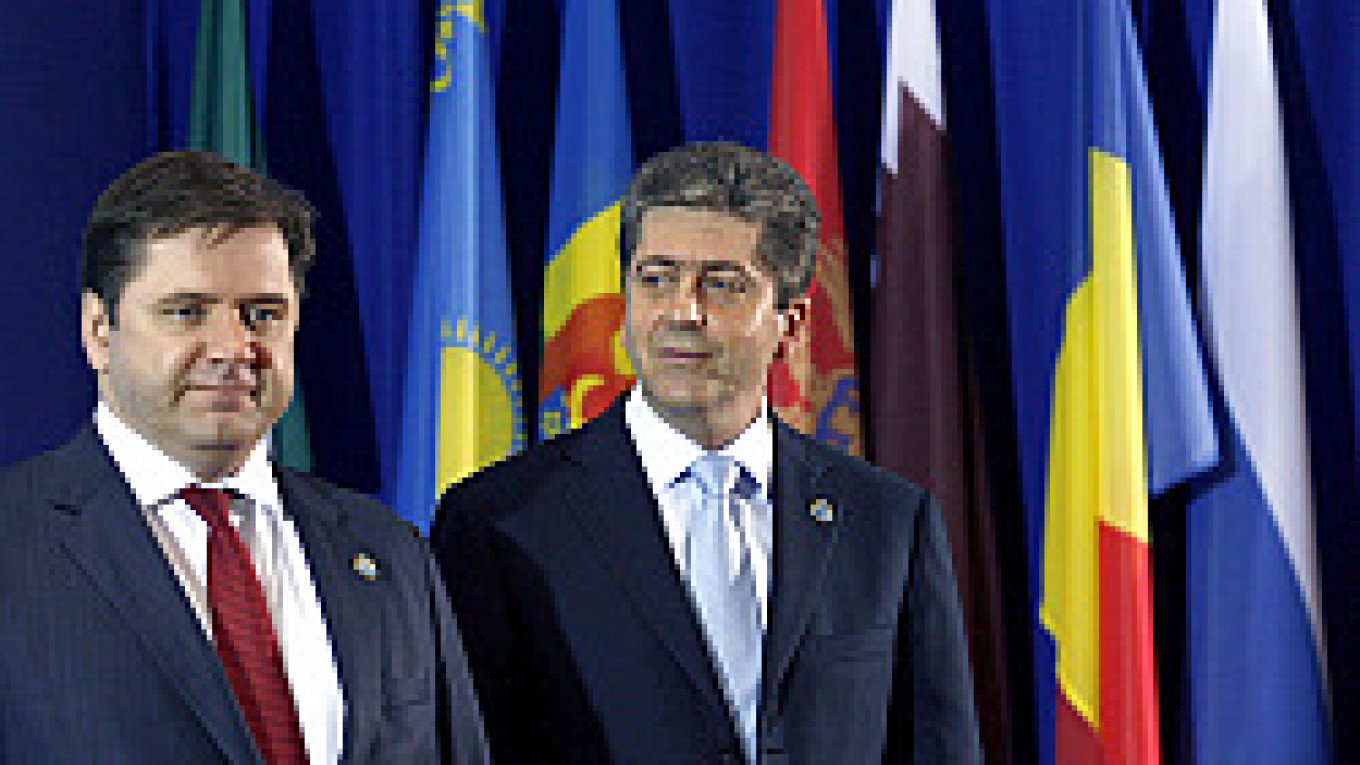
Bulgarian Prime Minister Sergei Stanishev was scheduled to arrive in Moscow on Monday for a three-day working visit, which will include a meeting with President Dmitry Medvedev on the first day and talks with Prime Minister Vladimir Putin on Tuesday.
The talks in Moscow follow two-day gas negotiations in Sofia. Putin canceled his attendance after Bulgaria declined to give in to Gazprom's demands on the South Stream pipeline, Bulgarian Foreign Minister Ivailo Kalfin said, the 24 Hours newspaper reported Saturday.
Shmatko told a news conference that both sides should be ready to compromise and reminded Bulgaria to live up to its political promise to join South Stream. Bulgargaz, the country's state-run gas utility, said it was demanding a direct gas supply contract with Gazprom, which would enable Sofia to seek compensation for losses caused by gas cuts.
Bulgargaz chief executive Dimitar Gogov told reporters that the company was negotiating a new agreement with Gazprom to replace the current deal, which expires in 2010. Gazprom's external affairs director, Stanislav Tsygankov, said his company wanted to eliminate Bulgargaz from the talks.
"I kindly ask Gazprom not to determine with whom they will work in Bulgaria," Bulgarian President Georgi Parvanov told reporters.
Sofia is reluctant to sign a final deal on the 900-kilometer South Stream unless Moscow agrees to pay transit fees for the option of using existing pipelines, officials say. The Balkan country is opposed to Russia's plan to use its gas network to reduce the project's 10 billion euro ($13.2 billion) cost, arguing that this would undermine its goal of diversifying routes.
"Both sides must have reasonable positions and readiness for a compromise," Shmatko said after meeting Stanishev.
"We must not allow economic and company logic to dictate the political agenda," he said, speaking through an interpreter. "We believe that in the near future, we would reach an agreement."
South Stream, led by Gazprom, has been criticized in private by U.S. and European Union officials who are concerned that it will raise Europe's dependence on Russian gas. The EU, which relies on Russia for a quarter of its gas, is instead promoting the rival Nabucco pipeline to use gas from the Caspian Sea region but has not secured supplies so far.
Western diplomats in Sofia said the United States was unhappy to see Russia cementing its presence in the Balkans, possibly gaining a political and strategic foothold as well as an economic one.
Government officials in Sofia deny any involvement of Washington or Brussels in their position on South Stream, saying Bulgaria is simply defending its interests.
Gazprom pumps 17.8 billion cubic meters per year to Turkey, Greece and Macedonia via Bulgaria under a 30-year contract that started in 2006. About 3.5 bcm of that is consumed by Bulgaria, which gets all of its gas from Russia under a separate agreement that expires next year.
Bulgaria was the EU country worst hit by a two-week disruption of Russian gas supplies via Ukraine in January. Russia has rejected claims, saying Bulgaria's supply contract is with three of Gazprom's foreign subsidiaries, Bulgargaz's Gogov said.
Parvanov said Bulgaria should not rush into a deal but that it should also not postpone it beyond May, because the country would enter an election period that might delay the whole South Stream project. Bulgaria is due to hold parliamentary elections in July.
The intergovernmental South Steam agreement signed by Russia and Bulgaria in 2008 envisions building a separate pipe, Parvanov said Saturday.
"We will work to implement the South Stream agreement under the terms that we signed with Mr. Putin in 2008," Parvanov said.
A Message from The Moscow Times:
Dear readers,
We are facing unprecedented challenges. Russia's Prosecutor General's Office has designated The Moscow Times as an "undesirable" organization, criminalizing our work and putting our staff at risk of prosecution. This follows our earlier unjust labeling as a "foreign agent."
These actions are direct attempts to silence independent journalism in Russia. The authorities claim our work "discredits the decisions of the Russian leadership." We see things differently: we strive to provide accurate, unbiased reporting on Russia.
We, the journalists of The Moscow Times, refuse to be silenced. But to continue our work, we need your help.
Your support, no matter how small, makes a world of difference. If you can, please support us monthly starting from just $2. It's quick to set up, and every contribution makes a significant impact.
By supporting The Moscow Times, you're defending open, independent journalism in the face of repression. Thank you for standing with us.

Remind me later.