

RusAl has entered its fourth month of not paying creditors, who have approved another payment freeze -- this time until July 28 -- to complete talks on restructuring the debt. The company's management said the terms would be identical for the more than 70 foreign banks to which it owes the $7.4 billion.
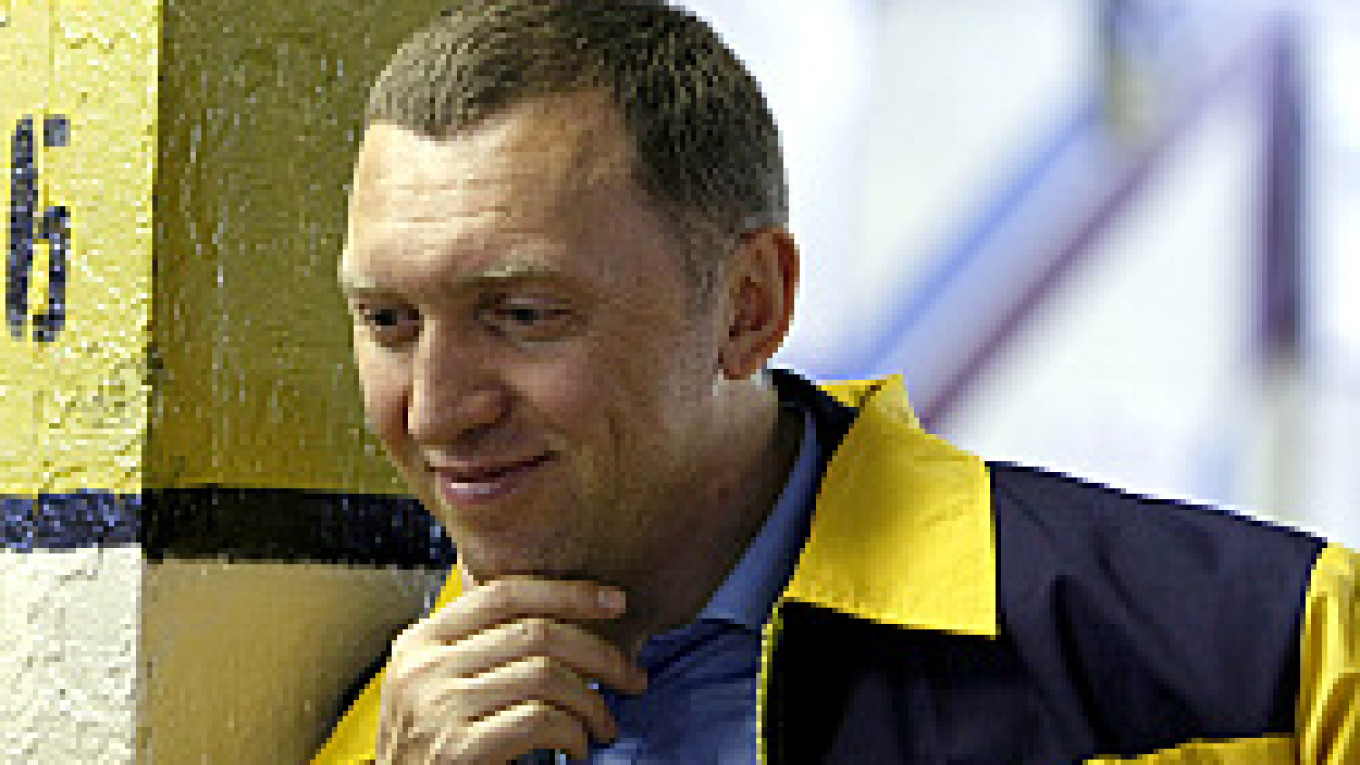
The aluminum giant also owes $2.1 billion to Russian banks, $4.5 billion to state development bank VEB and $2.8 billion to Mikhail Prokhorov, who owns a 14 percent stake in RusAl. The company is controlled by Oleg Deripaska, with 56.8 percent.
RusAl recently agreed with one of its shareholders, Swiss commodities trader Glencore (10.3 percent), on the sale of 500,000 to 900,000 tons of aluminum per year, Dow Jones reported. The deal could bring RusAl at least $200 million, a source familiar with the terms told the news agency, and it could improve RusAl's position in talks with its creditors.
The banks and RusAl are negotiating a payment scale that will be based on the ratio of debt to earnings before interest, taxes, depreciation and amortization for the entire period of the agreement, or up to 10 years, sources at several foreign lenders told Vedomosti.
Initially, the interest rate could be fixed at the maximum level, the London interbank offered rate plus 7 percent, one banker said. Another banker said the talks were already focusing on a rate of 6 percentage points over LIBOR. As the debt is paid down and EBITDA increases through cost cutting and higher aluminum prices, the rate will be cut and could fall as low as 3 points over LIBOR, they said.
The interest will begin accruing immediately, but RusAl will not be required to start making payments right away, the bankers said. RusAl has said it is negotiating for a two-year moratorium.
One of the creditors said he thought that RusAl would also need to put up additional revenue as collateral. The terms of the agreement are not final, however, and negotiations are being held nearly every day, he added.
The bankers say they have few options -- either writing off the debt or restructuring it -- and that while the talks will continue for another few weeks, an agreement will be reached.
RusAl is currently paying about 4 percent on its debt. But the new level will also be very comfortable for the company, said Marat Gabitov, an analyst at UniCredit Securities.
ArcelorMittal issued 2.5 billion euros ($3.5 billion) in eurobonds earlier this month at 8.25 percent to 9.375 percent per year, while Rio Tinto had a $3.5 billion eurobond issue in April at about 9 percent.
For now, there isn't much risk that RusAl's payments will be linked to LIBOR, which currently has a three-month dollar rate of about 0.6 percent. The rate is unlikely to pass 1 percent this year, and for the foreseeable future it shouldn't increase very much either, Trust analyst Yevgeny Nadorshin said.
Before the crisis hit, the highest LIBOR rate was 5.73 percent, in September 2007.
A Message from The Moscow Times:
Dear readers,
We are facing unprecedented challenges. Russia's Prosecutor General's Office has designated The Moscow Times as an "undesirable" organization, criminalizing our work and putting our staff at risk of prosecution. This follows our earlier unjust labeling as a "foreign agent."
These actions are direct attempts to silence independent journalism in Russia. The authorities claim our work "discredits the decisions of the Russian leadership." We see things differently: we strive to provide accurate, unbiased reporting on Russia.
We, the journalists of The Moscow Times, refuse to be silenced. But to continue our work, we need your help.
Your support, no matter how small, makes a world of difference. If you can, please support us monthly starting from just $2. It's quick to set up, and every contribution makes a significant impact.
By supporting The Moscow Times, you're defending open, independent journalism in the face of repression. Thank you for standing with us.

Remind me later.