


But we do not find this out for another 200 pages, as Siljak takes us back through several decades of argument and ideology to place Vera in her cultural context and to show how Russian radicalism had arrived at this point.
Anyone expecting "Angel of Vengeance" to be a straightforward biography of Vera Zasulich may be disappointed, as it is both more and less than that. More, in the sense that Siljak, a professor of history at Queen's University in Ontario, takes as her subject the entire development of the Russian revolutionary movement -- its ideological mainsprings, its key texts, its disillusionments and its transformations. Less, in that Vera herself appears rather rarely at the forefront of the action and, when she does, she has been missing for so long that the reader has almost forgotten about her.
Taking as her starting point the influence of the New Testament on Russian radicals (Josef Stalin was by no means the first to make the switch from seminary to revolutionary cell), Siljak next turns to the hero (or anti-hero) of Ivan Turgenev's novel "Fathers and Sons," the nihilist -- or more properly, materialist -- Bazarov. Scornful of everything represented by his elders, Bazarov has faith only in what he can physically dissect. He also demonstrates a salient feature of many revolutionaries, certainly of most of Vera's comrades -- that it is easier to scoff than to offer constructive criticism, to destroy than to build.
There are certain aspects of the Russian revolutionary mentality that seem decidedly odd at a distance of a century and a half. Chief among these, perhaps, is the adulation accorded Nikolai Chernyshevsky's turgid text "What Is to Be Done?" serialized in 1863 and subtitled "Novel of the New People." "Young, educated Russians of the 1860s did not merely read this novel. They reread it obsessively, memorized it, quoted passages from it like a catechism, and carried it around with them like a prayer book," Siljak writes. Lenin himself, no great judge of literature, was passionate about its portrayal of the exemplary revolutionary, a character of almost inhuman single-mindedness.
One of Chernyshevsky's influences was Charles Fourier, who apparently decided while delving in the book stacks at the Biblioth??que Nationale to write, as Siljak puts it, "the single book that would end all writing." In fact, much of the revolutionary impetus resembles adolescent fantasy -- dreams of omnipotence that should have been outgrown and never were, leading to murderous consequences. Fourier's delusions at least seem to have been relatively harmless in themselves; he imagined that in the new world order, which he would help to bring about, the climate would become "universally mild, and the sea would turn into a sweet, potable liquid much like lemonade."
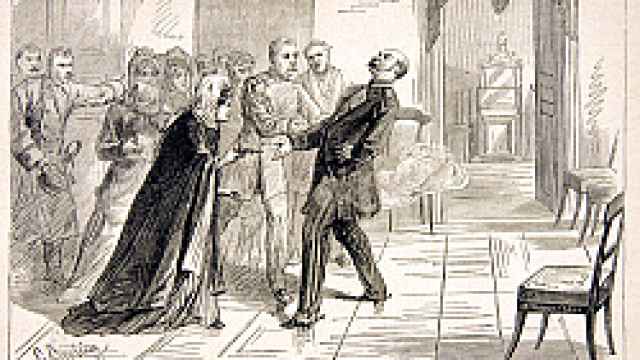 St. Martin's Press Zasulich's attempt on the life of Governor Fyodor Trepov, as shown to readers of a French newspaper a month and a half later. |  |
| |
After these digressions, we finally encounter Vera again. There are still 10 years to go before the scene that opens the book, and she is on the verge of meeting a man who is to have a lasting effect on her life. This is one of the most notorious and enigmatic figures of the Russian revolutionary movement, Sergei Nechayev. The young Vera, shy and lacking in self-confidence but with a belief that she was destined for greater things than the life of an impoverished provincial noblewoman, became easy prey for this hypnotic and disturbing character. The jury is still out as to whether Nechayev was acting in good faith in fomenting revolution, or whether he was a pathological liar whose greatest talent was for betraying his accomplices. In any event, through a correspondence he initiated, Vera became implicated in revolutionary activities, and consequently spent five years of her life in prison or exile. This experience, along with the writings of the revolutionary Mikhail Bakunin, helped to change her from a vaguely dissatisfied girl into a rebel with a cause.
After a further period of exile, Vera managed to escape the clutches of the tsarist secret police and ended up in Kiev, living in a small commune with a group calling themselves the Southern Rebels. The normally unsociable Vera was happy here, as no one minded her "dishevelled hair, tattered clothes, and scuffed boots" or expected her to do any housework. In 1876, the Southern Rebels took off into the countryside to stir up revolution among the peasants -- by the unlikely means, in Vera's case, of trying to set up a tearoom -- but the peasants, it seems, were unimpressed, and the rebels beat a frustrated retreat.
Comrades of Vera, but not Vera herself, now ended up at St. Petersburg's House of Preliminary Detention, a model prison based on London's Pentonville, where political prisoners were detained prior to their trials and where occurred the event that sparked Vera's decision to assassinate the city's governor. Trepov had arrived unexpectedly one day for an inspection, been horrified by the lax regime he found in place and, almost as a reflex action, ordered one of the inmates, a man called Bogolyubov, to be flogged. Such treatment was normally never meted out to the young intellectuals held in the "Prelim," and riots ensued. Vera herself had never met Bogolyubov, but she decided to avenge him anyway, and to become a martyr for the revolution in the process.
Siljak recounts the story of Vera's trial in detail and with a lively sense of drama. In his summing up, the judge asked the jury to consider not only whether Vera had shot Governor Trepov (about which there was really no doubt), but also whether she had intended to kill him. It took only 30 minutes for the jury, sympathetic to Vera's stated aim "to prove that no one should be sure they are beyond punishment when they violate human dignity," to clear her of all charges. Pandemonium broke out, and the stunned Vera found herself cast in the role of heroine and founding mother of Russian terrorism.
She seems to have spent the rest of her life repenting at leisure. Living in exile in Switzerland, it did not take her long to become convinced that terror was not the answer, but her voice would never be listened to; she would always be remembered for what she had done, not for what she might say. She died in Petrograd soon after revolution finally came to Russia, having written, "The Russia that I knew and loved is gone."
Virginia Rounding is the author, most recently, of "Catherine the Great: Love, Sex, and Power.
A Message from The Moscow Times:
Dear readers,
We are facing unprecedented challenges. Russia's Prosecutor General's Office has designated The Moscow Times as an "undesirable" organization, criminalizing our work and putting our staff at risk of prosecution. This follows our earlier unjust labeling as a "foreign agent."
These actions are direct attempts to silence independent journalism in Russia. The authorities claim our work "discredits the decisions of the Russian leadership." We see things differently: we strive to provide accurate, unbiased reporting on Russia.
We, the journalists of The Moscow Times, refuse to be silenced. But to continue our work, we need your help.
Your support, no matter how small, makes a world of difference. If you can, please support us monthly starting from just $2. It's quick to set up, and every contribution makes a significant impact.
By supporting The Moscow Times, you're defending open, independent journalism in the face of repression. Thank you for standing with us.

Remind me later.