

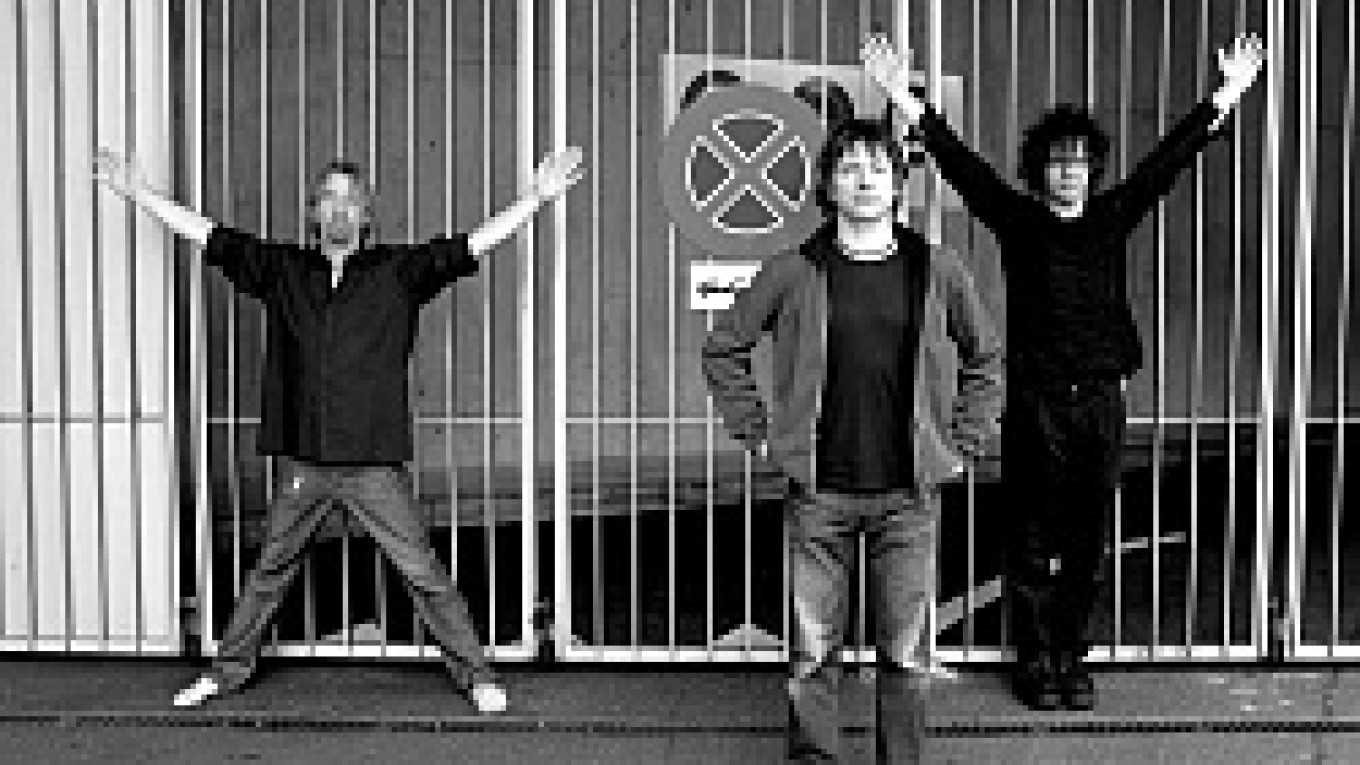
The Young Gods formed in 1985 on the initiative of Zurich native Franz Treichler as a remedy for his disillusionment with the increasingly staid New Wave scene. The group took its name from a composition by Swans, the New York gods of the reactionary music style called No Wave. The Young Gods adopted something akin to that band's harsh stylistics, and enlisted Swiss-born Swans member Roli Mosimann as producer on their early records.
Treichler is the band's vocalist and only constant member. A classically trained guitarist, he nevertheless put the instrument aside when he started The Young Gods, opting for what was then a marvel of modern technology: a sampler. The band's lineup has changed over the years but has generally consisted of Treichler on vocals, a sampler operator and a drummer. This minimal configuration was practically unheard of in 1985, and its novelty was partly why Treichler assembled it. But guitar was not absent from the band's sound, for -- despite its lack of a dedicated guitarist -- it has a unique way of sampling and repeating guitar riffs. The current lineup is Alain "Al Comet" Monod on keyboards and Bernard Trontin on drums.
"Our idea was to make rock music in an unconventional way," Treichler explained by e-mail this week. "Sampling technology let us do that like never before. Electronic music has existed since the '40s, but it became huge in the '90s. Rock music was becoming mainly a commercial business, but the emerging electronic scene was much more adventurous [with genres such as] techno, ambient, dub, house, minimal."
The Young Gods are something of musicians' musicians -- not particularly well known among electronic music aficionados, but exerting a tremendous influence on some very well-known electronic acts. Songs by Ministry and KMFDM sound, respectively, like the early Young Gods tracks "Envoye" and "Gasoline Man." Even someone as influential as David Bowie has referenced the band. Asked whether his 1995 record "Outside" was industrial-inclined because of his interaction with Trent Reznor of Nine Inch Nails, Bowie said no, but admitted to being influenced by The Young Gods.
As for their own influences, Treichler said, "We are sons of the '70s. Our main influences come from that decade, including punk."
Indeed, the Young Gods sound more punk than a lot of electronic bands that formed in their wake. Nevertheless, they're also known for their musical sophistication. In 1989, festivals in Geneva and Fribourg commissioned the band to play songs by German-Jewish composer Kurt Weill, which led to studio versions of some of the songs for the 1991 album "Play Kurt Weill." Their latest records, "Six Dew Points" and "Music for Artificial Clouds," find them veering into ambient territory.
The Moscow set will consist of a career overview reminiscent of their last album, a two-disc set called "XX Years 1985-2005." There will also be material from the band's next record, due for release in early 2007, Treichler said.
"I like to describe our live shows as volcanic," he added. "The power-trio format is very demanding: The three of us have to be there nonstop, 100 percent -- a fireball! The fact that everything is played live on a keyboard and there is no sequencer helps. The live acoustic drums also link the electronic with the organic. We try to show that there is a future for 'man/machine' -- we can cohabitate and do good things together."
The Young Gods play Sat. at 10 p.m. at Ikra, located at 8A Ulitsa Kazakova. Metro Kurskaya. Tel. 262-4482.
A Message from The Moscow Times:
Dear readers,
We are facing unprecedented challenges. Russia's Prosecutor General's Office has designated The Moscow Times as an "undesirable" organization, criminalizing our work and putting our staff at risk of prosecution. This follows our earlier unjust labeling as a "foreign agent."
These actions are direct attempts to silence independent journalism in Russia. The authorities claim our work "discredits the decisions of the Russian leadership." We see things differently: we strive to provide accurate, unbiased reporting on Russia.
We, the journalists of The Moscow Times, refuse to be silenced. But to continue our work, we need your help.
Your support, no matter how small, makes a world of difference. If you can, please support us monthly starting from just $2. It's quick to set up, and every contribution makes a significant impact.
By supporting The Moscow Times, you're defending open, independent journalism in the face of repression. Thank you for standing with us.

Remind me later.