

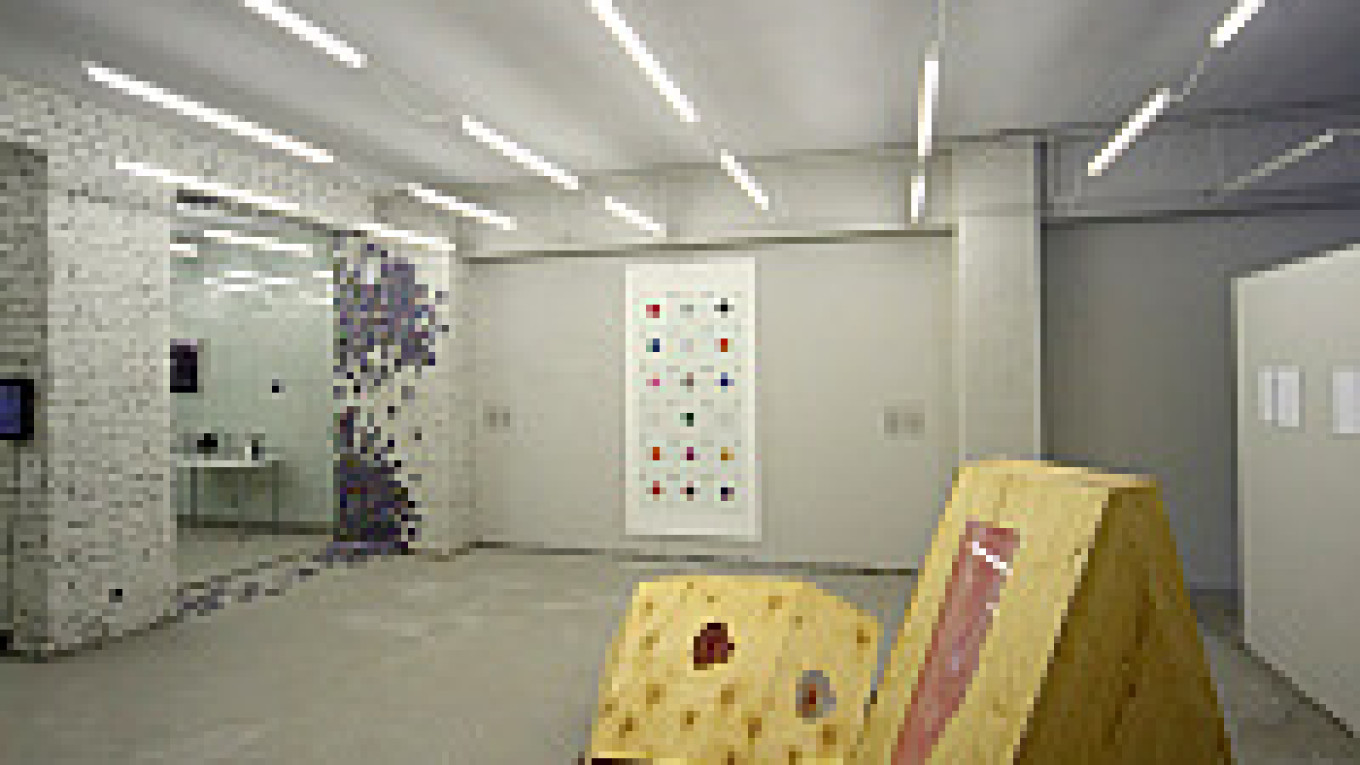
This journey into a sci-fi universe was an art installation called "+/-" by Daria Buyum and Dmitry Stepanov, described as an "experimental space of harmonization of acoustic, light,[and] electromagnetic waves." The work is part of the "Laboratoria. Experiment 1" exhibition, which endeavors to present contemporary art infused with inspiration from modern science.
"The idea is mainly for communication between scientists and young artists, for the artists to try new things," said curator Daria Parkhomenko about what is to be the first of several "experiments" or exhibits at the Laboratoria Art and Science Space.
Much like the "+/-" installation, "Laboratoria. Experiment 1" is a concept that initially sparks curiosity but then, upon more thorough inspection, does not quite live up to the lofty expectations it generates.
A few video screens in the small exhibition hall feature artists' interviews with scientists, who talk for several minutes about new developments in physics and chemistry and the possible technological changes they herald.
"During these conversations, [the artists] received new information as well as inspiration for their work," Parkhomenko said.
In several of the pieces on display, ideas and inspiration were not necessarily lacking, but rather the execution came off as amateurish, as with the "+/-" installation, which Parkhomenko said sought to convey "the visualization of sound."
Some works seemed not to have much substance to them at all, like the empty beaker with red and blue LEDs under it, dubbed "Blue Blood;" or the wooden mobile, painted in metallic gray, that visitors could spin to witness the "miracle" of kinetic energy.
On the other hand, some of the artists produced efforts with genuine esthetic appeal, based on fascinating scientific principles or observations. Hanging from the wall diagonally opposite the entrance is a series of enlarged images of the transistor metals silicon and germanium, which are the building blocks of the current information revolution. Up close, these tiny particles look like worlds in themselves, with incandescent greens and pinks bursting forth from the flawed, pockmarked surfaces of the spherical and rhombus-like forms.
Another eye-catching display is Natasha Zintsova's "The Signals," where wooden boxes have screens affixed to them that show multicolored, flowing patterns that recall a lava stream or a massive, undulating school of fish.
Parkhomenko said Zintsova's work was inspired by the notion, discussed by one of the scientists, that even inanimate material like wood "has a memory, that material remembers what it was before. The flowing suggests that wood was once alive."
As the name plainly states and the curator repeated, Laboratoria's "Experiment 1" is just that: a first trial. For all its sundry shortcomings, there seems to be promise that future exhibits Laboratoria, like the scientific methods and discoveries from which it draws its creative energy, will build upon trial and error, learning from past mistakes.
Pieces in the next exhibit would directly incorporate more sophisticated scientific and technological aspects, Parkhomenko said. "Next year, we are planning 'Experiment 2,' which will go deeper than just communication and experimentation between science and art."
"LABORATORIA. Experiment 1" runs to Aug. 31 at the L. Karpov Physics and Chemistry Institute, located at 3 Obukha Pereulok. Metro Kurskaya, Chkalovskaya. Tel. 730 0167. Entry is free of charge.
A Message from The Moscow Times:
Dear readers,
We are facing unprecedented challenges. Russia's Prosecutor General's Office has designated The Moscow Times as an "undesirable" organization, criminalizing our work and putting our staff at risk of prosecution. This follows our earlier unjust labeling as a "foreign agent."
These actions are direct attempts to silence independent journalism in Russia. The authorities claim our work "discredits the decisions of the Russian leadership." We see things differently: we strive to provide accurate, unbiased reporting on Russia.
We, the journalists of The Moscow Times, refuse to be silenced. But to continue our work, we need your help.
Your support, no matter how small, makes a world of difference. If you can, please support us monthly starting from just $2. It's quick to set up, and every contribution makes a significant impact.
By supporting The Moscow Times, you're defending open, independent journalism in the face of repression. Thank you for standing with us.

Remind me later.