

Inside the movie theater in central Moscow, about 50 twenty-somethings watch a private premiere of a documentary. The final scene sees the Moscow graffiti group SNO Crew tagging their name high up on an advertising board overlooking Red Square. The police look on helpless.
Then the group go out into the night and start tagging the city themselves, the more out-of-the-way places they find the better.
This is the Moscow graffiti world, made up of those who put their names on walls and trains and those not content with just that.
"[Many] think that Moscow is very avant-garde because the tagging is super-organized and in the craziest places, very ambitious," said one artist, who like all those who spoke to The Moscow Times asked for their names not to be used.
"We have nearly twenty graffiti shops, and a city like Paris, a center for street art, has just ten," said another artist Dobry.
It is also easy to get away if you are caught. "If the cop is in a decent mood and you are a good talker," said artist 0331 c.
The taggers have precise teams with each person having a specific role, but when the night ends — one run-in with the police successfully bypassed — the graffiti hierarchy becomes clear: There are taggers and others who like Dobry and 0331 c call themselves graffiti artists.
"There are about 10 or so of us doing real work," said 0331 c, a tall, gangly 25-year-old.
And it is these artists who are the pulse of Moscow street art, more at home working on walls than canvases. Their works, touching on the personal, social and political, are often beautiful, big and ambitious.
"We are real painters, and one way for us to show how we feel is to put in on the wall. This is for me; I don't need to write my name everywhere," said Dobry, who also works on canvas, "How popular it was drew us in, and over time we saw the wall as a better way to express ourselves."
One of those artists shot to fame this week as the artist called Pasha P183 had galleries of his Moscow work published on the websites of three English newspapers.
They dubbed P183 the Russian Banksy, after the most famous graffiti artist in the world. A comparison he is unlikely to find flattering.
"Banksy does interesting things, but he is a monopolist. If a person is fighting with McDonald's, he himself becomes McDonald's," he said in an interview with Afisha magazine last year.
Speaking to The Moscow Times, Pasha, who in his day job also works as an artist, explained what draws him to work illegally.
"Day and night are very different, and in graffiti we often work at night. There's a palpable feeling, a night silence. I think this silence and the loneliness it implies are important to a lot of artists, but it's very difficult to convey. When I'm alone, my thoughts can actually leave my body and escape onto the wall," he said.
One of his most famous pieces is of Alyonka, the famous chocolate bar made by the Red October factory. The girl represents a child who will never grow up and never change, a symbol for the modern person forced to sell himself to the whims of society without consent, he said.
"What I do is more social commentary than political. What's most important is to represent the atmosphere in Moscow and to find the wall that is right for each piece. We don't need to tag the Kremlin. The suburbs will do just fine," he said.
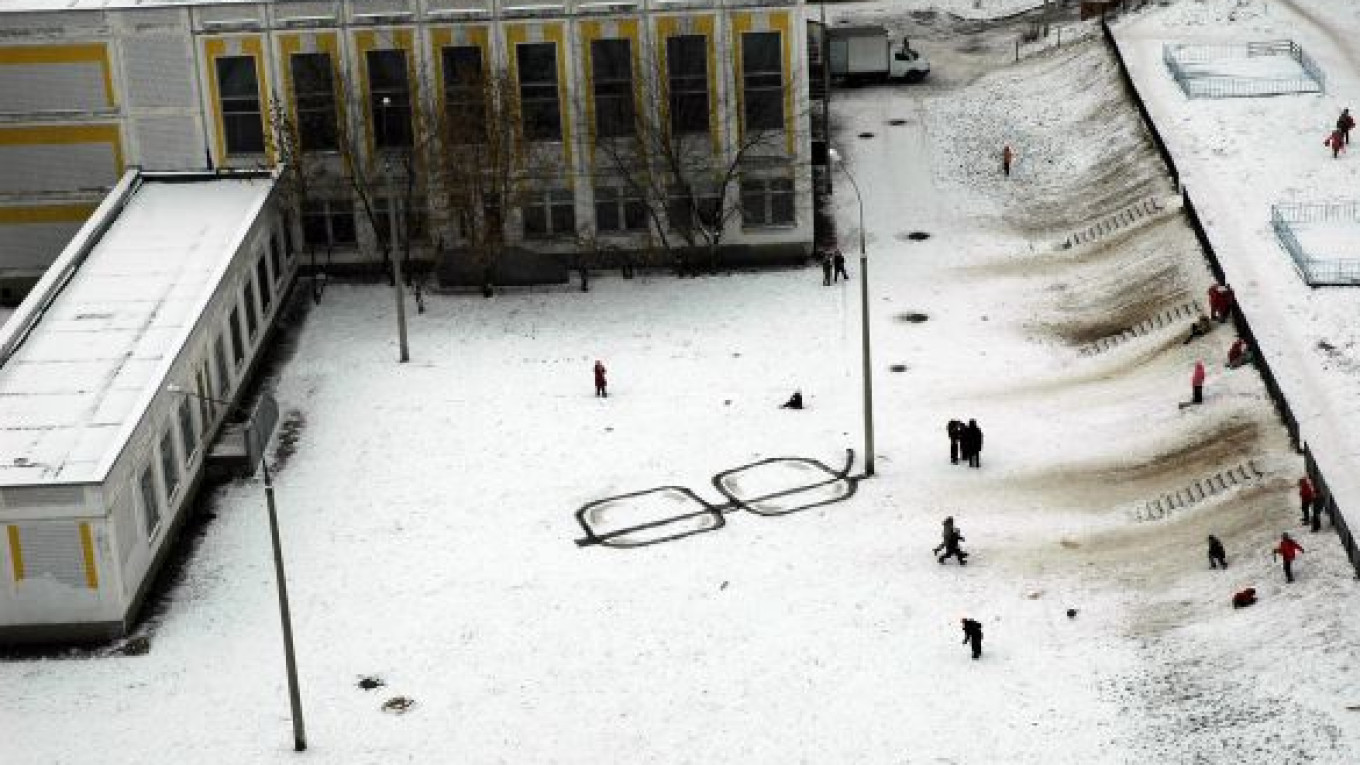
Other famous work includes a huge pair of spectacles drawn so that a lamppost appears to be the frames of the glasses and a man in a scarf holding a flaming torch on a bridge.
Much of the work only now exists in photos as local councils move quickly to clean walls, he said.
All of the artists are unwilling to be pinned down about what they believe in.
"I do political stuff for myself. I don't need people to know who I am or what it means," Dobry said.
Radical measures are the only answer if you want to make a political statement, 0331 c said.
"Otherwise it's better not even to talk about it. Politics don't belong in art. Some people put politics in their art to get famous, but that's too easy," 0331 c said.
A Message from The Moscow Times:
Dear readers,
We are facing unprecedented challenges. Russia's Prosecutor General's Office has designated The Moscow Times as an "undesirable" organization, criminalizing our work and putting our staff at risk of prosecution. This follows our earlier unjust labeling as a "foreign agent."
These actions are direct attempts to silence independent journalism in Russia. The authorities claim our work "discredits the decisions of the Russian leadership." We see things differently: we strive to provide accurate, unbiased reporting on Russia.
We, the journalists of The Moscow Times, refuse to be silenced. But to continue our work, we need your help.
Your support, no matter how small, makes a world of difference. If you can, please support us monthly starting from just $2. It's quick to set up, and every contribution makes a significant impact.
By supporting The Moscow Times, you're defending open, independent journalism in the face of repression. Thank you for standing with us.

Remind me later.