

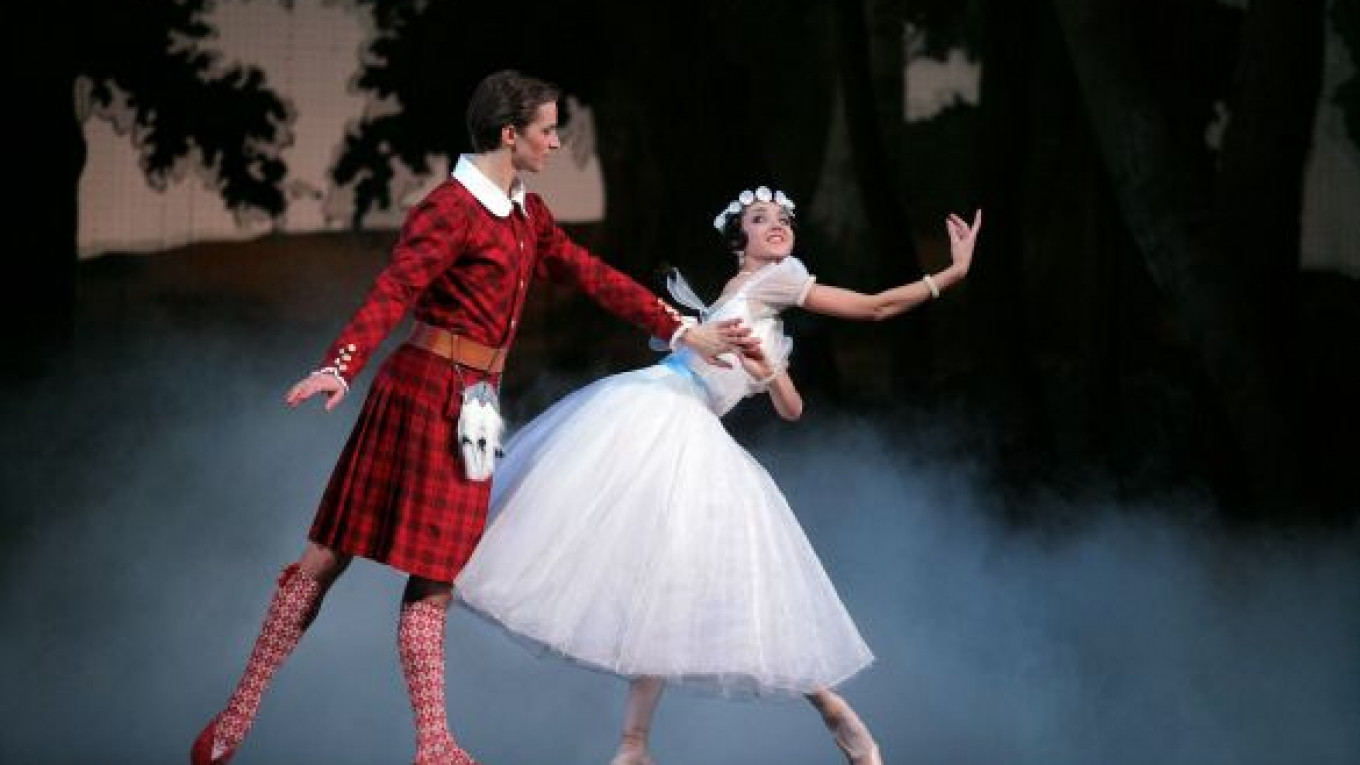
The Stanislavsky and Nemirovich-Danchenko Musical Theater has enjoyed remarkable success over the past three years in adding to its ballet repertoire. And the weekend before last, it provided Moscow ballet audiences with still more to be grateful for when it premiered “La Sylphide,” the oldest work in the international ballet repertoire that remains today more or less in its original form.
There are, in fact, two versions of “La Sylphide” currently to be found on the world’s ballet stages. One is a reconstruction of the original Paris staging of 1832 created four decades ago for the Paris Opera Ballet by French choreographer Pierre Lacotte. The other is a version with different music and greatly altered choreography that August Bournonville “pirated” four years later for his Royal Danish Ballet and that that company has continued to perform, with relatively minor changes, right up to the present day.
The past 17 years have seen two productions of Bournonville’s “La Sylphide” at the Bolshoi Theater, the second and more authoritative of which was staged there in 2008 by the
Danish-born star of London’s Royal Ballet, Johan Kobborg. The Stanislavsky and Nemirovich-Danchenko, on the other hand, has opted for Lacotte’s reconstruction. And with that, Moscow has probably become the only place in the world where both versions are now simultaneously on display.
The choreography of the original “La Sylphide,” as created by Filippo Taglioni to showcase the extraordinary talent of his ballerina daughter Marie, has long been lost. For his reconstruction, therefore, Lacotte has relied on prints, drawings and archival material from the time of the ballet’s premiere, as well on his own vast store of knowledge as to how ballet was danced during the middle years of the 19th century.
The result is a “La Sylphide” in the spirit and style of its first staging rather than an attempt to accurately reproduce the original. Some aspects of Lacotte’s production clearly differ from what was seen at the Paris Opera in 1832. At the premiere, only Marie Taglioni danced in pointe shoes, which were then a novelty in ballet of very recent origin. Lacotte has placed them on the feet of the entire female corps de ballet. The principal male role of James was essentially created for an actor. In Lacotte’s reconstruction, James becomes a full-fledged dancer. Despite these and other bits of “modernization,” Lacotte’s version of “La Sylphide” quite convincingly evokes the ballet world of a long-lost era, just as his reconstruction did for the Bolshoi 12 years ago of Marius Petipa’s classic from the 1860s, “The Pharaoh’s Daughter.”
The story of “La Sylphide” concerns a so-called sylph — an imaginary being believed to inhabit the air — who appears to a young Scotsman named James on his wedding day and lures him away to her forest home. James tries to catch her, but she eludes his grasp. Suddenly, an old hag named Madge comes on the scene and presents him with a magical scarf that she claims will capture the sylph. Madge, however, has hexed the scarf and when James wraps it around the sylph she expires in his arms. As she is borne away by her sister sylphs, “the unfortunate James,” in the words of Bournonville, “overwhelmed by grief, casts yet another look at his airy mistress and falls to the ground in a swoon.”
The past few seasons have seen the Stanislavsky and Nemirovich-
Danchenko’s ballet troupe superbly master the complicated and unfamiliar choreography of such modern masters as Nacho Duato, Jorma Elo and Jiri Kylian. Now, with the 79-year-old Lacotte himself in charge of its “La Sylphide,” the troupe has shown itself almost equally adept at assimilating the intricate and, for Russian-trained dancers, very “foreign” movements of French Romantic-era ballet.
The theater’s first cast, which I missed, featured its regular guest soloist from the Mariinsky Theater, Yevgenia Obraztsova, in the title role, and Brazilian Thiago Bordin, from the Hamburg Ballet, as James. But a less starry pair of principals in the second cast, drawn from the theater’s own roster, Erika Mikirticheva and Oleg Rogachev, gave very skilled and satisfying accounts of their respective roles. The corps de ballet danced rather cautiously in ensembles that call for faultless coordination, but showed real promise of a greater sense of security once more familiar with the steps.
Lacotte’s reconstructed “La Sylphide” will probably appear in repertory once or twice a month throughout the remainder of the Stanislavsky and Nemirovich-Danchenko’s current season, while in February the Bolshoi is due to bring back Bournonville’s equally entrancing and rather more ethereal version of the ballet following a long absence from its stage. Comparing the two is likely to be a very special treat.
“La Sylphide” (Silfida) next plays on Jan. 19 and 20 at 7 p.m. at the Stanislavsky and Nemirovich-Danchenko Musical Theater, located at 17 Bolshaya Dmitrovka. Metro Chekhovskaya, Pushkinskaya. Tel. 629-2835.
A Message from The Moscow Times:
Dear readers,
We are facing unprecedented challenges. Russia's Prosecutor General's Office has designated The Moscow Times as an "undesirable" organization, criminalizing our work and putting our staff at risk of prosecution. This follows our earlier unjust labeling as a "foreign agent."
These actions are direct attempts to silence independent journalism in Russia. The authorities claim our work "discredits the decisions of the Russian leadership." We see things differently: we strive to provide accurate, unbiased reporting on Russia.
We, the journalists of The Moscow Times, refuse to be silenced. But to continue our work, we need your help.
Your support, no matter how small, makes a world of difference. If you can, please support us monthly starting from just $2. It's quick to set up, and every contribution makes a significant impact.
By supporting The Moscow Times, you're defending open, independent journalism in the face of repression. Thank you for standing with us.

Remind me later.