

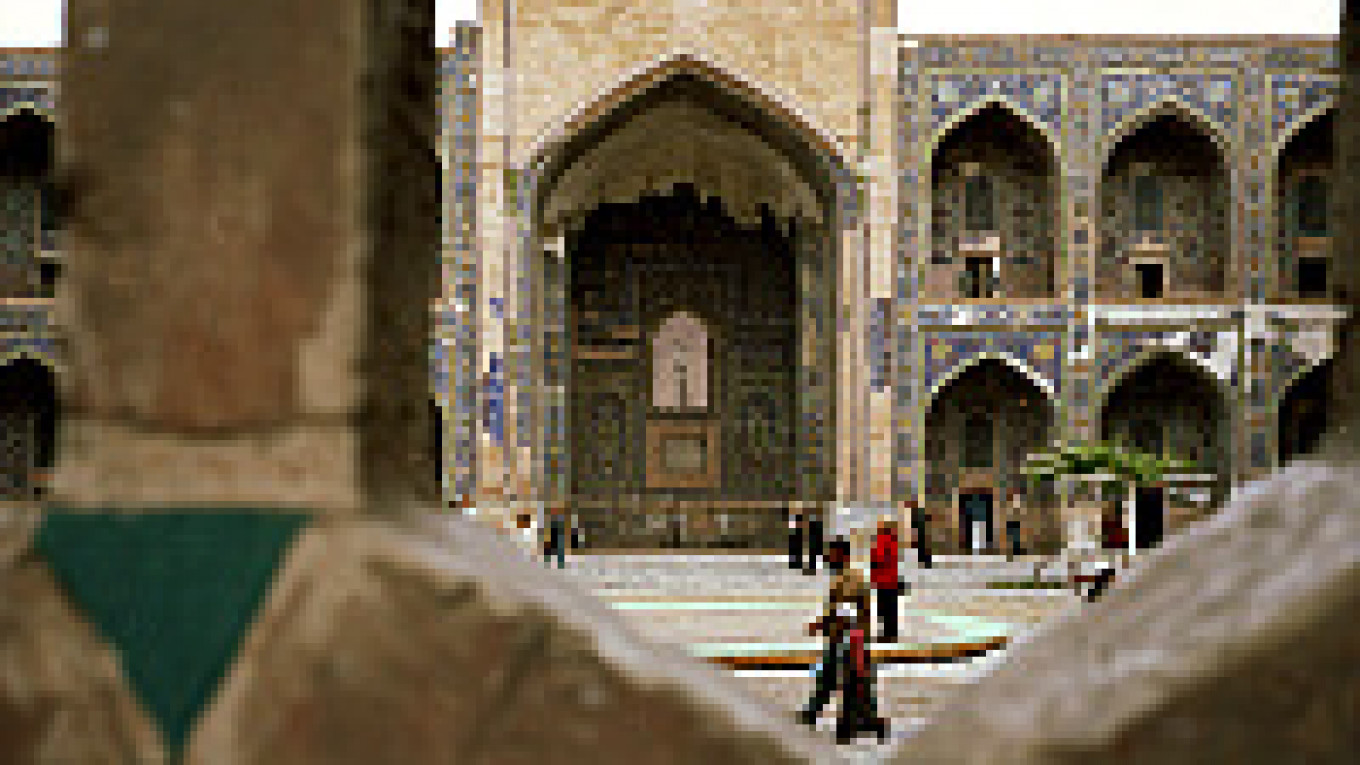
At nighttime, the three madrassas on Registan Square serve as a backdrop for a show that combines colored illumination with loud and ominous narration in different languages, recounting the story of Tamerlane. The rumbling "Ich bin Timur!" can jolt tourists out of peaceful enjoyment of the scenery, and the technicolored light beams are a tacky reminder of the 21st century.
But although Samarkand is a tourist town compared with the rest of Uzbekistan, there is still plenty of authenticity to go around, from tasting local halvah and haggling for the price of spice at the Siob bazaar to sitting down at one of the mausoleums with a group of pilgrims. Of course, as a foreigner you would have to pay five to 10 times more than the locals for these experiences, but even with such a steep difference, most sights cost 3,800 soms, or just under $3.
Timur, or Tamerlane, was a mighty conqueror who built his empire on the debris remaining after Genghis Khan's bloody stampede across Central Asia. There are very few pre-Mongol structures left in Samarkand, and most of the city's postcard views with turquoise domes, glazed tiles and mosaics are post-14th century creations of Timur or other rulers of the Timurid dynasty. The most notable members of Timur's family are buried in the Gur-i-Amir mausoleum, a small ornate chamber southwest of Registan.
The Bibi Khanym Mosque is another must-see in the old town. Named after Timur's wife, this complex was at the time one of the largest religious structures in the world, stretching the limits of architecture. Today's building is a remake from the 1970s, since the original crumbled after an earthquake. The structure in the center of the courtyard is a hangout for people selling art and various trinkets. It's actually a huge marble Koran.
Commerce surrounds Bibi Khanym on all sides -- peddlers attack you by the entrance, armed with handicrafts, shark's teeth and even Russian down shawls from Orenburg. A little further down is the colorful Siob bazaar with everything you can imagine, from local snacks, like salted apricot pits, to Uzbek tubeteikas, towering stacks of flat breads and the unsightly meat stalls.
Maria Antonova / MT
From a distance, the Shah-i-Zinda mausoleum complex resembles a space module.
|  |
| |
From Shah-i-Zinda, you can also take an overheated minibuses or a cab to the Ulughbek observatory on the outskirts of town. Unlike the green avenues of the western part of the city, this part of town has seen little construction. The Tashkent-bound road runs through bare, sun-brazen hills that hide ruins of Afrasiab, the oldest part of Samarkand and one of the oldest dwellings in the world, home to Zoroastrians, Christians and later, Arabs. Archeologists have been picking at it since the 1870s, and you can see some of their finds at the history museum.
The grandeur of Samarkand's main attractions coexists with Soviet architecture, communist mosaics, drab all-purpose shops and giant schools constructed after 2006, when the government budget for education increased by 8 percent. The Soviet part of town consists of several boulevards that fan out westward.
Older central neighborhoods, called mahallas in Uzbek, have one-story houses, some of which have been converted to guesthouses and B&Bs. In Uzbekistan, private residences have imposing walls and gates, hiding a courtyard garden with rooms around its perimeter. Occasionally, the action spills out into the neighborhood chaikhonas (or, cafes) or on to the streets. One family on Mulokandov street hangs dozens of birdcages on a tree outside of their house, allowing passersby to enjoy the singing of their canaries.
Life in Samarkand mostly dies down around nine in the evening. Cafes may serve you some bread and stale shashlik after that, but you are better off getting food earlier or fixing your own dinner. Although at lunchtime you can see people digging into a pile of plov or eating hearty soups, evening cafe culture appears to be limited to beer, tea and gossip.
How to Get There
By air: There are daily flights to Samarkand from Domodedovo Airport, serviced by Uzbekistan, Moskovia, and Domodedovo Airlines.
By train: A comfortable train "Registon" runs between Samarkand and Tashkent twice a day. The trip takes 2.5 hours.
Where to Stay
Bahodir B&B
A guesthouse that is run by Bahodir and his large family. There are dorm rooms and separate suites, priced from $6 per person. The cheapest accommodation here is rather shoddy, but a convivial atmosphere, breakfast and proximity to Registan wholly makes up for it.
A Message from The Moscow Times:
Dear readers,
We are facing unprecedented challenges. Russia's Prosecutor General's Office has designated The Moscow Times as an "undesirable" organization, criminalizing our work and putting our staff at risk of prosecution. This follows our earlier unjust labeling as a "foreign agent."
These actions are direct attempts to silence independent journalism in Russia. The authorities claim our work "discredits the decisions of the Russian leadership." We see things differently: we strive to provide accurate, unbiased reporting on Russia.
We, the journalists of The Moscow Times, refuse to be silenced. But to continue our work, we need your help.
Your support, no matter how small, makes a world of difference. If you can, please support us monthly starting from just $2. It's quick to set up, and every contribution makes a significant impact.
By supporting The Moscow Times, you're defending open, independent journalism in the face of repression. Thank you for standing with us.

Remind me later.