

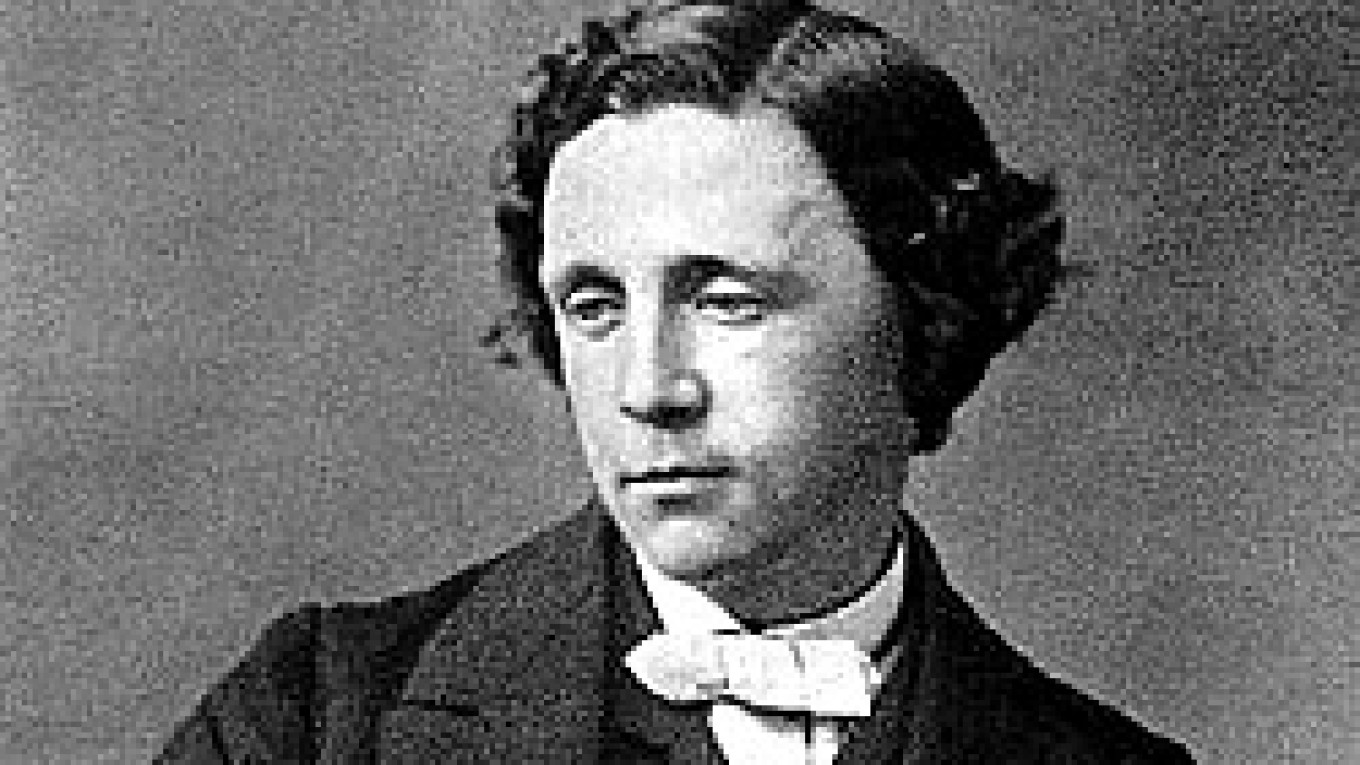
The publishing house Olma Group has issued a book in its series titled "The Library of Publisher Angel de Coitier" (at least that's how I reconstruct this mock-foreign pen name from its Cyrillic version). This particular book contains an early Russian translation of "Alice in Wonderland" -- an interesting detail in the reception of Lewis Carroll in Russia, though somewhat surprising, given the existence of several superior translations. But the most interesting part is the "publisher's" foreword, which debunks the myth of Carroll's pedophilia. A noble task -- were it not an extremely kitschy retelling of an article by Alexandra Borisenko and Nina Demurova (the best Russian translator of Carroll), published several years ago in "Foreign Literature" magazine and widely available on the Internet. Careful examination of the two texts reveals that Coitier had no other source of information about Carroll whatsoever; he either quotes the article verbatim without any references or adds some jargon expression and exclamation marks. It's a good thing Coitier is not a real person.
Another publishing house, Molodaya Gvardia, has issued a new book in its popular series "Everyday Life," this time "Everyday Life of Victorian England" by Tanya Dittrich. Even in a popular book, the absence of an index of names, footnotes and any indication of the sources consulted is somewhat baffling. More baffling are lengthy quotes from fiction as proof of the author's points, apparently in Dittrich's own translation (because Soviet translations of English classics were never so bad), and, again, without any indication of their origin. Add to that a very liberal understanding of the Victorian era, which, according to Dittrich, accommodates Jonathan Swift (who died in 1745) and P.G. Wodehouse (whose literary career spanned from 1902 to 1975). Queen Victoria, of course, reigned from 1837 to 1901. Dittrich also routinely mixes people up, such as Beatrix Potter of Peter Rabbit fame and Beatrice Potter Webb, the socialist and ardent defender of Soviet Communism.
The Victorians have lots to tell us. It is sad that the current state of Russian popular nonfiction results in such wonderful material being rendered so unsatisfactorily.
A Message from The Moscow Times:
Dear readers,
We are facing unprecedented challenges. Russia's Prosecutor General's Office has designated The Moscow Times as an "undesirable" organization, criminalizing our work and putting our staff at risk of prosecution. This follows our earlier unjust labeling as a "foreign agent."
These actions are direct attempts to silence independent journalism in Russia. The authorities claim our work "discredits the decisions of the Russian leadership." We see things differently: we strive to provide accurate, unbiased reporting on Russia.
We, the journalists of The Moscow Times, refuse to be silenced. But to continue our work, we need your help.
Your support, no matter how small, makes a world of difference. If you can, please support us monthly starting from just $2. It's quick to set up, and every contribution makes a significant impact.
By supporting The Moscow Times, you're defending open, independent journalism in the face of repression. Thank you for standing with us.

Remind me later.