

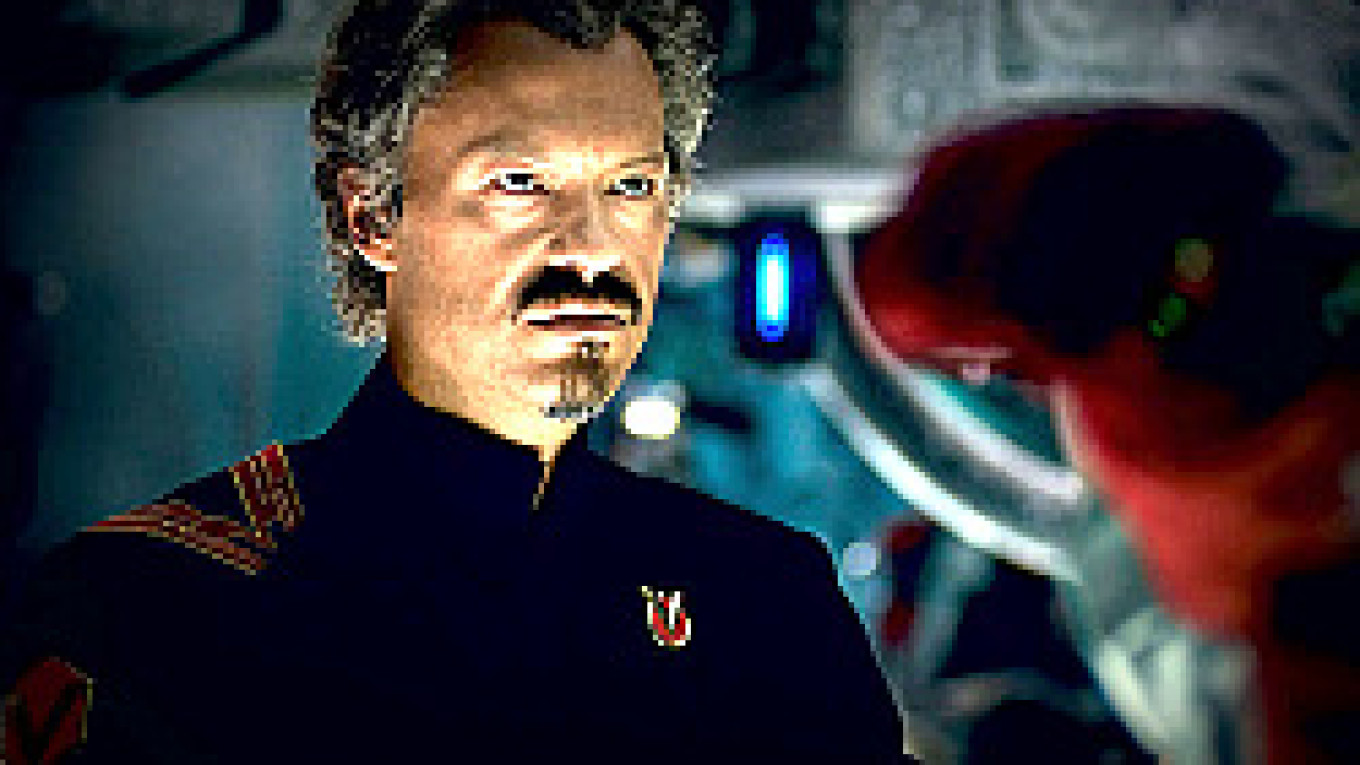
That gives it an epic hype -- but, as is so often the case with these mega-blockbusters, the question remains as to whether the finished product lives up to it. It's epic visually, to be sure, but I have to confess to being rather underwhelmed by the whole effect, not least because of a certain lack of emotional engagement with its characters, who are downplayed by the dazzling d??cor.
"Inhabited Island" is an adaptation of a celebrated science fiction novel from 1968 by the brothers Arkady and Boris Strugatsky. It's essentially a dystopia, set in the year 2758 in a solar system where technological progress has brought as many problems as it has benefits. In its day, the book had a contemporary frisson -- as most depictions of totalitarian regimes inevitably did in the Soviet Union -- and that's a touch that remains timely today, although to what extent the filmmakers intended to make the film relevant in that way remains unclear.
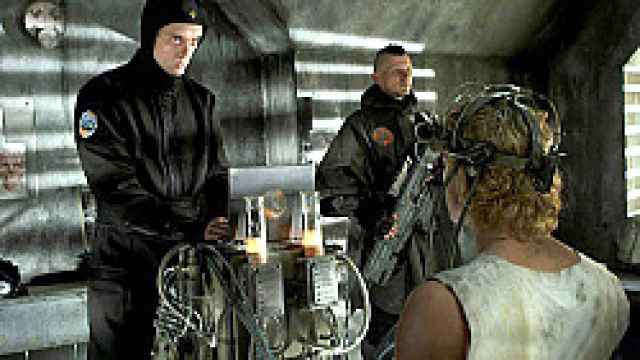
Central hero Maxim (played by the young and highly photogenic Vasily Stepanov) is essentially a space explorer, who crash-lands his spacecraft on the planet Saraksh. There, things are not going well: In the aftermath of nuclear wars, the environment is in crisis, and political rule is concentrated in the hands of five "Unknown Fathers" ( the baddies, essentially).
 Obitaemy Ostrov |  |
| |
Director Bondarchuk came out of the pop video and advertising climate of the 1990s, and it certainly shows in "Inhabited Island." By contrast, his "Company 9" achieved considerable emotional depth with a story that, at first glance, might have seemed unpromising; the soldier-to-soldier bonding in that film was set up strongly, and narrative and pace seemed exactly right, which can't be said for the director's new film. In some way, it alludes to Tolkien's "Lord of the Rings," whose central characters guard their fates against an uncertain external world -- but with so much more empathy than anything to be found in "Inhabited Island."
Of course, the visual effects -- which are truly impressive -- somewhat make up for that. Full credit is due to cinematographer Maxim Osadchy (although his close-ups on faces have considerably more power than the epic landscape shots) and even more to the film's production designers. The music is suitably epic where it needs to be, which unfortunately contrasts with the script by Eduard Volodarsky, a decidedly wordy text.
A venerable cast of supporting actors includes the likes of Sergei Garmash and Gosha Kutsenko, who are depicted in a style that should certainly earn the film's make-up artists an award. Bondarchuk himself appears in the role of the local law-enforcer, or prosecutor, with a chilliness of character that he plays well (so naturally that one suspects it is inborn).
His character helps form what ends up a fascinating political sub-text: What we see is essentially a New York-style mixed-up metropolis with a crypto-fascist regime. You might think of Russia today -- it certainly reminded me of a few contemporary Central Asian nations.
It presents a view of politics as a process that is highly cynical to say the least, and it isn't satirical. That may be how life is -- but it's a reality that is hard to warm to.
A Message from The Moscow Times:
Dear readers,
We are facing unprecedented challenges. Russia's Prosecutor General's Office has designated The Moscow Times as an "undesirable" organization, criminalizing our work and putting our staff at risk of prosecution. This follows our earlier unjust labeling as a "foreign agent."
These actions are direct attempts to silence independent journalism in Russia. The authorities claim our work "discredits the decisions of the Russian leadership." We see things differently: we strive to provide accurate, unbiased reporting on Russia.
We, the journalists of The Moscow Times, refuse to be silenced. But to continue our work, we need your help.
Your support, no matter how small, makes a world of difference. If you can, please support us monthly starting from just $2. It's quick to set up, and every contribution makes a significant impact.
By supporting The Moscow Times, you're defending open, independent journalism in the face of repression. Thank you for standing with us.

Remind me later.