

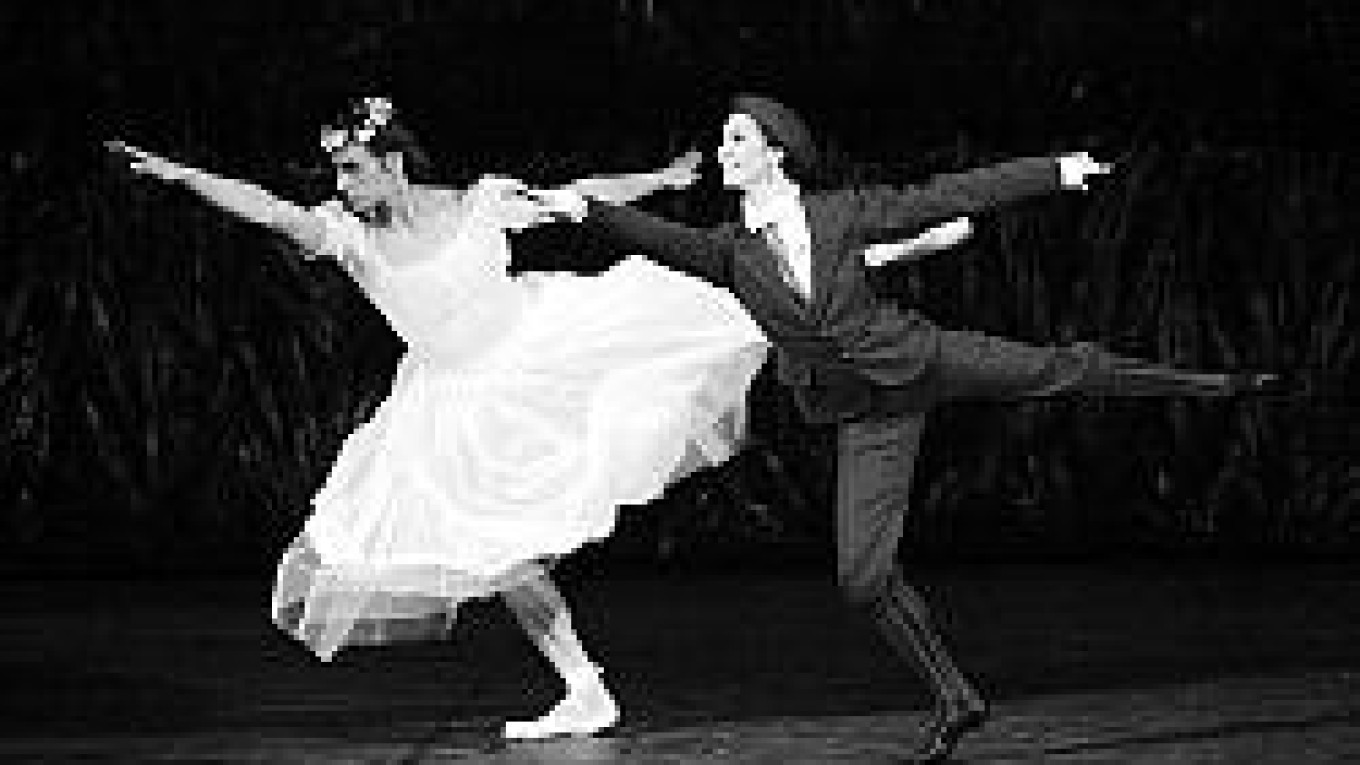
Of course, times have changed since the Bolshoi first wooed New York audiences with a taste of its rigor and grace at the old Met in 1959. Reviewers pointed out that women now outshine the company's historically powerful male dancers. And rather than the Soviet warhorses, it was the new productions -- a revival of Marius Petipa's "Pharaoh's Daughter" and a reworking of Dmitry Shostakovich's "The Bright Stream" -- that elicited the most enthusiastic critical applause.
Audiences, however, snatched up tickets for the mainstays of the Bolshoi's repertoire. Perhaps, as Eleanor Randolph noted in The New York Times, this was because the Met was packed with "so many Russians it sounded like the old days on Teatralnaya Square." The heavily emigre audience flocked to Lincoln Center from the city's Russian-populated neighborhoods and suburbs, eagerly snatching up tickets for "Spartacus" and "Don Quixote."
The company opened with a faithful staple of its repertoire, "Don Quixote," to a chorus of mixed reviews. The New York Post thought the show a "buoyant and stylish introduction," pointing to a "sparkling, exquisite and perfectly poised" Kitri, danced by Svetlana Zakharova, the company's ex-Mariinsky star. Other reviewers dissented, however, suggesting that Zakharova was miscast and lacked gusto.
Next on the bill was "Spartacus," the Bolshoi's signature Soviet-era work of muscular athleticism, still virtually unchanged since being choreographed in 1968 by Yury Grigorovich to an Aram Khachaturian score. For all its inherent masculinity, reviewers singled out the female performers as the show's true stars, although most agreed that it was well done overall -- what New York Times dance critic John Rockwell called an "affectionate glance back at Soviet ballet at its apogee."
Spotlighting Ratmansky's adventuresome proclivity for new productions, the troupe next presented "The Bright Stream," recently choreographed by Ratmansky, who took the Bolshoi's helm in January 2004. Shostakovich's whimsical, light-hearted farce set on a collective farm charmed audiences and critics alike. Rockwell named it "the most enjoyable ballet of this run. It was lively and charming, taking gently satirical cognizance of the Soviet past but full of contemporary elan."
It was during a "Bright Stream" curtain call on July 25 that Ratmansky announced Svetlana Lunkina's promotion to principal status -- reportedly startling the young dancer and surprising the rest of the troupe, which was apparently not informed beforehand.
Topping off the New York run was "The Pharaoh's Daughter," a production inspired by the 1862 work of legendary balletmaster Marius Petipa, but in a modern adaptation choreographed and rescored five years ago by choreographer Pierre Lacotte. Zakharova and Maria Alexandrova, who both danced Aspicia, garnered rave reviews.
As the troupe left the city, most reviewers agreed that the Bolshoi's female dancers were superb -- although critics noted that if the men were not as impressive, perhaps it was because two leads had to withdraw from productions due to illness. Clive Barnes of The New York Post wrote, "Nowadays, the women are a good deal more interesting to watch than the men, and the Bolshoi has an abundance of female talent."
Echoing this, Rockwell pointed to the troupe's women and proclaimed, "This is the new face of the Bolshoi, and it's female."
A Message from The Moscow Times:
Dear readers,
We are facing unprecedented challenges. Russia's Prosecutor General's Office has designated The Moscow Times as an "undesirable" organization, criminalizing our work and putting our staff at risk of prosecution. This follows our earlier unjust labeling as a "foreign agent."
These actions are direct attempts to silence independent journalism in Russia. The authorities claim our work "discredits the decisions of the Russian leadership." We see things differently: we strive to provide accurate, unbiased reporting on Russia.
We, the journalists of The Moscow Times, refuse to be silenced. But to continue our work, we need your help.
Your support, no matter how small, makes a world of difference. If you can, please support us monthly starting from just $2. It's quick to set up, and every contribution makes a significant impact.
By supporting The Moscow Times, you're defending open, independent journalism in the face of repression. Thank you for standing with us.

Remind me later.