

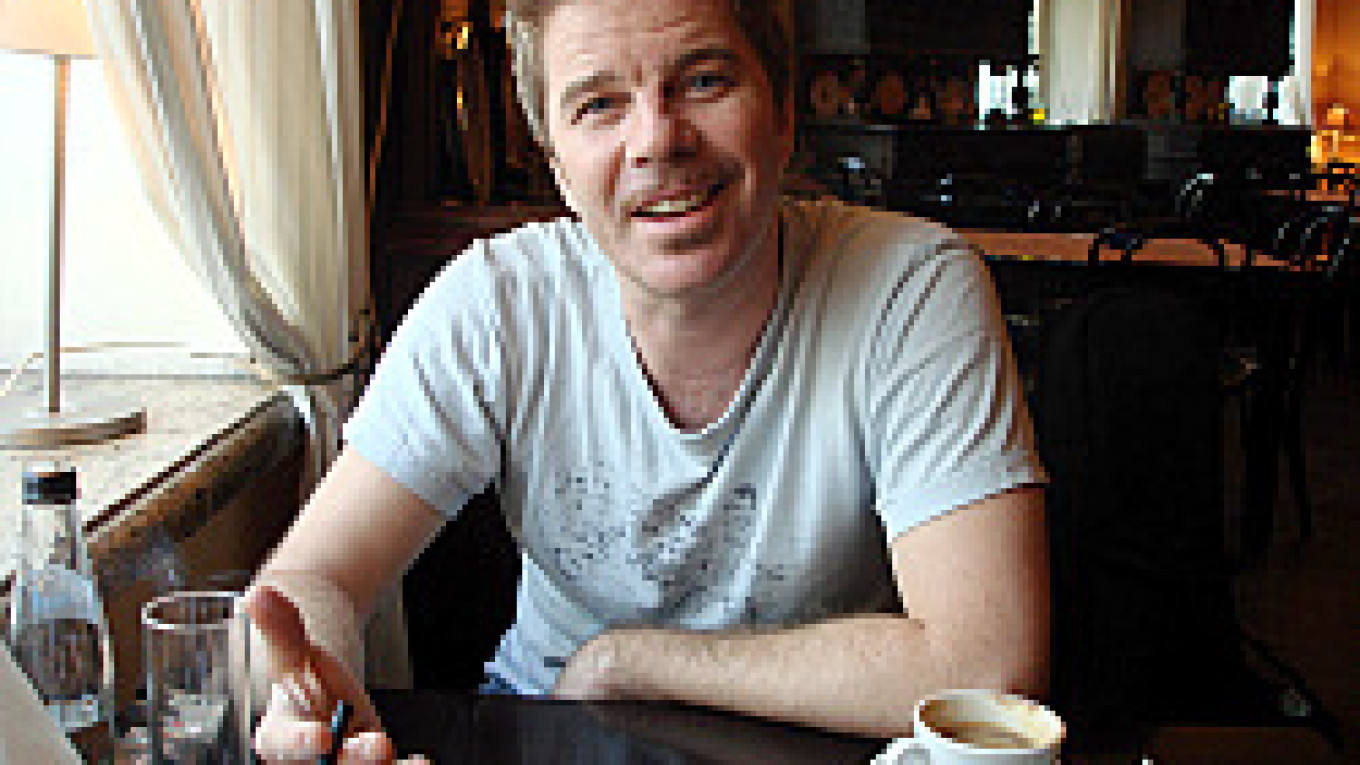
Brown, 40, is a self-educated world traveler who formed his musical style from elements encountered in his travels. He originally hails from Los Angeles, and is now based in Barcelona. Brazzaville's first lineup was all American, but after Brown moved to Barcelona in 2003 he assembled the current team, which includes two Americans and two Catalans. The band has played in India, Turkey and Kazakhstan.
Brown began his musical career at the age of 18 in San Francisco after buying an antique alto saxophone for its aesthetic value. With practically no prior musical training, Brown began taking lessons and eventually became skilled enough to get gigs with musicians including Siouxsie Sioux, Ben Lee and Jude. In the mid-1990s, he hooked up with indie icon Beck, who asked Brown to be his regular saxophonist. While touring with Beck in 1997, Brown conceived the idea for his own musical project. Brazzaville is named after the riverside capital of the Republic of Congo, which Brown first encountered as a dateline in a newspaper while searching for a name for the band.
"It's obviously the name of a place, because of the 'ville.' But 'Brazza' -- what a strange sound," Brown said in an interview in Moscow on Sunday. "It didn't sound necessarily African, European or South American. I thought maybe it could be like a mythological place of creativity and music for me."
The word Brazzaville has some of the same phonemes as Brazil, a country in which Brown spent six months traveling. The musician, who had been raised on a diet of quirky rock such as Magazine, Roxy Music, the Clash and the Stranglers, delved into Brazilian music and came away with the defining element for the sound of Brazzaville: bossa nova. Brazzaville's music is a singular, streamlined mix of bossa nova and rock infused with Brown's rich baritone and guitar-playing.
Brazzaville has a cult following in Europe and the United States, but enjoys widespread popularity in Russia due to extensive exposure. The band has toured cities other than Moscow and St. Petersburg fairly extensively and all of its records have been released on the local label Zakat/Soyuz. Brazzaville's 2004 album "Hastings Street" has so far only been released in Russia. Brown has even recorded a cover -- with new English lyrics -- of "A Star Called Sun" by Kino, the glasnost-era rock band from St. Petersburg.
"Russia remains a mystery to me. It's in Europe, and yet it has a very different culture than other European countries," Brown said. "Young people in Russia, especially in the provincial cities, have an innocence to them that's gone in the West."
Brazzaville plays Fri. at 7 p.m. at B1 Maximum, located at 11 Ulitsa Ordzhonikidze, Metro Leninsky Prospekt. Tel. 648-6777. David Brown plays Sun. at 9 p.m. at Ikra, located in the Gogol Theater at 8A Ulitsa Kazakova, Metro Kurskaya. Tel. 262-4482.
A Message from The Moscow Times:
Dear readers,
We are facing unprecedented challenges. Russia's Prosecutor General's Office has designated The Moscow Times as an "undesirable" organization, criminalizing our work and putting our staff at risk of prosecution. This follows our earlier unjust labeling as a "foreign agent."
These actions are direct attempts to silence independent journalism in Russia. The authorities claim our work "discredits the decisions of the Russian leadership." We see things differently: we strive to provide accurate, unbiased reporting on Russia.
We, the journalists of The Moscow Times, refuse to be silenced. But to continue our work, we need your help.
Your support, no matter how small, makes a world of difference. If you can, please support us monthly starting from just $2. It's quick to set up, and every contribution makes a significant impact.
By supporting The Moscow Times, you're defending open, independent journalism in the face of repression. Thank you for standing with us.

Remind me later.