

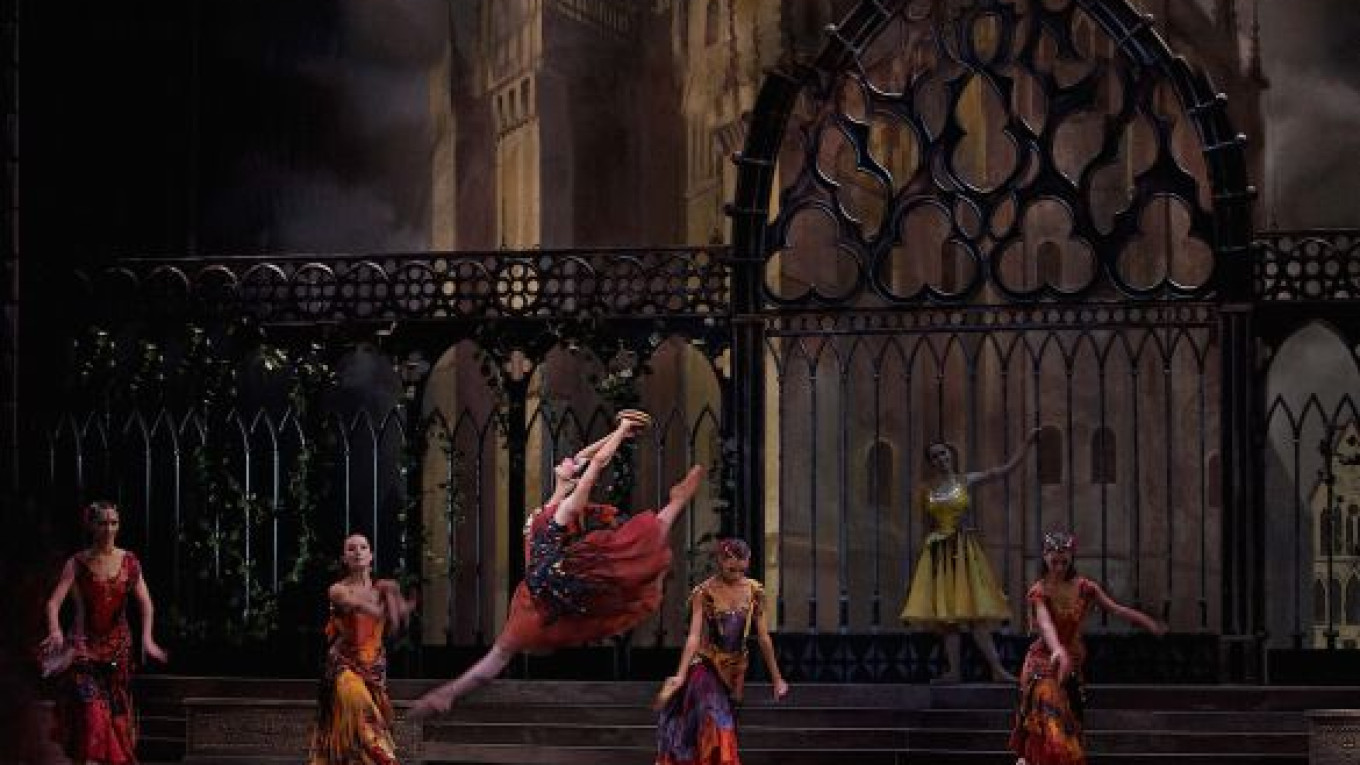
Late last month, the theater again struck gold, with a superb revival of one of its principal ballet treasures, an unorthodox version of the 19th-century classic “Esmeralda” created 59 years ago by Vladimir Burmeister, the theater’s ballet master for some three decades after his appointment in 1941.
“Esmeralda” is one of many works for stage and screen that takes its story from Victor Hugo’s famous novel “Notre Dame de Paris” and first appeared in London in 1844, 13 years after the novel’s publication, in choreography by Frenchman Jules Perrot, best-known as the creator of “Giselle,” and with music by prolific Italian ballet composer Cesare Pugni. In 1848, Perrot himself staged the Russian premiere of “Esmeralda” in St. Petersburg and two years later brought it to Moscow.
Burmeister’s version of the ballet strays quite far from Perrot’s original and emerges as one of the rare examples of “drambalet,” or dramatic ballet — the expression in dance of Stalin’s doctrine of Socialist Realism that reigned supreme on the Soviet stage from the 1930s to 1960s — that can still be enjoyed today without serious reservation. The music is a reworking of Pugni’s score by the eminent Soviet composer Reinhold Gliere, with several additions to the score by long-time Moscow Conservatory professor Sergei Vasilenko.
For benefit of the few who may be unfamiliar with its underlying story, the ballet tells of a young Parisian street dancer named Esmeralda, kidnapped as an infant by gypsies, who has captured the eye (and lust) of both Phoebus, Captain of the King’s Archers, and a worldly priest named Claude Frollo, the Archdeacon of Notre Dame Cathedral. Esmeralda falls for the handsome Phoebus and spurns the advances of Frollo, who takes his revenge by implicating her in an attempted murder of Phoebus, an act that he himself has committed. Esmeralda dies on the gallows, but Frollo soon meets his own death, thrown from a tower of Notre Dame by the cathedral’s deformed bell ringer, Quasimodo.
For its revival of “Esmeralda,” the theater has meticulously copied Alexander Lushin’s original 1950 decor, which depicts late 15th-century Paris with startling realism and includes a facade of Notre Dame detailed right down to the very last gargoyle. There is nothing revolutionary about Burmeister’s classically based choreography. But it is filled with imaginative touches expertly attuned to the story and in total effect provides one of the most enthralling evenings of ballet to be found anywhere in Moscow.
Russia’s stages boast many a fine ballerina. But none I can think of seems more perfectly suited to the title role in Burmeister’s “Esmeralda” than Natalya Ledovskaya, who danced it on opening night. Even in the autumn of her career, she retains technical skills second to none, which she combines with an almost uncanny ability to create character within the constraints of classical dance.
Both dance and pantomime appeared in abundance among the rest of the large cast, a tribute not only to ballet artistic director Sergei Filin’s staging but also to his revitalization of the company during his season and a half at its helm.
Young soloist Semyon Chudin gave a commanding account of Phoebus; veteran Viktor Dik proved a suitably sinister Claude Frollo; and Natalya Somova, though a bit too much the conventional ingenue, danced quite beautifully as Phoebus’ rich and haughty fiancee, Fleur-de-Lys.
Deserving special praise among others in the cast were two of the company’s most highly promising young women, Maria Semenyachenko (a first-prize winner in Moscow last June at the 11th International Ballet and Choreographers’ Competition) and Oksana Kardash, who danced variations in the big scene of Fleur-de-Lys. Also noteworthy were the idiomatic Gypsy of Irina Belavina, the wonderfully grotesque Quasimodo of Anton Domashev and the whole company of Fools that provided such a rousing start to the first act.
Probably by accident, rather than design, Moscow audiences have just been presented with yet another “Esmeralda,” this time at the Bolshoi Theater in a reconstruction of the choreography created by Marius Petipa for a revival at St. Petersburg’s Mariinsky Theater in 1899. But comment on that will have to wait until The Moscow Times reappears in January.
“Esmeralda” next plays Jan. 29 at 7 p.m. at the Stanislavsky and Nemirovich-Danchenko Musical Theater, 17 Bolshaya Dmitrovka. Metro Chekhovskaya. Tel. 650-2835, www.stanmus.ru.
A Message from The Moscow Times:
Dear readers,
We are facing unprecedented challenges. Russia's Prosecutor General's Office has designated The Moscow Times as an "undesirable" organization, criminalizing our work and putting our staff at risk of prosecution. This follows our earlier unjust labeling as a "foreign agent."
These actions are direct attempts to silence independent journalism in Russia. The authorities claim our work "discredits the decisions of the Russian leadership." We see things differently: we strive to provide accurate, unbiased reporting on Russia.
We, the journalists of The Moscow Times, refuse to be silenced. But to continue our work, we need your help.
Your support, no matter how small, makes a world of difference. If you can, please support us monthly starting from just $2. It's quick to set up, and every contribution makes a significant impact.
By supporting The Moscow Times, you're defending open, independent journalism in the face of repression. Thank you for standing with us.

Remind me later.