

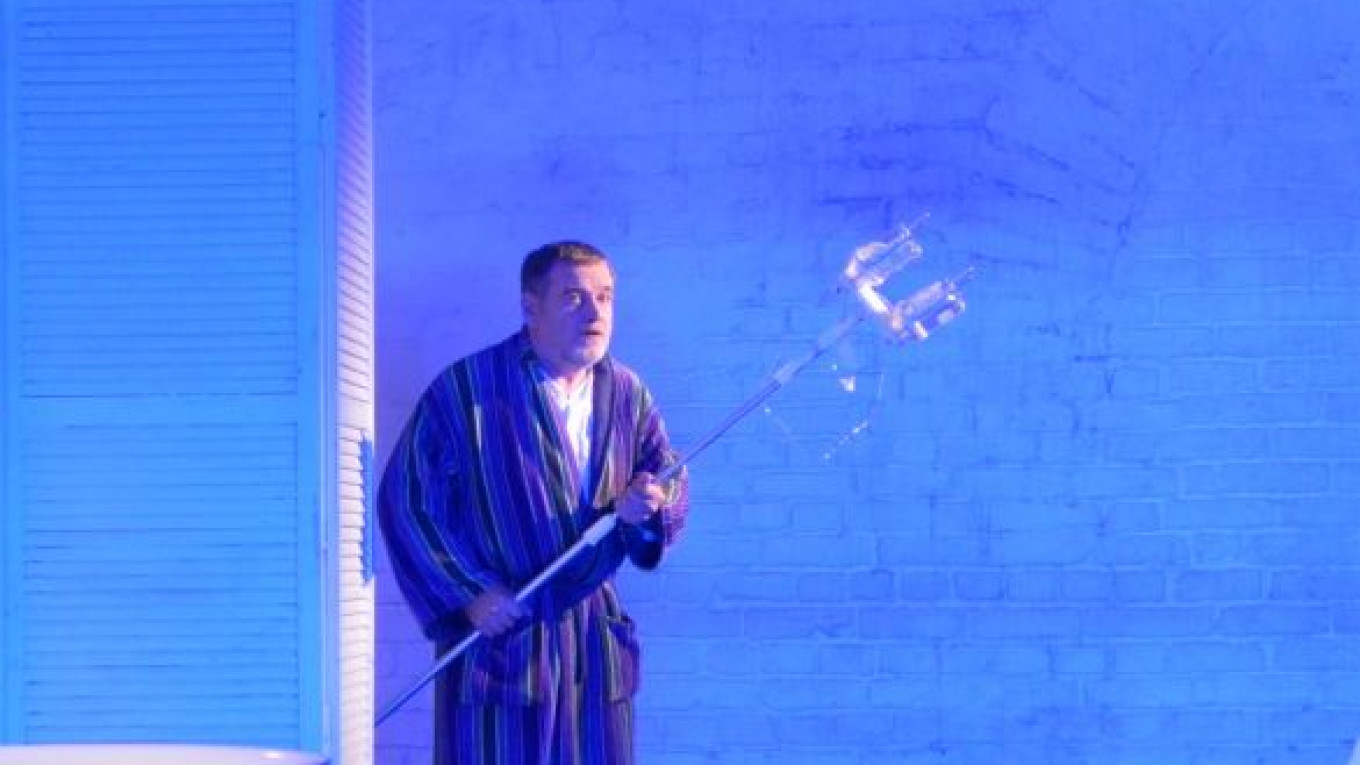
Don Quixote is one of a handful of non-Russian myths that have played significant roles in the formation of the Russian cultural psyche. The indecisive Hamlet — who has certain spiritual ties to Don Quixote — is another, but Yevgeny Slavutin's production of "Don Quixote. Reboot" at the Moscow Open Student Theater has me thinking about the Spanish hidalgo at present.
Don Quixote is the quintessential dreamer. He sees foes where there are none and imagines allies where none are to be found. Hailing from the town of La Mancha, he is convinced that fate has summoned him to save the world. He is an idealist whose ideals are supported by nothing but his own desire to do good. He is all nobility and precious little substance.
All of this, with one particular exception, applies to the titular hero of Viktor Korkia's "Don Quixote and Sancho Panza on the Island of Taganrog," which forms the basis of "Don Quixote. Reboot." The difference is that Korkia's Don Quixote is from Anton Chekhov's hometown of Taganrog, the small southern Russian town (though not island) on the banks of the Azov Sea. As Korkia asks at one point in his play, wasn't Chekhov, with his pince-nez, a Don Quixote himself?
Korkia's verse play, which first appeared over a decade ago, is a loose, warmly rambling rumination on the baffling nature of life and the place of the Russian Don Quixote in it. It is, in turns, funny, philosophical and sad. But it is always funny.
Slavutin boiled Korkia's long, episodic poem down to a series of dialogues that take place between Quixote and his sidekick Sancho Panza. But it wasn't enough for the director that these encounters take place in Russia — he reset them in an eerily blue-lit Russian hospital where Don Quixote has retired to treat his mysterious beriberi, or hypovitaminosis, disease.
What that really means is the guy is plum exhausted.
Or is this place an insane asylum? The head doctor (Yury Ogulnik) barges into the ward from time to time with an eager crew of interns imitating his every move, but there is no way of knowing what he really is up to. The only thing certain about him is his monstrously Freudian expression and the fact that he can't take the patient's pulse because his watch doesn't work.
In this version of Korkia's play the great Don lies on a gurney next to that of his friend Sancho. Now, Sancho is a friend of a special kind. This is the type of person that would drive anyone mad. Like a child he is full of questions; like a boor he has all the answers. Like a bad neighbor he won't shut up. Like any gallant knight's worst enemy he lets none of Quixote's shortcomings pass unnoticed and, what's worse, without commentary. As played by Yevgeny Nikulin, this Sancho is akin to a nightmare. He is a comic nightmare, to be sure, but he mounts a merciless onslaught nonetheless.
Nikulin is all over the place, spouting and sputtering Korkia's verse punch lines about the impossibility of living with flaccid members, the dangers of being an ass — that is a donkey — and the responsibility of being an icon to whom the world looks in times of need. Indeed, when Sancho howls in despair Quixote criticizes him for doing it too realistically. "I can't howl unrealistically," the sidekick admits sadly.
Alongside the ubiquitous Sancho, Quixote (Ilya Kozhukhar) comes across as something of a straight man. One word from him calls forth a hurricane of rejoinders, observations and theories from the sidekick who is wracked with ambition, curiosity, suspicion and any other number of thought-provoking and butt-moving stimuli.
All of this rides on Korkia's flowing verse, in which wit and lyricism constantly relinquish their place of honor to one another.
The final scene — moved from the prologue in Korkia's original text — is a meditation on the nature of the stage. It is, Korkia says by way of Don Quixote, an empty place whose primary quality is its resonance, its sonority, its magical ability to make the metaphysical take tangible shape and form. Isn't that still another definition of the Russian Don Quixote — someone who has the ability to take nothing and make something of it?
Slavutin, especially in the person of Nikulin's Sancho Panza, creates a simple, though effective framework for Korkia's play.
"Don Quixote. Reboot" (Don Kikhot. Perezagruzka) plays Nov. 12 and 26 at 8 p.m. at MOST, the Moscow Open Student Theater, located at 6 Bolshaya Sadovaya Ulitsa. Metro Mayakovskaya. Tel. 699-8137, 699-5941. . Running time: 1 hour, 25 minutes.
A Message from The Moscow Times:
Dear readers,
We are facing unprecedented challenges. Russia's Prosecutor General's Office has designated The Moscow Times as an "undesirable" organization, criminalizing our work and putting our staff at risk of prosecution. This follows our earlier unjust labeling as a "foreign agent."
These actions are direct attempts to silence independent journalism in Russia. The authorities claim our work "discredits the decisions of the Russian leadership." We see things differently: we strive to provide accurate, unbiased reporting on Russia.
We, the journalists of The Moscow Times, refuse to be silenced. But to continue our work, we need your help.
Your support, no matter how small, makes a world of difference. If you can, please support us monthly starting from just $2. It's quick to set up, and every contribution makes a significant impact.
By supporting The Moscow Times, you're defending open, independent journalism in the face of repression. Thank you for standing with us.

Remind me later.