

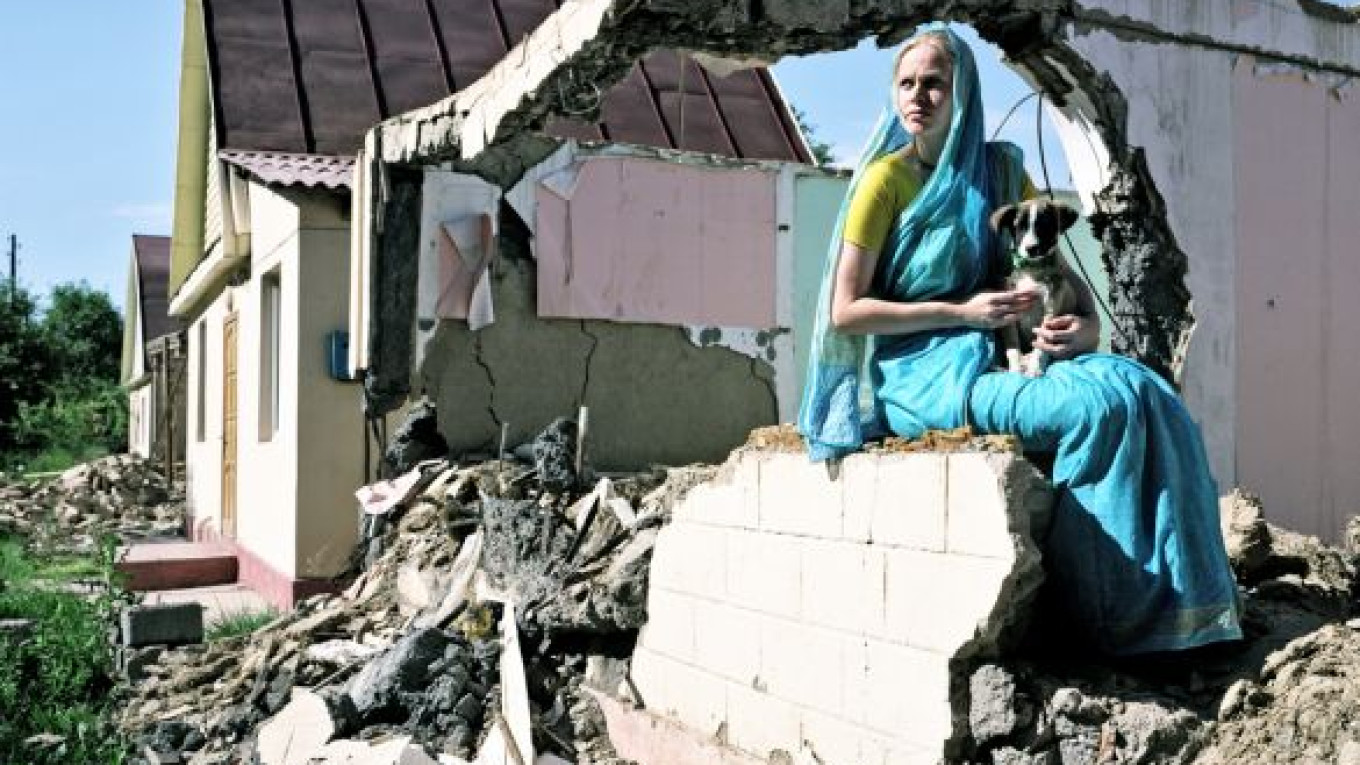
Moscow's Museum of Modern Art is currently hosting "Displacement," an exhibit by New York-based Italian photographer Giada Ripa that offers a glimpse of the diversity across the former Soviet Union and a narrative on travel and identity.
Two photo series, "Beyond the Oil Route" and "Falling Icons," make up the exhibit, the first an attempt to shed light on the lives of different ethnic and religious groups living in oil-rich countries along the former Silk Road, and the second the artist's exploration of her own identity in different landscapes.
"This is the first time these two works have been shown together; they appear to have very different visual language, but come from a similar source," Ripa told The Moscow Times in an interview.
This diverse show is the latest in a series of events associated with the Russian-Italian year of culture. But, in contrast to the Caravaggio exhibition currently on display at the Pushkin Museum of Fine Arts, it is something of a hidden gem. Its debut in Moscow has been accompanied by little fanfare, and its staging at MMoMA brings out the intimate feel of its subject matter.
"Beyond the Oil Route" is distinguished by its sensitive character portraits and the signs of fast-paced change that it points to in Central Asia and the Caucasus.
Shot over the last seven years, it captures people in everyday poses — whether at the market, on the steppe or at home — and has a special focus on displaced minority groups living along the former Silk Road, now sometimes known as the Oil Route.
A particularly poignant moment is captured in 2007 in Seleskia, Kazakhstan, where a Hare Krishna sits amid rubble. Kazakh authorities had ruled that the land on which the local Hare Krishna community center was built was not legally registered and demolished it.
In another of Ripa's photographs, the viewer is shown inside the home of the leader of the Molokan Orthodox Christian community in Ivanovka, Azerbaijan, a mountain village where Soviet-style cooperative ownership of land and sectarian beliefs still hold sway.
"Most of the Western world, through the media, hears about Xinjiang, Azerbaijan and Kazakhstan through economical and financial terms often referring to the oil business. But very few are aware of who inhabits these lands and of the multicultural face that exists beyond this once highly trafficked area that linked the Asian world to the old continent," Ripa said.
In contrast, the second series, "Falling Icons," is marked by introspection and experimentation.
Here we see Ripa lost in sweeping landscapes and dwarfed by the towering structures she encounters. She rarely appears at the center of the image — at times she is falling in a diagonal pose with her face obscured, at others no more than a blur.
In one large-scale photograph, Ripa is seen falling at the water's edge by the Nurek Dam in Tajikistan, the tallest such construction in the world. Her diminutive form, with its even smaller shadow, is overwhelmed by the scale of the boulders, mass of water and soaring mountains that frame the edge of the picture.
In this way, "Giada Ripa tells a story of solitary freedom through the places she visits in continuous pursuit of herself," said Maddalena d'Alfonso, a member of the curatorial team for the show.
"Displacement" runs till Jan. 22 at the Moscow Museum of Modern Art, 9 Tverskoi Bulvar. Metro Tverskaya. Phone: 231-4410.
A Message from The Moscow Times:
Dear readers,
We are facing unprecedented challenges. Russia's Prosecutor General's Office has designated The Moscow Times as an "undesirable" organization, criminalizing our work and putting our staff at risk of prosecution. This follows our earlier unjust labeling as a "foreign agent."
These actions are direct attempts to silence independent journalism in Russia. The authorities claim our work "discredits the decisions of the Russian leadership." We see things differently: we strive to provide accurate, unbiased reporting on Russia.
We, the journalists of The Moscow Times, refuse to be silenced. But to continue our work, we need your help.
Your support, no matter how small, makes a world of difference. If you can, please support us monthly starting from just $2. It's quick to set up, and every contribution makes a significant impact.
By supporting The Moscow Times, you're defending open, independent journalism in the face of repression. Thank you for standing with us.

Remind me later.