

Over the past few years, Chinese art has seen some of the fastest growth in contemporary art sales worldwide. Last month, Zeng Fanzhi's "Mask Series 1996 No. 6" became the most expensive Chinese artwork ever sold, fetching $9.7 million in a Hong Kong auction. And "Homunculus" itself is expected to go for a cool half-million euros.
"China ... Forward!" which has taken over most of the fourth floor of TsUM, was brought to the store by Parisian gallerist Albert Benamou, who has worked with controversial Russian artists AES+F and The Blue Noses.
The disproportion and sheer scale of "Homunculus" are recurring themes in the exhibition. And for the artistic meeting of two very large countries, very much obsessed with their own size, it could hardly be any other way. It is formally the first representative showing of contemporary Chinese art in Russia, though many of the artists in the collection have already been displayed in the Tretyakov Gallery and at Winzavod.
These motifs also appear in the Gao Brothers' red, bronze sculpture, "Miss Mao No. 3," portraying the leader of the Cultural Revolution as a cartoonish, buck-toothed character with a Pinocchio nose and a ridiculously large bosom -- unsubtle kitsch reflecting the dictator's inflated obsession with the massive.
Yet, distortion and disproportion are not the only ways to deal with a society and a political apparatus whose scale seems beyond the grasp of the individual. Zhang Huan's "To Add One Meter to a Anonymous Mountain" shows a pyramid of naked bodies, face-down and prone, one on top of the other, on the summit of a mountain. Anonymous and faceless, the individuals have added their mass, corporeal and modest as it is, to the social and political system.
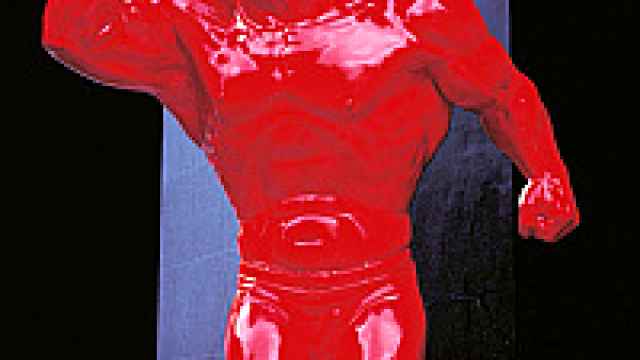 Tsum Chen Wenling's "Homunculus," expected to sell for around a half-million euros, greets visitors outside TsUM. |  |
| |
Ongoing concerns among Russians over the "Made in China" logo make a department store an interesting and slightly ironic location to hold the exhibition. Fears of low-quality goods and out-sourcing local manufactures to China form the backdrop to relations between the two neighbors. And yet, the growing integration of the two countries' industrial production only serves to underscore the unavoidable artistic integration of the giants, whose influence on each other is unavoidable.
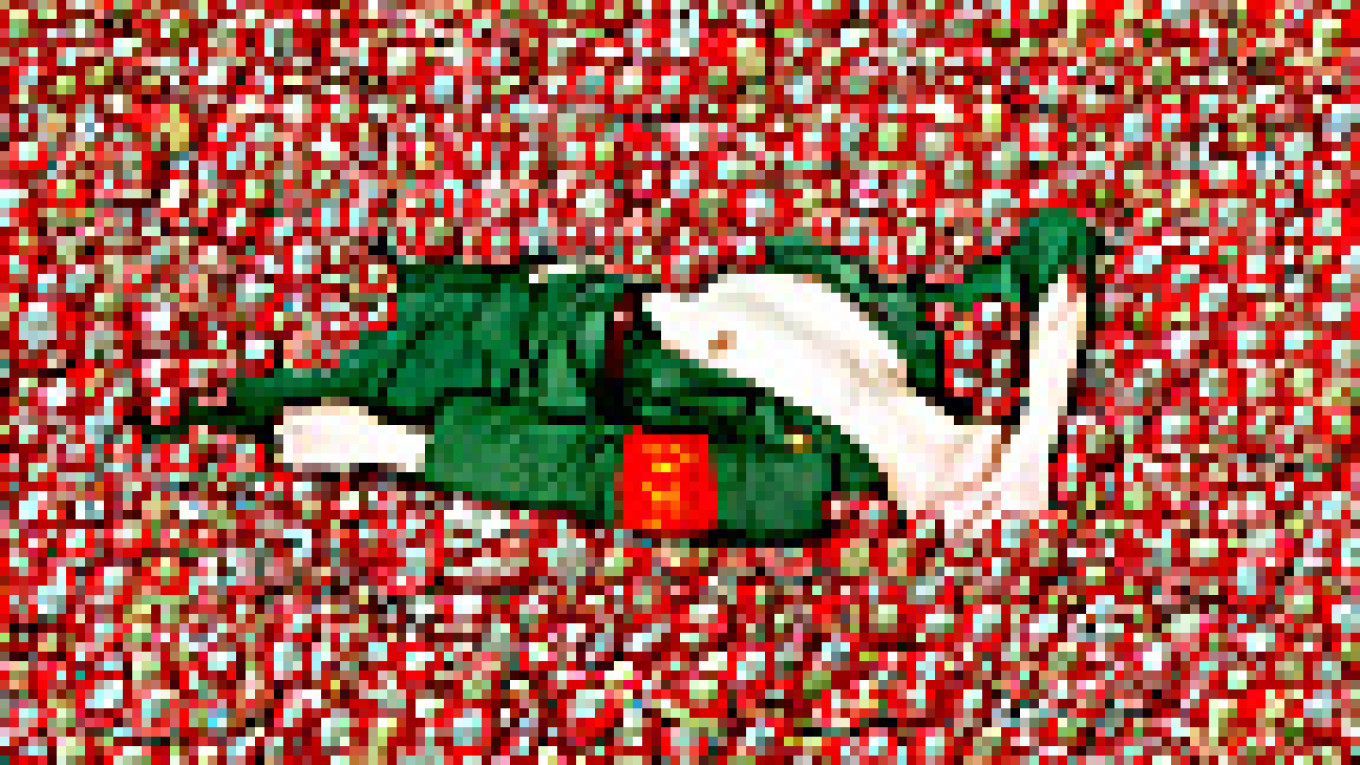
Russian Sots Art of the '60s and '70s, in which state symbols and sanctioned motifs are juxtaposed with pop art and kitsch, find new expression in the works of the Gao Brothers, as well as of Han Bing and Tian Taiquan: A female body, apparently dead, with her breast bare and wearing a red armband, bathes in a sea of propaganda pins bearing the face of Mao in Tian's "Memory About a Totem."
Han's "Theatre of Modernization" portrays in three canvases a worker and peasant woman, wielding the appropriate hammer and sickle, respectively, standing in the bucket of a loader. A nouveau riche businessman with what appears to be a crown in his hands begins to rise, only to be knocked down in the last canvas by the triumphant-looking proletarians.
Those quintessential Soviet symbols also appear in Zhong Biao's "Socialism," which examines the artist's place in the overwhelming social structure of the country, as well as in history. Are the lives of individuals doomed ultimately to only exist in the work of the artist? And how will this art then relate to the state?
This dilemma is at the heart of one of the most billed aspects of the exhibition. Huang Yan, whose "Four Times of the Year" is included in "China ... Forward!" saw his work "The Chinese Shan-Shui Tattoo" forbidden by the Chinese government from export to Russia. It has also been prohibited from showing in France, according to the French daily Liberation.
But while some of the works deal subtly with their subjects, many of the pieces represent an easy, nonconformist kitsch, choosing obvious subjects like Mao and Tiananmen. This can be seen as a conscious catering to a dilettante audience by using accessible themes -- something we have become used to from contemporary Russian artists.
"China ... Forward!" (Kitai ... Vperyod!) runs to June 30 at TsUM, located at 2 Ulitsa Petrovka. Metro Teatralnaya.
A Message from The Moscow Times:
Dear readers,
We are facing unprecedented challenges. Russia's Prosecutor General's Office has designated The Moscow Times as an "undesirable" organization, criminalizing our work and putting our staff at risk of prosecution. This follows our earlier unjust labeling as a "foreign agent."
These actions are direct attempts to silence independent journalism in Russia. The authorities claim our work "discredits the decisions of the Russian leadership." We see things differently: we strive to provide accurate, unbiased reporting on Russia.
We, the journalists of The Moscow Times, refuse to be silenced. But to continue our work, we need your help.
Your support, no matter how small, makes a world of difference. If you can, please support us monthly starting from just $2. It's quick to set up, and every contribution makes a significant impact.
By supporting The Moscow Times, you're defending open, independent journalism in the face of repression. Thank you for standing with us.

Remind me later.