

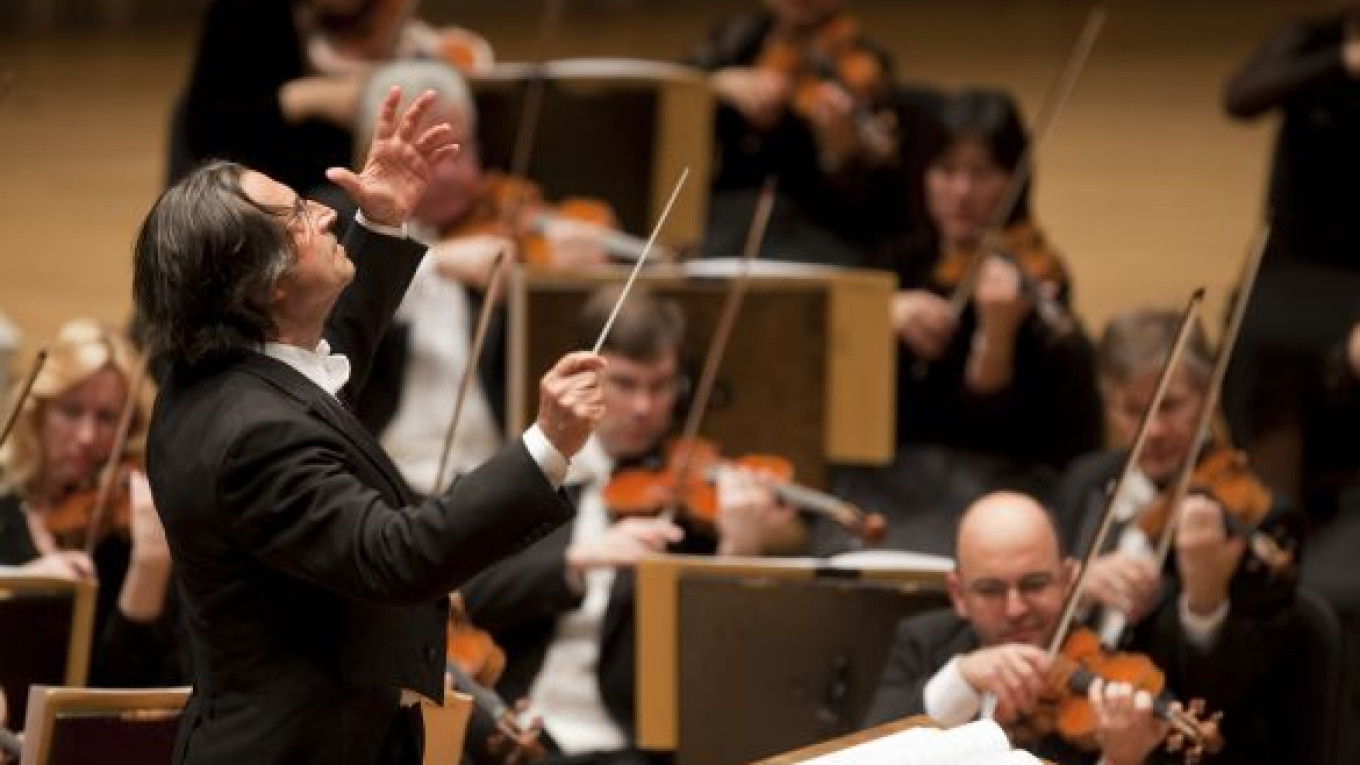
The Great Hall of the Moscow Conservatory plays host Wednesday and Thursday to one of the world's most esteemed orchestral ensembles, the Chicago Symphony Orchestra, in its first visit to Moscow since 1990. The orchestra appears this time under the auspices of the Obama-Medvedev Bilateral Presidential Commission and as part of a yearlong cultural festival titled American Seasons in Russia.
On the podium will be renowned Italian maestro Riccardo Muti, who in 2010 became the tenth music director to head the Chicago Symphony since its founding 121 years ago.
Chicago is my own native city, and it was there, at about the age of 10, that I first heard the Chicago Symphony. Over the following two decades, I attended countless of its concerts in Chicago's Orchestra Hall and at its summer residence north of the city in Ravinia Park (where I managed, surreptitiously, to witness rehearsals by such now-legendary conductors as Otto Klemperer, Fritz Busch and Eugene Ormandy). During my high school days, I also had the privilege of being taught the bassoon by a member of the orchestra.
The Chicago Symphony was founded in 1891 by German-born Theodore Thomas. Upon his death in 1905, his likewise German-born protege, Frederick Stock, took command, leading the orchestra for the next 37 years and, in the process, turning it into one of America's very finest. In 1947, the baton was entrusted to the great Polish conductor Artur Rodzinski, who, due to quarrels with the orchestra's trustees, lasted only one season. But what a season it was. I was present at Rodzinski's farewell concert, which provoked probably the most boisterous and heartfelt ovation I have ever witnessed. And on stage, accompanying Rodzinski during the applause, was his three-year-old son Richard, who last year in Moscow became general director of the Tchaikovsky Competition.
With the appointment of Hungarian-born Fritz Reiner in 1963, the Chicago Symphony enjoyed a decade of success practically unparalleled in the annals of American orchestral history. Reiner was one of the last great tyrant-conductors, dubbed by some in the orchestra, given his Hungarian origins, as a reincarnation of Attila the Hun. But the music he produced was phenomenal.
Etched forever in my memory is a concert the orchestra gave on November 28, 1963, planned in memory of Reiner, who had died two weeks earlier. Inside the program book was a black-bordered photograph of the conductor. And inside as well, inserted as a separate page, was a black-bordered photograph of John F. Kennedy, assassinated just six days before. For a still horror-stricken audience, no work of music could have been more consoling than the Requiem Mass in D Minor of Wolfgang Amadeus Mozart, particularly as played that evening under the baton of celebrated Italian conductor Carlo Maria Giulini.
For more than two decades, starting in 1969, the orchestra was led by another Hungarian-born maestro, Georg Solti. His successor, Daniel Barenboim, was still a journeyman conductor in 1991, but emerged over the course of his 15 years with the orchestra as one of the most respected members of his profession.
Maestro Muti is no stranger to Moscow, having last appeared here several seasons ago with the French National Orchestra in a concert devoted to the music of Franz Schubert. This time he has chosen a repertoire, which seems much more suited to his tastes and talents.
Featured Wednesday is the Symphony No. 5 in D Minor of Dmitry Shostakovich, no doubt intended as a nod toward Russia, but still a rather curious choice, considering how frequently the work is heard in Moscow. The Chicago Symphony, however, has played it often and recorded it several times with great success.
I recall having heard the Shostakovich 5th for the very first time at a Chicago Symphony Friday matinee concert in the late 1950s. Friday matinees were then largely attended by matrons from the city and its suburbs, who had first enjoyed a round of shopping and lunch in Chicago's downtown Loop. In those days, the Shostakovich symphony was still considered by many a rather unlistenable work. And almost immediately after its opening bars that afternoon, the music was accompanied by a rustle of shopping bags, as large parts of the audience fled to escape it.
Also on Wednesday's program is a work called "Space Odyssey" by Soviet-born composer Dmitri Smirnov, a resident of Britain since 1991, and a suite of music for the 1963 Luchino Visconti film "The Leopard" by the late master of Italian cinema music, Nino Rota, who is probably best known for his "Godfather" scores.
"Space Odyssey" is due to be repeated Thursday, in a program that also includes Richard Strauss' tone poem "Death and Transfiguration" and the Symphony in D Minor of Cesar Franck, the latter of which, I would venture to guess, will turn out to be the high point of the Chicago Symphony's visit.
A Message from The Moscow Times:
Dear readers,
We are facing unprecedented challenges. Russia's Prosecutor General's Office has designated The Moscow Times as an "undesirable" organization, criminalizing our work and putting our staff at risk of prosecution. This follows our earlier unjust labeling as a "foreign agent."
These actions are direct attempts to silence independent journalism in Russia. The authorities claim our work "discredits the decisions of the Russian leadership." We see things differently: we strive to provide accurate, unbiased reporting on Russia.
We, the journalists of The Moscow Times, refuse to be silenced. But to continue our work, we need your help.
Your support, no matter how small, makes a world of difference. If you can, please support us monthly starting from just $2. It's quick to set up, and every contribution makes a significant impact.
By supporting The Moscow Times, you're defending open, independent journalism in the face of repression. Thank you for standing with us.

Remind me later.