

Cultural anniversaries in Russia are rather like a party that never ends. With all the great writers, painters and composers over the centuries, you can always find some important person or event to hang an anniversary celebration on.
Consider the possibilities for 2010. One hundred years ago Marina Tsvetayeva published her first collection of poems. That same year, 1910, Osip Mandelshtam debuted as a poet. Also that year the famous and influential Jack of Diamonds art exhibit opened in Moscow. One hundred and fifty years ago the great landscape painter Isaak Levitan was born.
None of these anniversaries, however, are likely to come close to receiving the attention that will accrue to Anton Chekhov, born Jan. 29, 1860. That is, 150 years ago Friday.
Chekhov’s characters, suggests Dmitry Krymov, who is one of several directors offering shows for a special “Chekhov Days” festival this week, are rather like a “Chernobyl mushroom” or “Pushkin’s poetry: They are all blown up out of proportion.”
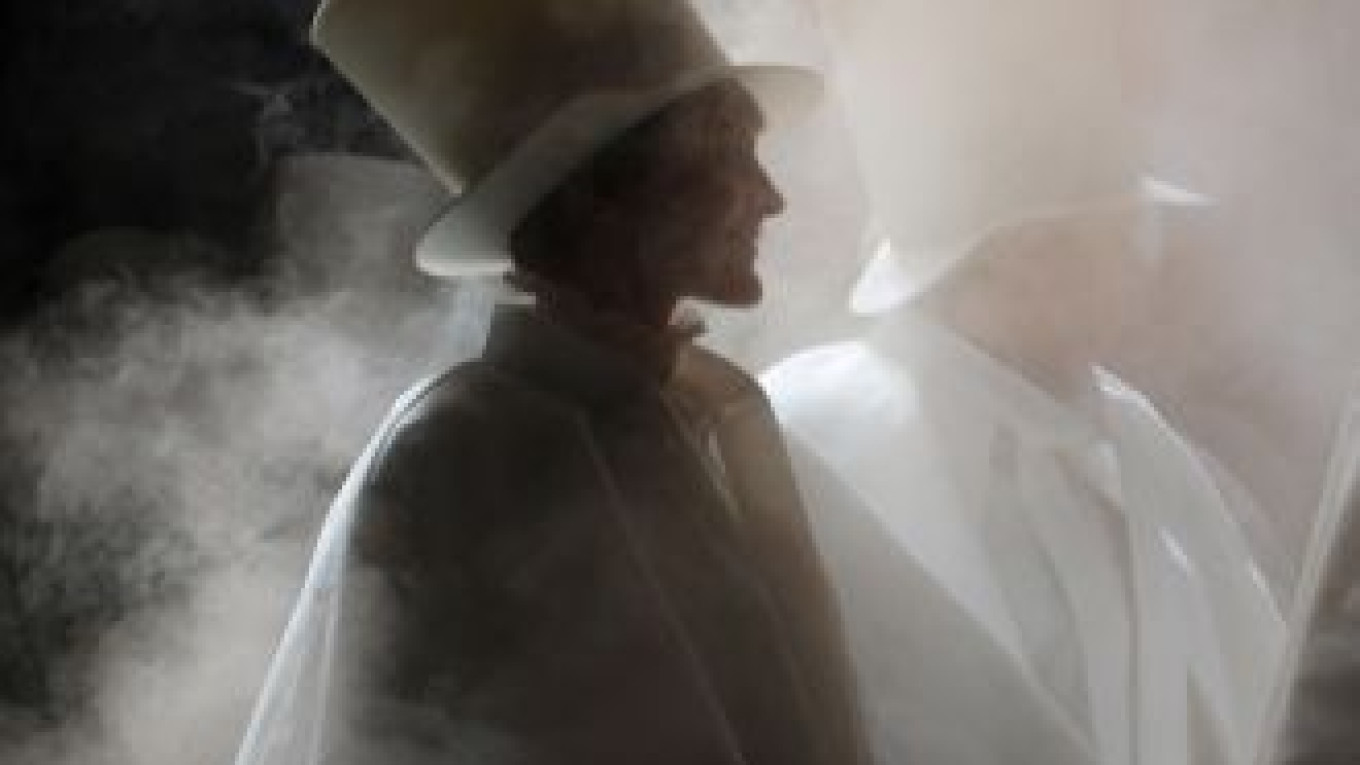
This season’s Chekhov onslaught began in September with major productions of “Uncle Vanya” at the Vakhtangov Theater and “The Cherry Orchard” at the Lenkom. Since then Andrei Konchalovsky staged “Uncle Vanya” at the Mossoviet Theater, Yury Butusov mounted “Ivanov” at the Chekhov Moscow Art Theater, and this week at the School of Dramatic Art Krymov opens a production called “Tararabumbia.” This show, which Krymov created in tandem with composer Alexander Bakshi, promises to be an unorthodox look at Chekhov’s characters through the prism of the century that has passed since the writer died in 1904.
These and other shows, organized by the Chekhov International Theater Festival, will play in Moscow over a six-day period, concluding Sunday. Among the foreign productions, Vladimir Pankov’s “The Wedding” for the Yanka Kupala National Theater of Belarus plays through Friday at the Fomenko Studio, and Daniele Finzi Pasca’s “DONKA (A Letter to Chekhov)” for the Teatro Sunil of Switzerland runs Friday to Sunday at the Mossoviet Theater.
Having offered a brief, though intense, taste of Chekhov in January, the Chekhov Festival will return with a vengeance in May, June and July with its usual offerings of productions from all over the world. There were complaints from some quarters when the festival was created 18 years ago, that, for an event named after Chekhov, the writer’s works were underrepresented. After this anniversary year ends, no one will say that again.
Returning to Chekhov has been a revelation for Krymov.
“I did Chekhov once,” he says, referring to a production called “Auction,” an eclectic rendering of scenes from various Chekhov plays at the School of Dramatic Art. “I thought I had said what I had to say about him. But I didn’t. And in this show we haven’t done nearly all we could have.”
It is difficult to imagine in advance what the show will look like. The spacious workshop where Krymov and I sit down to talk is gloriously given over to creative chaos. But most of the models and props and costumes that I see strewn over tables, chairs, cabinets, floors and one another are from other projects and will have nothing to do with the new piece.
“Tararabumbia” — the title is taken from a nonsense phrase that the doctor Chebutykin utters in “Three Sisters” — employs 83 actors and musicians wearing some 500 costumes. And yet, the only design object to speak of will be a 30-meter moving sidewalk running the length of the large stage at the School of Dramatic Art — that and a team of actors on stilts.
If I understand Krymov correctly, characters from Chekhov’s plays will drift across the stage, occasionally stopping to mingle with individuals, or participate in re-enactments of cultural events that marked Russian history in the 20th century.
“This show, basically, is our gift to Chekhov,” Krymov declares. “It’s a demonstration of our attitude to him. But so much happened in Russia after Chekhov died. Since then Russia experienced the worlds of Mikhail Bulgakov, Varlam Shalamov, Alexander Solzhenitsyn and the Solovki prison. We lived in a terrible time. With this show we also want to show Chekhov where we have been.”
Krymov sees “Tararabumbia” as a “mark of his own freedom.”
“We are trying to keep a certain distance from Chekhov,” he explains. “It’s as though we slipped free of a leash that is still tied to the stake, that is, to Chekhov. We wander away for a while but then we always come back. You need to have those little escapes and returns in order to measure your freedom.”
The production came together, as is always true of Krymov’s projects, thanks to contributions from many members of the creative team. Krymov’s former student Maria Tregubova is the designer, and she brought “a young point of view” to the piece, helping to shape several of the scenes, the director says. “Some of the most risky elements are hers,” he adds.
Bakshi, with whom Krymov collaborated on the award-winning “Opus No. 7” last season, is one of Krymov’s central collaborators.
“Bakshi was the initiator of the show,” Krymov explains. “He came to me and said there was a chance of doing something for the Chekhov Festival in connection with the Chekhov anniversary. After working on ‘Opus,’ we had the feeling we hadn’t had enough of each other.”
“Bakshi is an amazing person,” Krymov continues. “He puts his whole heart into whatever he does. But what he’s concerned about is not his own personal contribution. When it’s necessary, he’s willing to sacrifice his own work for the greater good of the production.”
This kind of selflessness has impressed Krymov elsewhere in this large, almost anonymous ensemble piece. “If I say I need two more people somewhere, actors jump in and volunteer,” he says.
The cast consists of seven of Krymov’s usual company, including Anna Sinyakina, Sergei Melkonyan, Mikhail Umanets and Natalya Gorchakova, who have starred in his popular productions of “Auction,” “The Cow,” “Opus No. 7,” “The Death of a Giraffe” and others. But the bulk of the cast is drawn from people whom Krymov had never worked with. Among them are Igor Yatsko, chief director at the School of Dramatic Art, and Oksana Mysina, a well-known independent actress.
Chekhov, Krymov suggests, is eternally contemporary because he perceived the world “through pain.”
“He perceives everything — youth, old age, birth, death, generational change — through pain. It’s everywhere, in the relationships between men and women, in marriage, in food even. Think of that tea that you want to drink, but no one brings it to you. A formula of misfortune — that’s what Chekhov is.”
But most of all, Krymov sees Chekhov permeating Russian life with his mood.
“More than his plots and characters, Chekhov is a mood. I have the arrogant hope that if someone comes to our production and they don’t know a single line, or a single character of Chekhov’s plays, they will still recognize Chekhov’s mood.”
“Tararabumbia” plays Thurs., Fri., Sat. and Sun., Feb. 5 to 7, and 12 to 14, at 8 p.m. at the School of Dramatic Art, located at 19/27 Ulitsa Sretenka. Metro Sukharevskaya. Tel. 632-9377, 632-9344. www.sdart.ru. For information about other “Chekhov Days” events, go to www.chekhovfest.ru.
A Message from The Moscow Times:
Dear readers,
We are facing unprecedented challenges. Russia's Prosecutor General's Office has designated The Moscow Times as an "undesirable" organization, criminalizing our work and putting our staff at risk of prosecution. This follows our earlier unjust labeling as a "foreign agent."
These actions are direct attempts to silence independent journalism in Russia. The authorities claim our work "discredits the decisions of the Russian leadership." We see things differently: we strive to provide accurate, unbiased reporting on Russia.
We, the journalists of The Moscow Times, refuse to be silenced. But to continue our work, we need your help.
Your support, no matter how small, makes a world of difference. If you can, please support us monthly starting from just $2. It's quick to set up, and every contribution makes a significant impact.
By supporting The Moscow Times, you're defending open, independent journalism in the face of repression. Thank you for standing with us.

Remind me later.