

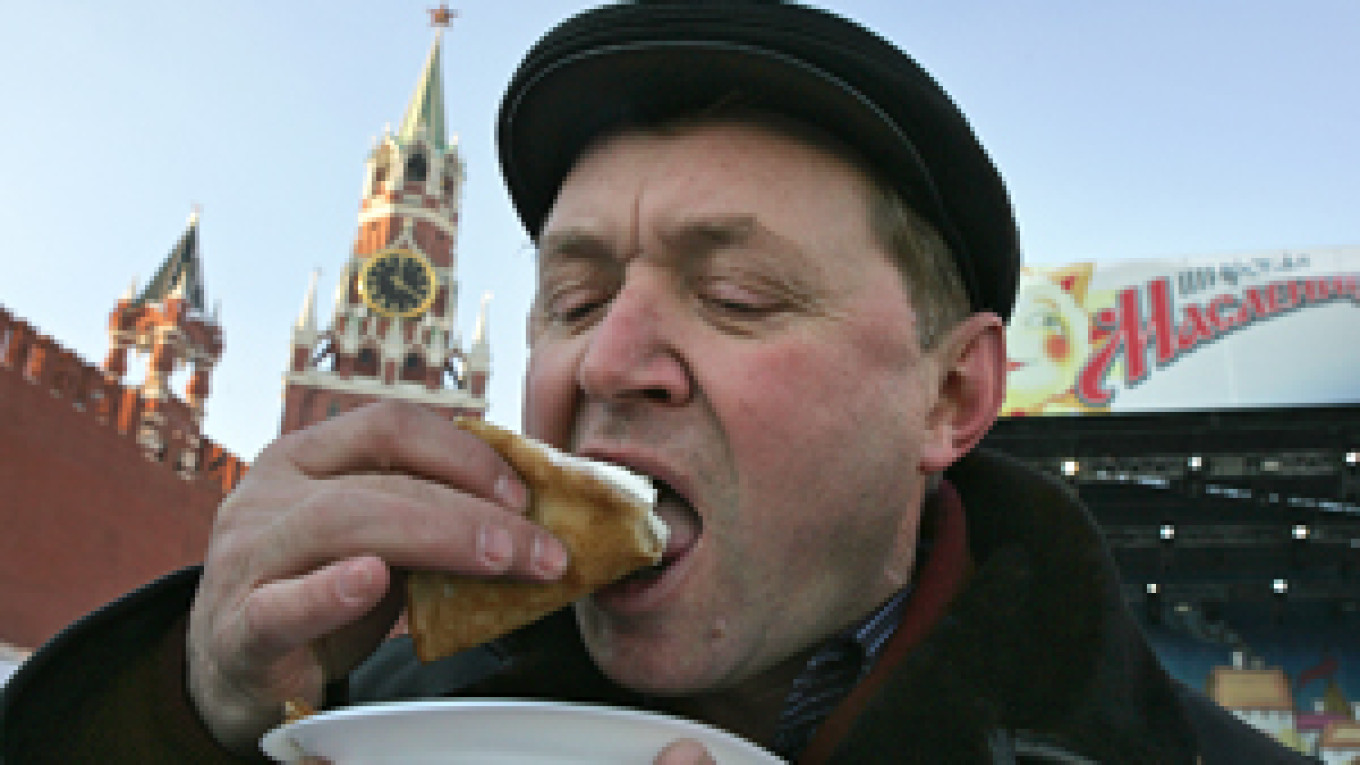
Celebration of Maslenitsa began as a pagan ritual to celebrate the end of winter and was later adopted by the Orthodox religion. After experiencing a decline during the Soviet period, as with most religiously affiliated holidays, Maslenitsa has come back as one of the most jubilant of Russian holidays, still maintaining many of its traditional elements.
In the past, festivities included the performance of bears plied with large quantities of vodka, ending with a wrestling match between tamer and bear. It goes without saying: The bear would usually win. Another tradition was the burning of bonfires and a straw woman representing “Maslenitsa” in order to send off the winter.
This year, the revelry runs all week to March 1, with daily programs taking place all over the city. The Izmailovsky Kremlin, the All-Russian Exhibition Center (VDNKh), Sokolniki, Kolomenskoe, Tsaritsyno, Park Kultury and Gorky will come to life, greeting visitors with outdoor performances, ferris wheels, traditional Slavic games, folk dancing, troika rides and stalls of food and curios.
The center of festivities is Vasilyevsky Spusk, just behind St. Basil’s Cathedral. On Monday, visitors could see dancing and singing, as well as a good old group fistfight — not the drunken-bar variety, but instead a Maslenitsa tradition, supposedly in commemoration of Russian military history when soldiers used to participate in hand-to-hand combat.
 | Best of all, visitors will be treated to free samples of the fundamental element
of Maslenitsa: blini, the Russian pancake. Traditionally representing the sun — warm, round, golden — blinis are an appropriate way to greet the coming of spring. The blini gained further significance after being adopted by the Eastern Orthodox religion, as eating meat during this week is forbidden by the church. Throughout the holiday, blinis topped with anything from caviar to sour cream to sugar and jam will be given out to all. |
To celebrate the “Year of the Youth,” special competitions and activities for children will take place Tuesday, with candy divided among participants.
The highlight, however, promises to be Thursday, when an attempt will be made to break a world record for cooking blinis. In 2004, a 14.58-meter-high stack of blinis set the world record for the tallest pile of pancakes. In 2008, bakers created a 2-meter-by-1.8-meter map of the world out of blinis.
The final day of the festivities is Sunday, when a traditional march will go down Tverskaya Ulitsa, the central street in Moscow, from Triumfalnaya Ploshchad near Mayakovskaya metro station to Vasilyevsky Spusk. Orchestra players, drummers, jesters on stilts, clowns, acrobats, accordion players and a range of carnival and folk entertainers will fill the streets, and a large gala concert on Vasilyevsky Spusk in the afternoon will conclude the festivities.
Maslenitsa runs to March 1. Apart from Vasilyevsky Spusk, there will be events in the Izmailovsky Kremlin, the All-Russian Exhibition Center (VDNKh), Sokolniki, Kolomenskoe, Tsaritsyno and Gorky Park.
A Message from The Moscow Times:
Dear readers,
We are facing unprecedented challenges. Russia's Prosecutor General's Office has designated The Moscow Times as an "undesirable" organization, criminalizing our work and putting our staff at risk of prosecution. This follows our earlier unjust labeling as a "foreign agent."
These actions are direct attempts to silence independent journalism in Russia. The authorities claim our work "discredits the decisions of the Russian leadership." We see things differently: we strive to provide accurate, unbiased reporting on Russia.
We, the journalists of The Moscow Times, refuse to be silenced. But to continue our work, we need your help.
Your support, no matter how small, makes a world of difference. If you can, please support us monthly starting from just $2. It's quick to set up, and every contribution makes a significant impact.
By supporting The Moscow Times, you're defending open, independent journalism in the face of repression. Thank you for standing with us.

Remind me later.