

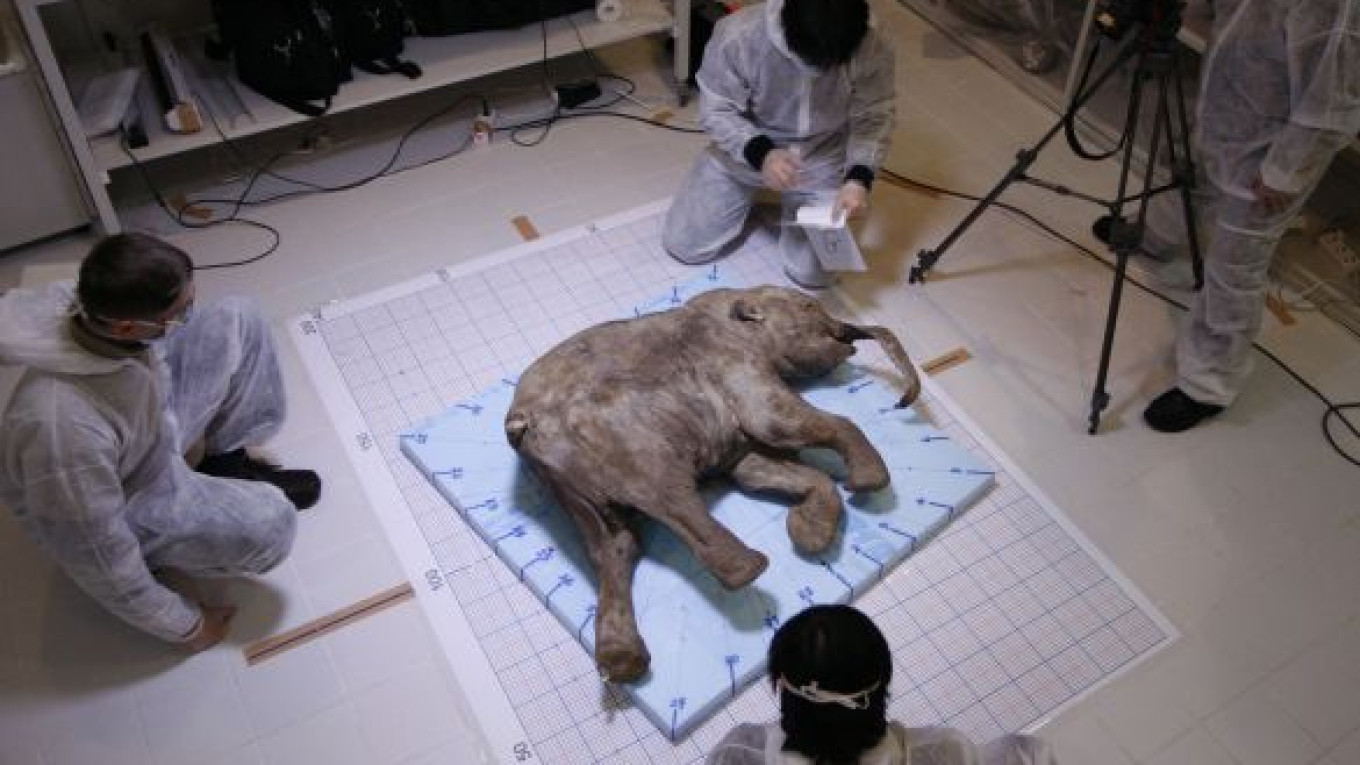
CHICAGO — Some 42,000 years after, scientists say, she fell into mud near a river and suffocated, an intact baby woolly mammoth from the Ice Age is to go on display for the first time in the United States at The Field Museum.
Scientists say the mammoth calf, named Lyuba, is the best preserved and most complete mammoth specimen known. She was found in 2007 by a reindeer herder in northern Siberia’s remote Yamal-Nenets autonomous region and named after his wife.
“Her preservation, her really lifelike qualities allow you to form a better impression of what the past was ?really like,” said Dan Fisher, a ?University of Michigan paleontologist and? the museum’s exhibit curator. “It? becomes more immediate. It’s real.”
In the exhibit that opens Friday, visitors can see the folds and creases in Lyuba’s skin, the bottom of her foot and small patches of hair on her ear and leg. At 114 centimeters long, Lyu?ba weighs about 42 kilograms and if fully grown could have measured 2.4 meters tall at her shoulder and weighed between 2.7 metric tons and 3.6 metric tons, Fisher said.
Lyuba has been a boon for scientists, who have done MRIs, CT scans and DNA testing among other analyses on the baby mammoth.
“The things you can learn from a fleshy specimen like this you can’t learn from studying a skeleton,” said Tom Skwerski, The Field Museum’s project manager for the exhibit. “It’s as if all of a sudden you’ve been given this great gift to be able to reaffirm a lot of your theories.”
Scientists have analyzed Lyuba’s stomach contents, including her mother’s milk. They say she was 1 month old when she died and was in excellent condition.
Scientists first analyzed Lyuba’s baby tusks and chewing teeth, looking for details about diet, environment and health.
“The important thing about Lyuba, though, is that in a sense she gave us the answers to many of the questions we would ask through those analyses,” Fisher said. “Because there’s her? whole body preserved in its entirety.”
Experts say the baby mammoth remained well-preserved because she was frozen in permafrost for thousands of years. Fisher also said her body was colonized by naturally occurring bacteria that produced lactic acid, which kept her body in a “pickled” state.
Lyuba’s body was immersed in preservative solutions for her Chicago display, scientists said.
The baby mammoth’s home institution is the Shemanovsky Museum and Exhibition Center in Salekhard, in the? Yamal-Nenets autonomous region.
The exhibit is to travel to other North American cities: Jersey City, New Jersey; Anchorage, Alaska; St. Louis, Missouri; San Diego, California; Denver, Colorado; and Boston, Massachusetts.
Skwerski called the baby mammoth a “singular object” and said she has been valuable to scientists around the world.
“To get Lyuba for our exhibition is like getting the Mona Lisa for your exhibition on Italian art,” Skwerski said.
The baby mammoth’s true value may be in her ability to bring people closer to human history, the history of the Earth’s climate system and climate change, Fisher said.
“If Lyuba opens people’s minds to any of that, then she’s doing a great job for us,” he said.
A Message from The Moscow Times:
Dear readers,
We are facing unprecedented challenges. Russia's Prosecutor General's Office has designated The Moscow Times as an "undesirable" organization, criminalizing our work and putting our staff at risk of prosecution. This follows our earlier unjust labeling as a "foreign agent."
These actions are direct attempts to silence independent journalism in Russia. The authorities claim our work "discredits the decisions of the Russian leadership." We see things differently: we strive to provide accurate, unbiased reporting on Russia.
We, the journalists of The Moscow Times, refuse to be silenced. But to continue our work, we need your help.
Your support, no matter how small, makes a world of difference. If you can, please support us monthly starting from just $2. It's quick to set up, and every contribution makes a significant impact.
By supporting The Moscow Times, you're defending open, independent journalism in the face of repression. Thank you for standing with us.

Remind me later.