

I believe I have met Andrei Konchalovsky just twice. Both times are burned into my experience — not only my memory — as events of significance.
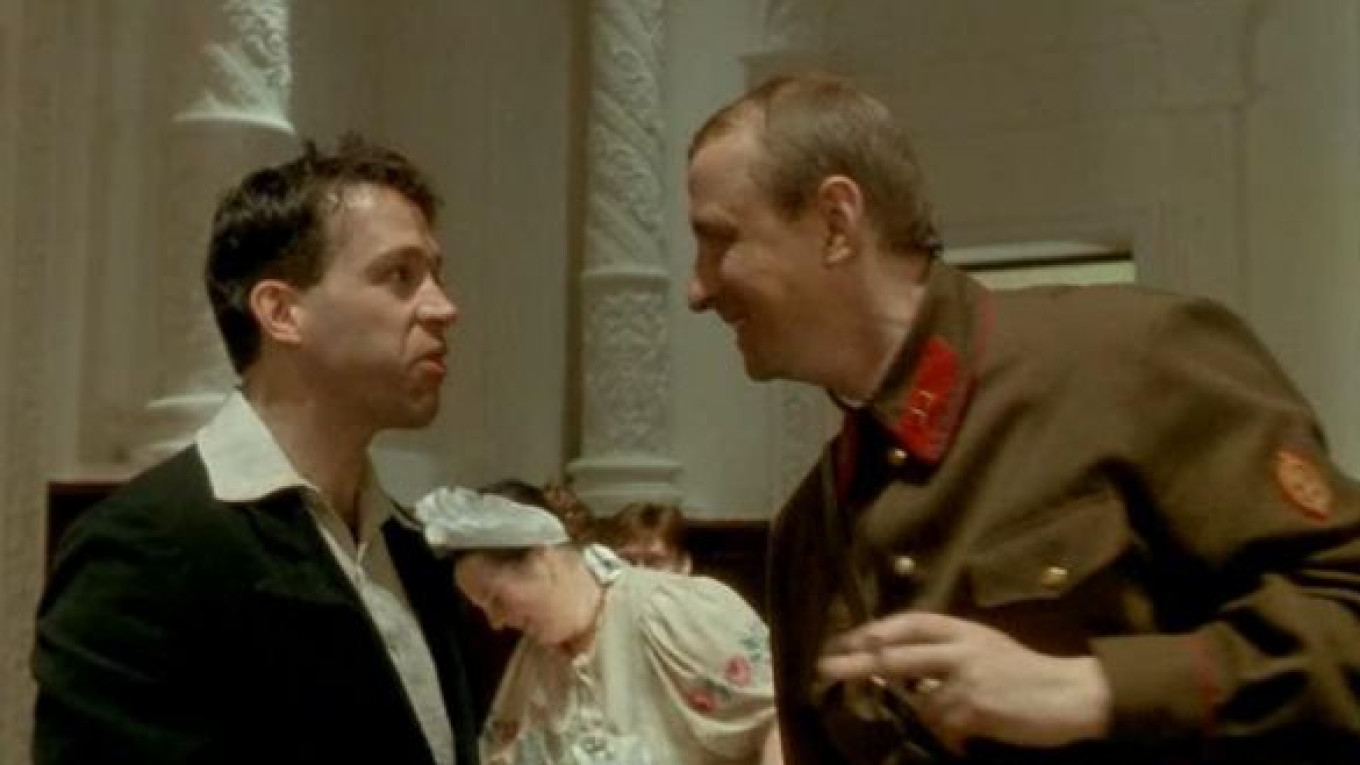
I have reason to think about that as the Cinema Club at Winzavod is hosting a retrospective of Konchalovsky’s films that finishes Tuesday with the showing of his 1991 film “The Inner Circle,” about Stalin’s personal projectionist.
The first time I crossed Konchalovsky’s path was in Warsaw in 2006 where I attended the premiere of his theater production of “King Lear” with Daniel Olbrychski at the Theater Na Woli. The second time was that same year on a soundstage in Moscow where the director was in the process of shooting his film “Gloss.” Both times were proverbial instances of calm and focus amid madding crowds. Of all of the impressions I carry of Konchalovsky and his work, perhaps this takes precedence over all: his extraordinary ability to be composed and present in the moment.
In Warsaw the theater was abuzz. People were scurrying around on tiptoe, whispering, hushing, ducking in and out of corridors. Konchalovsky was conducting the final on-stage preparations before the show would open in less than an hour. I was led into a small library-like room and asked to wait.
Because of all the hush-hush and hurry going on around me I couldn’t help but feel as though royalty was about to appear. I have a feeling this is what happens before Queen Elizabeth makes an appearance.
Ten minutes later the door opened and Konchalovsky entered briskly. He is a tall, forceful man, with a chiseled face and a strong handshake. He immediately apologized for being “late,” although he was not. He sat down across a table from me and began to talk about the minutiae of rehearsals as if we had known each other for years and were picking up the thread of a conversation dropped only recently.
More important, however, was the man’s accessibility. He put on no airs whatsoever. There was none of the hard, aggressive distance that people accustomed to dealing with the press and public understandably use to protect themselves. There wasn’t the vaguest notion of facetiousness when he said about staging Shakespeare’s “Lear”: “I don’t know how to do this.” He was clearly still rehearsing in his head, he had just left the stage, and with the minutes ticking down to curtain, he truly understood that he wished he knew better what he was doing. It was a simple observation made by a working artist about himself and his job.
Some six months later I was making a small documentary film about Anton Chekhov. Konchalovsky was the perfect person for me to talk to because he clearly has a deep, personal connection to Chekhov. His “Uncle Vanya” is one of the finest cinematic adaptations of Chekhov ever made, and by 2007, Konchalovsky had set himself the mission to direct all of Chekhov’s plays on stage.
Konchalovsky asked me to meet him in a cavernous warehouse, small sections of which had been remade for “Gloss” into a chic penthouse. I and my small film crew showed up slightly in advance of the agreed-upon time and so had ample opportunity to watch the director go over and over a scene in which a thug strikes a terrified young man across the face with a fashion magazine.
Deliberately, as though he had nothing but time on his hands and no other task in mind, Konchalovsky worked carefully with his cinematographer Maria Solovyova to catch just the right angle, just the right motion for these few violent seconds that would remain in his film after the editing process.
Without interrupting his work he acknowledged my presence at one point and apologized, again, that I would have to wait until he was done. When he was satisfied with what he and Solovyova had accomplished, he strode directly over to us and sat down in a soft director’s chair to talk.
Following a few hectic exchanges with assistants and a brief cell phone conversation or two, Konchalovsky settled into a 20-minute talk about Chekhov as though that is all he could possibly have on his mind. He answered my simplistic leading questions with thoughtful, expansive replies. It was as though he were sharing his love and respect for Chekhov in a private chat somewhere on a back porch. He betrayed no awareness whatsoever of the hundreds of members of his film crew bustling around him, or of the television camera honing in on his face.
Chekhov, Konchalovsky explained with conviction and a certain amount of admiring awe, “was very often perceived to be weak, modest, shy and compassionate. It’s not [true] at all. ... He was a womanizer. He was terrible with women — and with men. Very cruel. He was cynical, and he was not happy because of that.”
Here again was Konchalovsky, the artist fascinated by craft, in this case the craft of living a life no matter how well or badly. That, after all, is the stuff of art. He spat out these hard, probing words about Chekhov almost as though they were poetry. He hit his consonants and drew out his vowels in such a way as to capture the rhythm of what it is to be cruel, cynical and unhappy. Chekhov, he said, was his god. And as he spoke I could see him testing himself against the great writer and working to make me understand why that was important.
I just this moment looked at that film again to verify my quotes, and once more I was struck by Konchalovsky’s complete and total involvement in the words he spoke at that specific moment in time. Nothing tossed-off here. Nothing cast, as the saying goes, like pearls before swine.
The retrospective at Winzavod is timed to accompany the Russian release of “Years of Distant Journeys,” a DVD compilation of eight of Konchalovsky’s Western-made films, and to celebrate his 74th birthday on Aug. 20. It is, indeed, an event to celebrate.
A Message from The Moscow Times:
Dear readers,
We are facing unprecedented challenges. Russia's Prosecutor General's Office has designated The Moscow Times as an "undesirable" organization, criminalizing our work and putting our staff at risk of prosecution. This follows our earlier unjust labeling as a "foreign agent."
These actions are direct attempts to silence independent journalism in Russia. The authorities claim our work "discredits the decisions of the Russian leadership." We see things differently: we strive to provide accurate, unbiased reporting on Russia.
We, the journalists of The Moscow Times, refuse to be silenced. But to continue our work, we need your help.
Your support, no matter how small, makes a world of difference. If you can, please support us monthly starting from just $2. It's quick to set up, and every contribution makes a significant impact.
By supporting The Moscow Times, you're defending open, independent journalism in the face of repression. Thank you for standing with us.

Remind me later.