

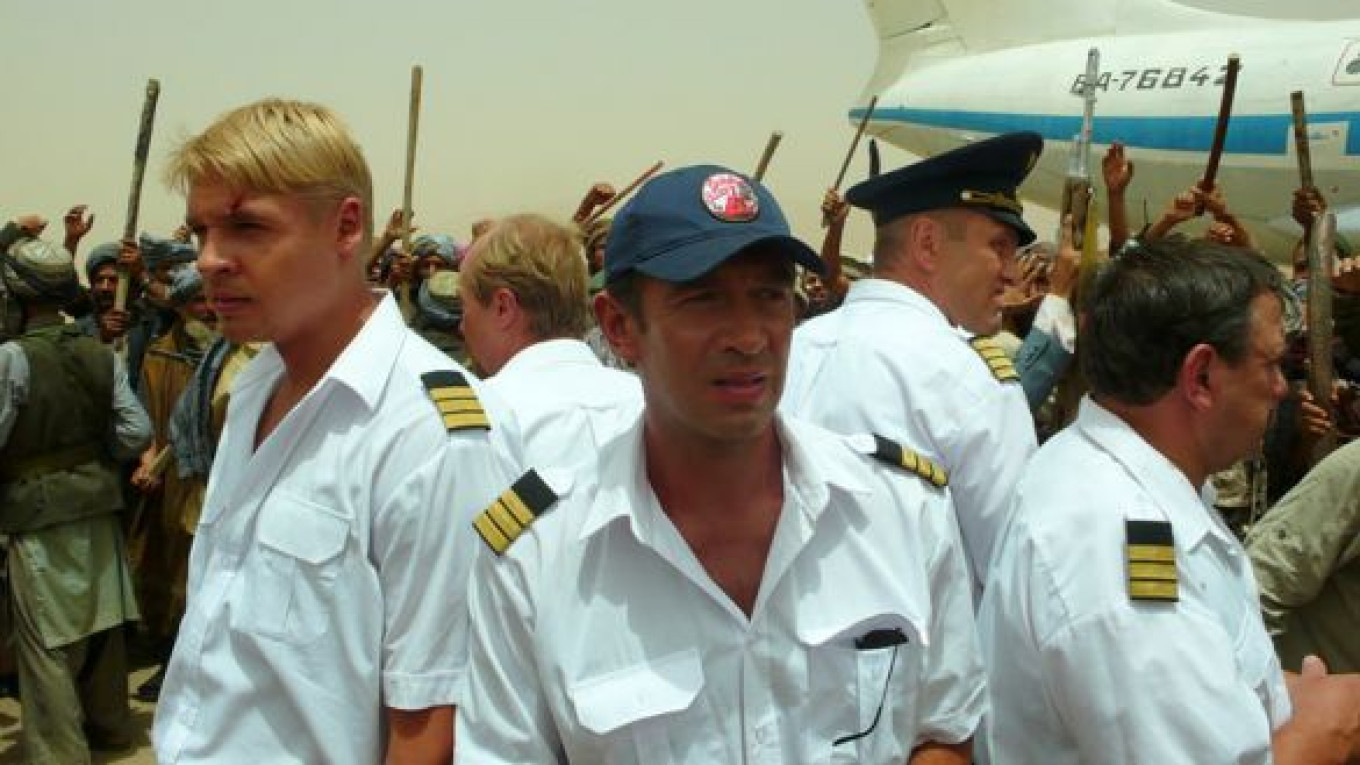
The film, which stars a trio of the country’s most famous actors, Vladimir Mashkov, Andrei Panin and Alexander Baluyev, is based on the true story of seven Russian Il-76 pilots who were captured by the Taliban in August 1995 while delivering arms to a Russian ally in Kabul. After spending more than a year in grim conditions in Taliban-controlled Kandahar, the pilots managed to escape by flying their own plane out.
The crew, even though a Taliban jet was sent after them, avoided recapture, and upon their return, two of them were awarded “Hero of Russia” medals.
While several films, most famously Fyodor Bondarchuk’s “The 9th Company,” have looked at the Soviet war in Afghanistan, the film by young director Andrei Kavun is the first one to look at Russia’s more recent history in Afghanistan.
The film’s script is based on a diary written in captivity by the crew’s captain, Vladimir Sharpatov, played by Baluyev, and focuses on their time in captivity and on the growing tensions between the group and especially between Baluyev’s character and Mashkov’s. A number of changes from the real-life story were made, with five crew in the film instead of the original seven and one of the crew crying at one point — something that Sharpatov is reported to have said would never have happened.
“It is a film about individuality, about personalities and not about a team. Their cooperation, arguments, clashes are the main part of the dramatic conflict in ‘Kandahar.’ I hope that this film will help fairness win out. In real life, there were seven, but only two became ‘Heroes of Russia.’ I think that is not fair,” Mashkov told Komsomolskaya Pravda.
Three of the original crew could not make the premiere of the film as they had flown out to earthquake stricken Haiti to deliver humanitarian aid.
Although some have accused the $7 million movie of attempting to match Hollywood war movies with its gung ho attitude, Kavun says the film is more about society than patriotism or bravery.
“I don’t understand the modern meaning of the word patriotism,” Kavun said in a telephone interview. “All these words like patriotism and motherland have lost their meaning. … My film is about the fact that it is possible to love your country, regardless of its attitude toward you.”
He has previously said that you can’t call a film patriotic when the main part of it is the failure of the state to rescue your heroes.
Critics have met the film with mixed reviews. Kommersant critic Lidia Maslova said that despite attempts to film a psychological drama, the film still falls into the trap of the typical thriller “about terrorists and real men who can resist them.”
Still, one fan is Dmitry Rogozin, a former nationalist politician and current ambassador to NATO in Brussels who tweeted, “I hope the film ‘Kandahar’ about pilot-heroes who dared to hijack a military transport plane right from the Taliban will be a great success,” even though in a previous tweet about the film he had written, “Nothing like watching Tarantino nonsense!”
The film’s pace is down to Italian editor Gabriella Cristiani, who won an Oscar for her editing of Bernardo Bertolucci’s “The Last Emperor.”
A Message from The Moscow Times:
Dear readers,
We are facing unprecedented challenges. Russia's Prosecutor General's Office has designated The Moscow Times as an "undesirable" organization, criminalizing our work and putting our staff at risk of prosecution. This follows our earlier unjust labeling as a "foreign agent."
These actions are direct attempts to silence independent journalism in Russia. The authorities claim our work "discredits the decisions of the Russian leadership." We see things differently: we strive to provide accurate, unbiased reporting on Russia.
We, the journalists of The Moscow Times, refuse to be silenced. But to continue our work, we need your help.
Your support, no matter how small, makes a world of difference. If you can, please support us monthly starting from just $2. It's quick to set up, and every contribution makes a significant impact.
By supporting The Moscow Times, you're defending open, independent journalism in the face of repression. Thank you for standing with us.

Remind me later.