

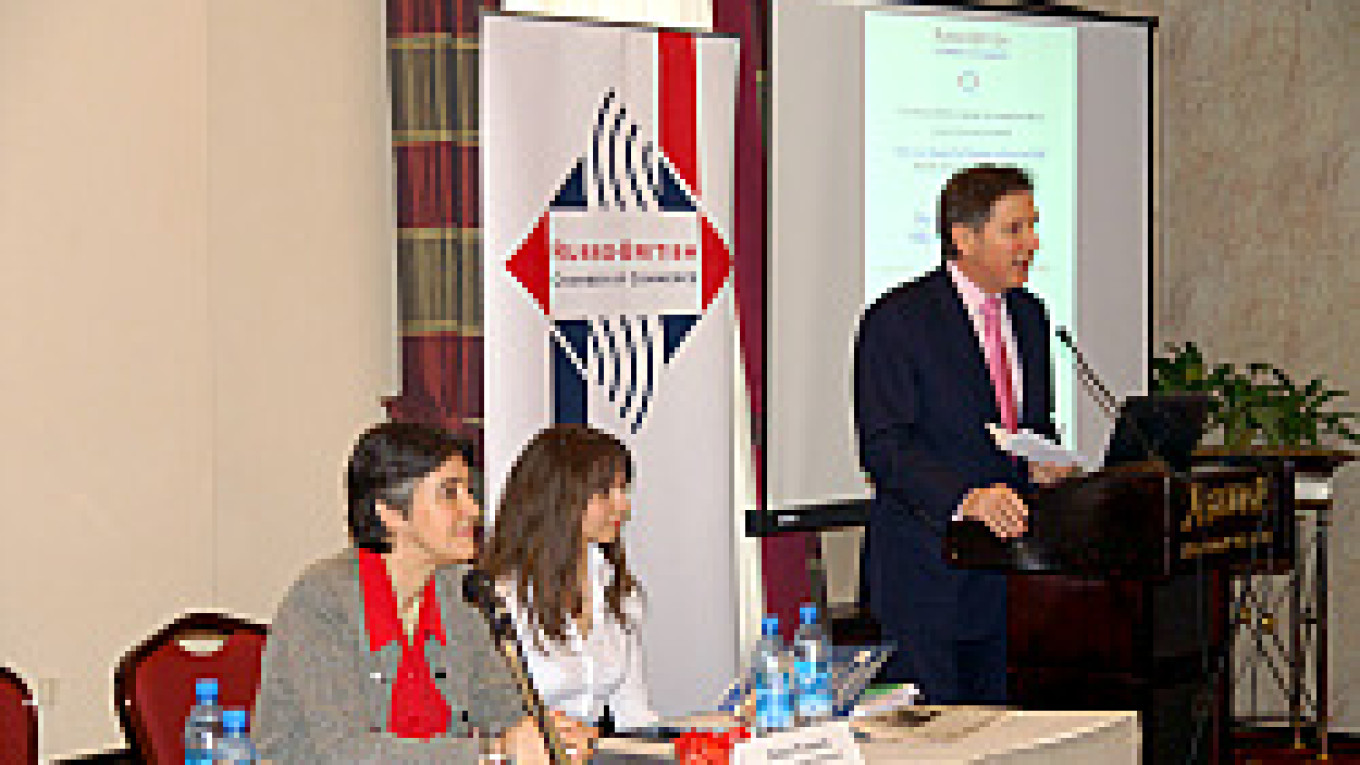
The Russo-British Chamber of Commerce addressed all these aspects in its "Survival Guide for Expats in Russia 2008."
"Russia is no different from any other civilized country," said Karina Khudenko, director of PricewaterhouseCoopers, when explaining pros and cons of life as an expat in Russia.
Among the cons that Khudenko highlighted were expats having to work under local contract law and a confusing tax regime.
Contracts are one issue that can cause grief for expats if they transfer from an international contract to a local one.
The main problem is that it is often not clear until it is too late that expats have to pay taxes on all benefits.
"Almost all types of traditional expat benefits are subject to personal income tax in Russia," Khudenko said.
"There is no special 'expat tax regime,'" she said.
Under Russian law there are two tax regimes, one for people who have spent less than 183 days in Russia, which subjects them to a 30 percent tax, and a second regime that kicks in after those first six months, which drops the tax rate to 13 percent.
At the same time, Khudenko said, the "taxes you find here are lower than you find in the U.S. and Europe."
Transitioning from addressing tax shelters to a discussion of shelter from the storm, Andrei Sado from Penny Lane Realty covered how to find housing, whom to trust and what benefits real estate agencies offer to their clients.
"If you successfully got through traffic to get here," said Sado from a podium at the Marriott Moscow Grand Hotel, "you've successfully completed stage one of the survival guide."
Sado's central recommendation was to "not go out on your own" when renting or buying property.
He cited the fact that landlords can choose to raise rents unpredictably or even kick out renters when relatives decide to move to Moscow as problems in going it alone.
Penny Lane and other local firms all provide services for their clients that can help smooth out any problems that may arise in renting a flat in Moscow, such as broken pipes, a fact of life in Stalin-era buildings, which he described as "historic" but could also be called "old."
Smoothing out problems, specifically the emotional and professional problems of moving to a new country, is what Angela Baxter, the director of business development at Berlitz International, aims to do.
Baxter described the standard emotional rollercoaster of moving to a new country as a sort of curve that starts out high and goes downhill, only to rise again over time.
High expectations and excitement, or a "honeymoon" phase, is the general state of new transplants. This phase lasts from four weeks to two months, Baxter said.
When the honeymoon is over, an expat enters a downhill slide, a state that can last one to three months.
The following "adaptation" phase can last around two months.
This is the usual way that expats react when moving to a new country. Baxter said that the goal is to "shorten and flatten the curve."
"No one can afford six months of acculturation," she said.
Successful business leaders are those with "global competency skills" who have shortened and flattened their curves by addressing the overlap of the three cultural perspectives: those of the individual, the corporate and the national, Baxter said.
Baxter also said 85 percent of failed overseas assignments were due to spouses and family members having problems adjusting.
In fact, families are prime factors contributing to the success of a stint overseas.
For expats with children, finding appropriate schools can be a daunting task. While some presenters claimed that there was a lack of good schools in Moscow, Ross Hunter, the headmaster of the English International School, said there are plenty.
"The main things to look at are the curriculum, languages, sports, ethos and location of a school," Hunter said. "The equation of transport, school, work and location all need to be solved simultaneously," he said.
Another issue is the perception that Russia is still the Wild West. For those that believe the stereotype, Mikhail Balev said MIG Security Services sells an Emergency Assistance Interregional Program, which provides a rapid deployment team of "two armed men and a lawyer" and 24-hour emergency phone service.
Regardless of adaptation, security and family issues, expats are still coming to Russia to work.
"The media cries that expats are leaving. We do not confirm this trend," said Yelena Yegorova, the director of sales and development at Penny Lane Personnel. "The specifics have changed, but expats still come," Yegorova said.
Around 30 percent of expats who come to work in Russia are from Western Europe and the United States, she said.
The argument for hiring expats is that they raise the prestige of a Russian company, improve the professionalism and bring in better negotiating skills,Yegorova said. On the downside, Yegorova added, Western Europeans and Americans suffer from culture shock and are more expensive than locals -- top expat managers command salaries that are an average of one-third higher than those of their Russian counterparts.
Additionally, they often do not know how to do business in Russia.
"They cannot master bribes and kickbacks," she said. "But they are coming to terms with it."
A Message from The Moscow Times:
Dear readers,
We are facing unprecedented challenges. Russia's Prosecutor General's Office has designated The Moscow Times as an "undesirable" organization, criminalizing our work and putting our staff at risk of prosecution. This follows our earlier unjust labeling as a "foreign agent."
These actions are direct attempts to silence independent journalism in Russia. The authorities claim our work "discredits the decisions of the Russian leadership." We see things differently: we strive to provide accurate, unbiased reporting on Russia.
We, the journalists of The Moscow Times, refuse to be silenced. But to continue our work, we need your help.
Your support, no matter how small, makes a world of difference. If you can, please support us monthly starting from just $2. It's quick to set up, and every contribution makes a significant impact.
By supporting The Moscow Times, you're defending open, independent journalism in the face of repression. Thank you for standing with us.

Remind me later.