

Formed in 1922, Persimfans -- a Sovietized shorthand for Perviy Simfonichesky Ansambl, or First Symphony Ensemble -- sought to embody the avant-garde spirit of the time.
"Just as the government didn't need a tsar, so the orchestra didn't need a director," says Pyotr Aidu of the School of Dramatic Art, which will revive the long-dead form at a premiere concert Thursday. The orchestra, counting among its ranks musicians from the Bolshoi Theatre and Moscow Conservatory, performed for a decade as the Soviet experiment allowed revolutionary artists to flourish.
It all came to an abrupt end in 1932, as infighting among the musicians, pressure from the Bolshoi and Stalin's purges tore the group apart.
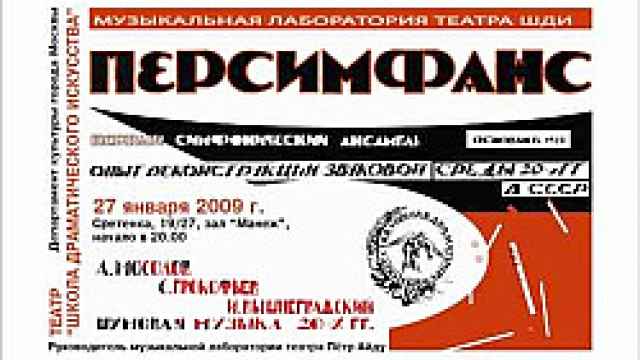
It will seek to come back today as Aidu gathers 35 musicians to take to the stage at the School of Dramatic Art in a revival of the 1920s art form.
The performance will be divided into two parts -- one for classical music, one for proletarian folk -- and include nontraditional instruments. Instruments made from bottles, tables, megaphones and brooms will stand alongside pianos and violins to push the revue in new directions.
"It's neither better or worse [than playing with a director]. It's like the difference between food and organic food," Aidu says.
 |  |
| |
Yet for those hoping to hear the revolutionary spirit of Persimfans, there may be some disappointment.
Aidu waxes poetic on the fervor of the time, when the Soviet experiment embraced and was embraced by avant-garde poets, artists and musicians. "The things people did then were unprecedented," he said.
The orchestra without a director -- also known at the time as a "noisy orchestra" -- took that to new levels. The ensemble would practice just like any orchestra but take to the stage alone, feeding off their own energy to drive the music forward.
"Just like a government, an orchestra can be governed in two ways -- in a totalitarian way or in a democratic way."
Is the performance a commentary on Russia's current state?
"I don't really know," Aidu says. "My life is art, not politics."
That is the state of so much Russian art today -- divorced from politics so it lacks the soul that made post-Revolutionary works so unique.
Yet Aidu doesn't see it that way. "Right now, there's a dawn of music, and all art, in Russia," he says. "There's a real appetite for art, in Moscow anyway. It's almost like New York."
Persimfans , 8 p.m. at the School of Dramatic Art, 19/27 Ulitsa Sretenka. Metro Sukharevskaya. Tel. 623-7025.
A Message from The Moscow Times:
Dear readers,
We are facing unprecedented challenges. Russia's Prosecutor General's Office has designated The Moscow Times as an "undesirable" organization, criminalizing our work and putting our staff at risk of prosecution. This follows our earlier unjust labeling as a "foreign agent."
These actions are direct attempts to silence independent journalism in Russia. The authorities claim our work "discredits the decisions of the Russian leadership." We see things differently: we strive to provide accurate, unbiased reporting on Russia.
We, the journalists of The Moscow Times, refuse to be silenced. But to continue our work, we need your help.
Your support, no matter how small, makes a world of difference. If you can, please support us monthly starting from just $2. It's quick to set up, and every contribution makes a significant impact.
By supporting The Moscow Times, you're defending open, independent journalism in the face of repression. Thank you for standing with us.

Remind me later.