

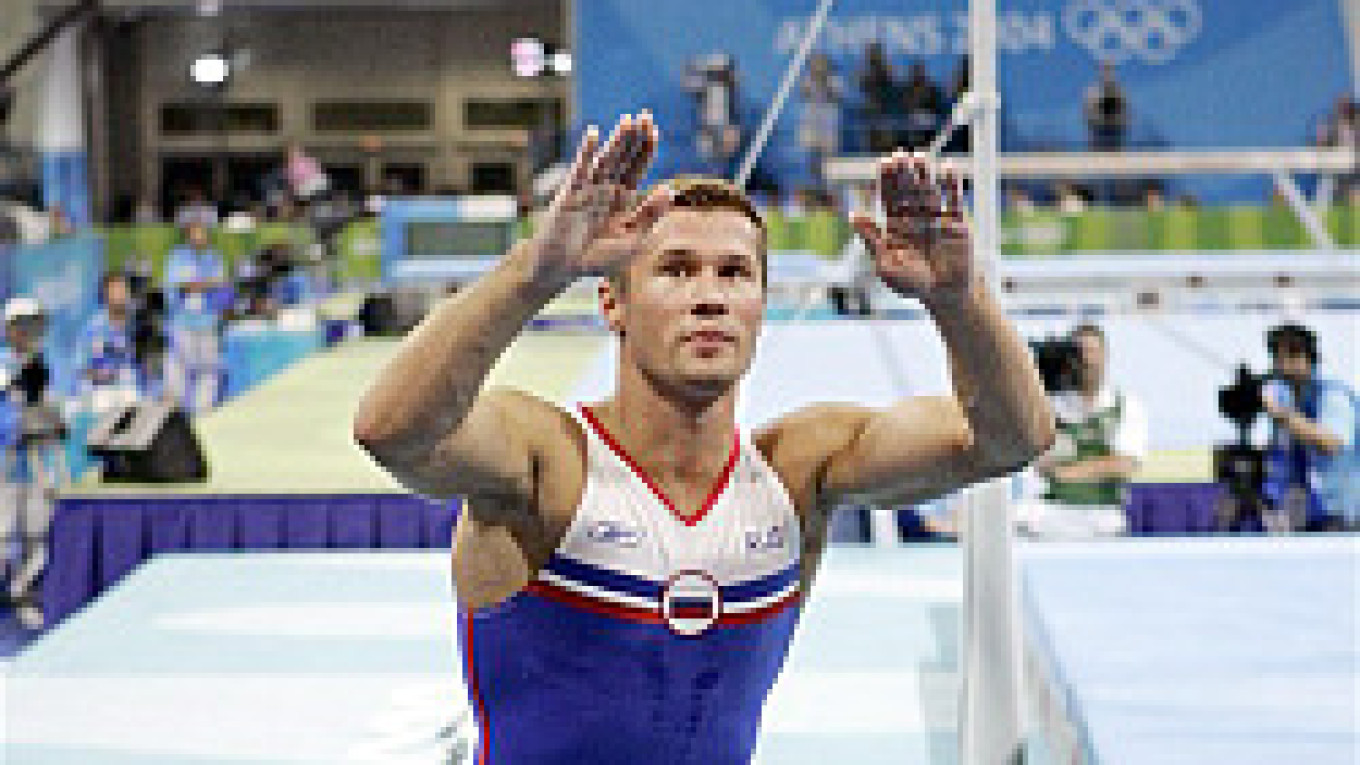
Like all other top gymnasts, the muscular Russian spent day after day, hour after hour polishing his complex programs in training. He hoped his hard work would earn him not only a gold medal but also a perfect 10.
With his final routine on the international stage, however, the four-times Olympic champion sparked a chain of events at the 2004 Athens Games which led to the abolishment of the iconic 10 score.
When the 2006 gymnastics world championships open in Aarhus, Denmark, on Friday, a new accumulative points scoring system -- awarded for content and execution -- will make its debut at a major global competition.
Known as "Sexy Alexei" to his legion of admirers, Nemov will be remembered as one of the most charismatic sportsmen to have graced the sport and his name will forever be linked with a watershed moment in gymnastics.
Chaos erupted during the men's horizontal bar final when the competition was held up for more than 10 minutes as fans booed and jeered at the mark awarded to Nemov for his gravity-defying display. With no sign of the crowd settling down, the stunned judges were forced to increase Nemov's score.
"I was just doing my job, and hence having the audience react the way they did was very important," Nemov said, while in London to back the 2014 Winter Olympics bid of Russia's Black Sea resort of Sochi.
"They gave me extra strength and proved there were flaws with the old judging system and that [a change] was necessary for the good of the sport.
"It was the audience's wish to make me a champion because of my excellent exercise. That probably made the officials think that they would have to change their judgement.
"I believe the judgement should be objective and this [new format] will benefit gymnastics."
Although the revised mark did not lift Nemov into the medals for the discipline, it convinced gymnastics officials that the scoring system had to be revamped.
Former Olympic champion Nellie Kim, who is now president of the International Gymnastics Federation's, or FIG, women's technical committee, was involved in devising the new Code of Points, or CoP, and believes it was long overdue.
"Before, the system took care of [well-executed but] average exercises by gymnasts and we kind of forgot about high-level performances ... as there was a maximum ceiling of scoring 10 points," said Kim, who was one of the first gymnasts to earn perfect 10s during the 1976 Montreal Games.
"So even if a gymnast had a fantastic routine, they could not score higher than a 10, which is what happened to Nemov.
"Everyone understood that his exercise was much more interesting and risky but judges did not have the tools to appreciate what he had done.
"It was a signal for us to start doing things differently."
Just as figure skating adopted an accumulative points format after dumping its age-old 6.0 system following the 2002 Salt Lake City Games judging scandal, gymnasts are now able to set new benchmarks every time they compete.
"Now the final score could be beyond 10. It could be 12, it could be 17, or whatever," Kim explained.
But, having competed all his life under the 10 format -- which had been in place since the 1920 Antwerp Games -- Nemov said he was sad to see gymnastics lose an important part of its identity.
"I don't like the fact that a 10 score is no longer possible as that was the system under which I competed," said Nemov, who compiled an impressive tally of 12 Olympic medals before bowing out in 2004.
"It was what everyone was used to. I personally would not have liked to compete under the new system."
A Message from The Moscow Times:
Dear readers,
We are facing unprecedented challenges. Russia's Prosecutor General's Office has designated The Moscow Times as an "undesirable" organization, criminalizing our work and putting our staff at risk of prosecution. This follows our earlier unjust labeling as a "foreign agent."
These actions are direct attempts to silence independent journalism in Russia. The authorities claim our work "discredits the decisions of the Russian leadership." We see things differently: we strive to provide accurate, unbiased reporting on Russia.
We, the journalists of The Moscow Times, refuse to be silenced. But to continue our work, we need your help.
Your support, no matter how small, makes a world of difference. If you can, please support us monthly starting from just $2. It's quick to set up, and every contribution makes a significant impact.
By supporting The Moscow Times, you're defending open, independent journalism in the face of repression. Thank you for standing with us.

Remind me later.